
por Álvaro André Zeini Cruz
1986. Rob Reiner adapta o conto O Corpo, de Stephen King, para o cinema. Há pouco de sobrenatural, no entanto. Talvez a amizade entre garotos durante esses últimos anos da infância e primeiros da adolescência; “nunca mais tive amigos como os que tive aos doze anos”, diz o protagonista ao narrar o passado como se falasse de um fantasma, de uma imagem etérea contraditoriamente impregnada nesse suporte movediço chamado memória. Por si só fantasmagórica, uma vez que é, quase sempre, uma aparição lacunar, incontrolável e fugidia, além de nos pregar peças. O filósofo Byung-Chul Han diz que, quando a memória cumpre seu traço ontológico de falhar, inventa-se, faz-se a ficção. Quando Gordie (Richard Dreyfuss), adulto, diz que nunca mais teve amigos como aqueles, faz do passado um fantasma e cria, em torno dele, uma aura.
A aura é daquele dia de sol docemente ardido, das aventuras infantis que se abrem em obstáculos episódicos, plantados pela jornada em busca de um corpo. Gordie (Wil Wheaton), Teddy (Corey Feldman), Vern (Jerry O’Connell) e Chris Chambers (River Phoenix) saem atrás de um menino morto, não por consideração ao falecido, mas porque, aos doze, a curiosidade pela outra ponta da vida é grande, ainda mais quando ela se apressa e invade esses dias próximos ao ponto de partida. Além do mais, tudo é desculpa para uma aventura (e para fugir dos monstros que habitam as casas). A viagem se dá com os pés entre os trilhos, tendo o trem como uma segunda aparição, uma espécie de fantasma que atravessa o próprio cinema para assombrar o quarteto de garotos. Na primeira vez, Teddy decide desafiar a locomotiva, brincando de faroeste. Mas numa jornada que, de alguma maneira, tem a morte como destino, o trem-fantasma se vê no direito de assombrar os meninos, aguardando para pegá-los na ponte.
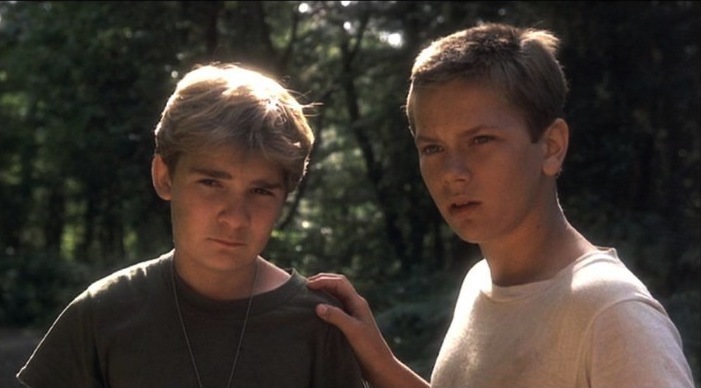
As linhas retas, porém, sempre abrem alguma escapatória; são as curvas e os desvios que conduzem aos perigos (os sanguessugas, as gangues) e desencontros. É numa dessas que Gordie se perde de Chris Chambers, que merece menção do nome completo porque age não como um garoto a quem basta o primeiro nome ou apelido, mas como um adulto que, no grupo, supre a falta de pais e irmãos mais velhos. Na caminhada em que Chris e Gordie conversam sobre cigarros e futuros (enquanto Teddy e Vern comparam o Super-Mouse e o Superman) ou na cena em que se desvencilham da luz da fogueira para exporem o que há de obscuro em suas almas, o rosto de Chris, emprestado de River Phoenix, surge como uma espécie de punctum. Os olhos apertados de um mini-James Dean, os cabelos louros — ora salpicados pela luz solar, ora delineados pelo contraluz noturno — cercam Chambers/Phoenix de uma aura que o destaca dos demais companheiros desse interior mundano, captado em imagens artesanais. Reiner é um cineasta-artesão que, na economia de um filme-conto, narra — ao invés de mostrar — o destino trágico de Chambers. Mas talvez seja a consciência do futuro de Phoenix que faz com que Conta Comigo, visto à distância (40 anos recém-completados), pareça não só cercá-lo de presságios, mas capturá-lo como a aparição sobrenatural de uma promessa interrompida, mas que soa ainda promissora porque segue pulsando como figura traçada na luz. Phoenix vive como uma singularidade poética dentro de um filme absolutamente narrativo, diferente de Gabe Nevins, cujo rosto é o espaço narrativo de Paranoid Park.
Se em Conta Comigo, a locomotiva assombra os garotos, em Paranoid Park, o trem é a chance de eles se transformarem em assombrações, interrompendo a tríade de movimentos observada por Luiz Carlos Oliveira Jr. — suspensão, fatalidade e queda. A promessa, portanto, não é o garoto Alex (Nevins) e seu rosto comum, mas o próprio trem, esse meio de transporte antigo e robusto, que contrasta o skate, a outra forma de locomoção que atravessa o filme. O skate até tenta imitar o trem quando acoplado a uma bicicleta, mas esses “vagões” têm funcionamentos próprios, enquanto o trem forma uma unidade com ponto de chegada e partida. É esse pragmatismo que, quando ameaçado, decepa e contamina as manobras errantes, lançando o grotesco pela rampa, colocando-o, inesperadamente, na tela.
Entre o vai-e-vem dos skates e a água que escorre pelo rosto até quase desidentificá-lo, entre a inserção irônica das músicas — ora hitchcockianas, ora dignas de um screwball — e a textura das imagens em super-8, meio homem se arrasta com as tripas passando entre os trilhos (certamente os Lumière não previram essa imagem). Essa é visão que assombra e atordoa Alex, e sabemos dela antes mesmo de vê-la, já que podemos intuí-la no longo plano do interrogatório em que a câmera vai se desvencilhando do espaço escolar para aproximar-se de Alex, até colocar-se frontalmente ao rosto dele. Este rosto adolescente assustado não é como o de Chambers/Phoenix, cuja luz perfuma os contornos, mas é posto sob uma luz branca violenta, que superexpõe todas as nuances e elimina todos os esconderijos. O rosto se torna uma pista em duplo sentido: é o indício e o espaço, a pista de curvas comuns por onde o filme vai flanar. Decifrar esse rosto não é uma questão para o diretor Gus Van Sant; o que interessa é vê-lo não pela dicotomia sujeito-que-olha/objeto-olhado, mas pelo entendimento de que o olhar da câmera compartilha o mesmo mundo que essa face.
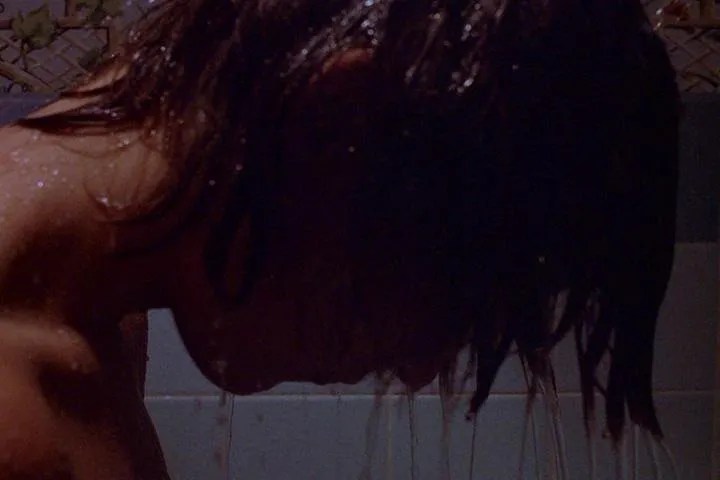
A famosa cena no chuveiro vela o rosto de Alex entre os cabelos molhados para, em seguida, transformar tudo numa silhueta disforme. Uma leitura apressada poderia dizer que há uma deformação da face humana em monstruosa, mas não é esse tipo de simbolismo que interessa a Van Sant, e, sim, o fenômeno da água que lava e escorre, independente dos demônios que cada um carrega. Se Conta Comigo fabrica um mundo ordinário para conter a expressão extraordinária de River Phoenix (não necessariamente pelo close), Paranoid Park torce o ordinário (em slows, texturas) para expor aquilo que é belo no mundano. Filmes opostos, mas também complementares no que têm em comum: rostos assombrados e assombrosos que, em algum momento, revelam-se sublimes. Fantasmas fílmicos desse trem de imagens encarrilhadas de inúmeras formas.
Cinematic Ghosts
by Álvaro André Zeini Cruz
1986. Rob Reiner adapts Stephen King’s short story The Body for the cinema. There is little of the supernatural about it, however. Perhaps the friendship between boys during those last years of childhood and first of adolescence; “I never had friends like I did when I was twelve,” says the protagonist as he narrates the past as if speaking of a ghost, of an ethereal image contradictorily impregnated in that shifting support called memory. Ghostly in itself, since it is almost always a lacunar, uncontrollable, and elusive apparition, besides playing tricks on us. The philosopher Byung-Chul Han says that when memory fulfills its ontological trait of failing, fiction is invented, made. When adult Gordie (Richard Dreyfuss) says he never had friends like those again, he turns the past into a ghost and creates an aura around it.
The aura is of that sweetly scorching sunny day, of childhood adventures that unfold into episodic obstacles, planted by the journey in search of a body. Gordie (Wil Wheaton), Teddy (Corey Feldman), Vern (Jerry O’Connell), and Chris Chambers (River Phoenix) set out after a dead boy, not out of consideration for the deceased, but because, at twelve, curiosity about the other end of life is great, especially when it hurries up and invades these days close to the starting point. Moreover, everything is an excuse for an adventure (and to flee from the monsters that inhabit their homes). The journey takes place with their feet between the rails, with the train as a second apparition, a kind of ghost that crosses cinema itself to haunt the quartet of boys. The first time, Teddy decides to challenge the locomotive, playing at Western. But in a journey that, somehow, has death as its destination, the ghost-train sees itself entitled to haunt the boys, waiting to catch them on the bridge.
Straight lines, however, always open up some escape; it is the curves and detours that lead to dangers (the leeches, the gangs) and missed encounters. It is on one of these that Gordie loses himself from Chris Chambers, who deserves mention of his full name because he acts not like a boy for whom a first name or nickname suffices, but like an adult who, in the group, fills the absence of parents and older brothers. In the walk where Chris and Gordie talk about cigarettes and futures (while Teddy and Vern compare Super-Mouse and Superman) or in the scene where they break away from the firelight to expose what is dark in their souls, Chris’s face, borrowed from River Phoenix, emerges as a kind of punctum. The narrowed eyes of a mini-James Dean, the blonde hair — now speckled by sunlight, now outlined by nocturnal backlighting — surround Chambers/Phoenix with an aura that sets him apart from his companions in this mundane interior, captured in artisanal images. Reiner is an artisan-filmmaker who, in the economy of a short-story film, narrates — rather than shows — Chambers’s tragic fate. But perhaps it is the awareness of Phoenix’s future that makes Stand by Me, seen from a distance (just turned 40 years old), seem not only to surround him with omens but to capture him as the supernatural apparition of an interrupted promise, which still sounds promising because it continues to pulse as a figure traced in light. Phoenix lives as a poetic singularity within an absolutely narrative film, unlike Gabe Nevins, whose face is the narrative space of Paranoid Park.
If in Stand by Me the locomotive haunts the boys, in Paranoid Park, the train is the chance for them to turn into hauntings, interrupting the triad of movements observed by Luiz Carlos Oliveira Jr. — suspension, fatality, and fall. The promise, therefore, is not the boy Alex (Nevins) and his common face, but the train itself, that old and robust means of transport, which contrasts with the skateboard, the other form of locomotion that runs through the film. The skateboard even tries to imitate the train when attached to a bicycle, but these “cars” have their own operations, while the train forms a unit with a point of arrival and departure. It is this pragmatism that, when threatened, severs and contaminates the wandering maneuvers, casting the grotesque down the ramp, unexpectedly placing it on the screen.
Between the coming and going of the skateboards and the water that runs down the face until it almost de-identifies it, between the ironic insertion of the music — at times Hitchcockian, at times worthy of a screwball — and the texture of the images in super-8, half a man drags himself with his guts passing between the rails (certainly the Lumières did not foresee this image). This is the vision that haunts and dazes Alex, and we know of it even before seeing it, since we can intuit it in the long interrogation shot in which the camera slowly disengages from the school space to approach Alex, until it places itself frontally before his face. This frightened adolescent face is not like Chambers/Phoenix’s, whose light perfumes the contours, but is placed under a violent white light, which overexposes all nuances and eliminates all hiding places. The face becomes a clue in a double sense: it is the evidence and the space, the track of common curves along which the film will wander. Deciphering this face is not a concern for director Gus Van Sant; what matters is seeing it not through the dichotomy of subject-who-looks/object-looked-at, but through the understanding that the camera’s gaze shares the same world as that face.
The famous shower scene veils Alex’s face between his wet hair, only to then transform everything into a shapeless silhouette. A hasty reading might say there is a deformation of the human face into a monstrous one, but it is not this type of symbolism that interests Van Sant; rather, it is the phenomenon of the water that washes and flows, regardless of the demons each one carries. If Stand by Me fabricates an ordinary world to contain the extraordinary expression of River Phoenix (not necessarily through close-ups), Paranoid Park twists the ordinary (in slows, textures) to expose what is beautiful in the mundane. Opposed films, but also complementary in what they share: haunted and haunting faces that, at some point, reveal themselves as sublime. Cinematic ghosts of this train of images railed in countless ways.

