
por Álvaro André Zeini Cruz
7. Originalidade

Dinheiro e Inteligência. A primeira publicação de Saiko e Shujin termina como um one-shot, um especial com um só capítulo, mas obriga a dupla a fazer uma “fusão”: isto é, a adotar o pseudônimo que combina os nomes do ilustrador e do roteirista — Ashirogi Muto (Moritaka Mashiro + Akito Takagi). “Por quanto você venderia seus pensamentos?” É a partir dessa premissa-pergunta que Ashirogi Muto cria a ficção científica ambientada numa sociedade em que pessoas podem comprar os pensamentos umas das outras.
Concluído o primeiro tratamento — a primeira versão da história escrita/ilustrada do começo ao fim —, Hattori sugere a inclusão do supercomputador, personagem da história anterior da dupla, em Dinheiro e Inteligência; para o editor, a máquina poderia avaliar humanos dispostos a negociar pensamentos. Os que protagonizam Bakuman compram a ideia, correm para o estúdio e efetivam esse crossover, recebendo, ao final do episódio 11, a notícia de que serão publicados; não sem antes passar por outras revisões.
No capítulo seguinte, Hattori faz observações à dupla: abreviar a narração, diminuir a exposição… Ou seja, fazer aquilo que, de alguma forma, aproxima o mangá do audiovisual — narrar mostrando. O editor incita a rivalidade com Niizuma Eiji como forma de desafiar a criatividade da dupla, mas acha que, mesmo vencendo a disputa, Saiko e Shujin deveriam se formar no ensino médio antes de serem serializados. Quando Hattori vê o tratamento final de Dinheiro e Inteligência, pensa: “esse tem espírito”.
O monólogo mental do editor explicita o encontro com algo essencial, mas nem sempre fácil de definir: a originalidade. Doc Comparato defende que a originalidade é a marca individual do texto, o estilo, “a maneira particular, surpreendente, de contar uma história conhecida”. Leandro Saraiva e Newton Cannito vão nesse mesmo sentido quando recuperam a tese do sociólogo Vilfredo Pareto de que a criatividade “é a capacidade de estabelecer novas relações entre os elementos de um repertório comum a todos”. Para Robert McKee, a originalidade se dá “na confluência de conteúdo e forma”. Completa: “se sua visão for profunda e original, o formato da estória será único”.
Dinheiro e Inteligência chega ao papel transbordando originalidade. E se, no Brasil, as novelas (nossas narrativas mais populares) são avaliadas por pesquisas de audiência e de opinião (hoje também pela repercussão nas redes sociais), no Japão, a medição da popularidade dos mangás é feita através de questionários anexados à publicação, convidando os leitores a apontarem suas histórias preferidas. É a partir disso que um novo desafio se abre a Saiko e Shujin: eles querem ser serializados (e, futuramente, “animados”), mas, além disso, querem ficar em 1º lugar nas enquetes.
Não será desta vez. Niizuma Eiji é quem fica no topo do ranking, mas nossos heróis não fazem feio; acabam em 3º lugar e com um elogio de Eiji, no primeiro encontro do trio na redação da revista. A frustração e a rivalidade fazem com que Saiko bata o pé: ele não quer serializar uma obra autoral, mas nichada, como Dinheiro e Inteligência; quer criar um mangá popular — um mangá de batalha.
Apesar do conselho de Hattori e do consenso da redação de que o estilo de Ashirogi Muto não combina com mangás de batalha, Shujin segue a vontade do parceiro e parte para a “pesquisa de campo” (e leva a pior numa luta com Kaya Miyoshi, a namorada). Na ânsia por um mangá popular, Saiko e Shujin escorregam na armadilha diagnosticada por Jean-Claude Carrière, que aponta a busca obsessiva pela originalidade é o caminho mais curto para os clichês e estereótipos.
McKee concorda: “o que está no topo da sua cabeça é todo filme que você já viu e todo romance que já leu, oferecendo clichês à vontade”, e defende que o roteirista original é aquele que esboça várias ideias para que, nesse exercício, as ruins se desfaçam e só as originais permaneçam. A ideia de um demônio espadachim, por exemplo, é uma das que ficam pelo caminho de Ashirogi Muto. A obsessão pela popularidade os leva a mais um erro erro: Saiko, num ímpeto, rasga o esboço da continuação de Dinheiro e Inteligência, quando todo bom roteirista sabe que a gaveta é o melhor lugar para uma ideia amadurar. Talvez uma saída para o bloqueio criativo que se aproxima esteja na fala de Niizuma Eiji: “Escreva sem pensar. Os personagens têm vida própria”, diz o “romancista ingênuo” de Bakuman, um tantinho amalucado, mas um bocado sábio.
In English
7. Originality
Money and Intelligence. Saiko and Shujin’s first publication ends up as a one-shot, a special with a single chapter, but it forces the duo to adopt a “fusion” — that is, a pen name combining the illustrator’s and the writer’s names — Ashirogi Muto (Moritaka Mashiro + Akito Takagi). “How much would you sell your thoughts for?” It’s from this premise-question that Ashirogi Muto creates the science fiction story set in a society where people can buy each other’s thoughts.
Once the first draft is finished — the first version of the story written/illustrated from beginning to end — Hattori suggests including the supercomputer, a character from the duo’s previous story, in Money and Intelligence; in the editor’s view, the machine could evaluate humans willing to trade thoughts. Bakuman’s protagonists buy into the idea, rush to the studio, and pull off the crossover, receiving, at the end of episode 11, the news that they’ll be published — though not before going through more revisions.
In the following chapter, Hattori gives the duo notes: tighten the narration, cut down the exposition… In other words, do what, in a way, brings manga closer to film and TV — show, don’t tell. The editor stokes the rivalry with Niizuma Eiji as a way to challenge the duo’s creativity, but he thinks that, even if they win the contest, Saiko and Shujin should finish high school before being serialized. When Hattori sees the final treatment of Money and Intelligence, he thinks: “This one has spirit.”
The editor’s inner monologue spells out an encounter with something essential, yet not always easy to define: originality. Doc Comparato argues that originality is a text’s individual signature, its style — “the particular, surprising way of telling a familiar story.” Leandro Saraiva and Newton Cannito make a similar point when they revisit sociologist Vilfredo Pareto’s thesis that creativity “is the ability to establish new relationships between elements of a repertoire common to everyone.” For Robert McKee, originality lies “at the confluence of content and form.” He adds: “If your vision is deep and original, the story’s form will be unique.”
Money and Intelligence hits the page brimming with originality. And while in Brazil telenovelas (our most popular narratives) are measured by audience ratings and opinion polls (nowadays also by social media buzz), in Japan manga popularity is measured through questionnaires attached to the publication, inviting readers to name their favorite stories. It’s from this that a new challenge opens up for Saiko and Shujin: they want to be serialized (and, eventually, “animated”), but beyond that, they want to come in first place in the polls.
Not this time. Niizuma Eiji takes the top spot in the rankings, but our heroes don’t do too badly either; they finish in 3rd place and earn a compliment from Eiji at the trio’s first meeting in the magazine’s editorial office. The frustration and rivalry make Saiko dig in his heels: he doesn’t want to serialize an auteur-driven, niche work like Money and Intelligence; he wants to create a popular manga — a battle manga.
Despite Hattori’s advice and the editorial staff’s consensus that Ashirogi Muto’s style doesn’t fit battle manga, Shujin goes along with his partner’s wish and heads off to do “field research” (and comes off worse for it in a fight with his girlfriend, Kaya Miyoshi). In their eagerness for a popular manga, Saiko and Shujin fall into the trap identified by Jean-Claude Carrière, who points out that the obsessive pursuit of originality is the shortest path to clichés and stereotypes.
McKee agrees: “What’s at the top of your head is every movie you’ve ever seen and every novel you’ve ever read, offering up clichés galore,” and argues that the original screenwriter is the one who sketches out many ideas so that, through that exercise, the bad ones fall away and only the original ones remain. The idea of a sword-wielding demon, for instance, is one of the ones that gets left behind by Ashirogi Muto. Their obsession with popularity leads them into yet another mistake: Saiko, in a fit of impulse, tears up the draft for the sequel to Money and Intelligence, when every good writer knows the drawer is the best place for an idea to mature. Perhaps a way out of the looming creative block lies in something Niizuma Eiji says: “Write without thinking. The characters have a life of their own,” says Bakuman’s “naïve novelist” — a little bit crazy, but pretty wise.
6. Frustração e Resiliência

Após terem mais uma história recusada ao prêmio mensal, Saiko e Shujin seguem na ficção científica; em 100 milhões de minutos, um supercomputador é criado e chips são implantados no cérebro de todos os seres humanos aos 15 anos de idade. Tudo faz parte de um projeto governamental para nivelar e controlar a sociedade, e, claro, haverá resistência de um grupo heroico de dissidentes.
Em um brainstorm avançado dessa história, que não deixa de ser contemporânea (humanos vs IA), Saiko, o ilustrador, sugere que os heróis deveriam ter armas para lutar. Shujin, o roteirista, responde prontamente: katanas, como nos mangás populares — Naruto, One Piece, Bleach, Gintama… Se o brainstorm costuma começar como um processo de pensamento horizontal, onde as ideias são lançadas de maneira instintiva, sem muitas travas ou censuras, Saiko e Shujin trabalham neste momento com o pensamento vertical, isto é, já ponderando e filtrando ideias a partir da experiência e da lógica. É o que Shujin faz quando sugere as katanas, e o que Saiko também faz quando observa que sabres de luz são katanas mais propícias a um universo futurista.
Hattori, o editor, diz que a dupla corrigiu os problemas das narrativas anteriores, que a história é genial e que os sabres de luz deixaram “as cenas de ação mais vívidas”; ou seja, uma Hattori nota uma escolha de conteúdo que reflete diretamente na forma, lembrando que se trata de duas faces de uma mesma moeda. Mas, num monólogo mental, ouvimos Hattori se preocupar: os garotos correram para entregar o trabalho no prazo do prêmio Tezuka, mas será que fizeram o suficiente para ganhar?
É oportuno um adendo: competições, prêmios e laboratórios são boas oportunidades não só para dar visibilidade a um trabalho, mas para seguir desenvolvendo-o. Os laboratórios, em especial, uma vez que, geralmente, eles partem de uma seleção de argumentos ou roteiros para dar a oportunidade aos roteiristas de trabalharem essas histórias com o acompanhamento de especialistas (algo muito parecido com o que Hattori faz nas devolutivas aos manuscritos de Saiko e Shujin, o que na área do audiovisual costuma-se chamar de script doctor). No Brasil, há laboratórios como o Novas Histórias e o Argumenta (ambos do Sesc), o BrLab, o Marieta e o Frapa; este último, o maior festival de roteiro do país, que conta tanto com labs, quanto com premiações. Outra oportunidade são os editais de desenvolvimento de roteiro, que possibilitam que roteiristas se dediquem a seus projetos com tempo e remuneração por isso, o que costuma alavancar a qualidade dos trabalhos, levando histórias mais maduras e originais às telas.
De volta a Bakuman: para além do entusiasmo de Hattori, Saiko e Shujin saem da reunião com uma nova missão — escrever um mangá para a Next, publicação especial da Jack. Um spoiler: as primeiras ideias serão frustradas; numa delas, Hattori observa que o protagonista é comum demais para uma publicação voltada a personagens com poderes especiais. A observação traz implícita uma regra de mercado, que, geralmente, figura como uma das primeiras perguntas em pitches ou rodadas de negócio: para onde é sua história?
Saiko e Shujin baterão um pouco mais de cabeça até chegarem a Dinheiro e Inteligência, sua primeira serialização; em um dos encontros, Hattori chegará a dizer que todas as ideias da dupla são horríveis e o editor-chefe surgirá para deixar-lhes uma verdade incontornável: apesar dos inúmeros diagnósticos possíveis dados a uma história, o único que vale é — um mangá precisa ser bom. Ah, sim, 100 milhões de minutos também não chega lá; fica entre os 8 semifinalistas, mas não figura entre os 4 mangás premiados. Antes do primeiro sucesso com Dinheiro e Inteligência, Saiko e Shujin aprenderão uma lição necessária a todo roteirista — frustração e resiliência.
In English
6. Frustration and Resilience
After having yet another story rejected for the monthly award, Saiko and Shujin move on to science fiction: in 100 Million Minutes, a supercomputer is created and chips are implanted in the brains of all human beings at age 15. It’s all part of a government project to level and control society, and, of course, there will be resistance from a heroic group of dissidents.
In an advanced brainstorm on this story—which remains contemporary in its way (humans vs. AI)—Saiko, the illustrator, suggests that the heroes should have weapons to fight with. Shujin, the writer, responds promptly: katanas, like in popular manga—Naruto, One Piece, Bleach, Gintama… If brainstorming usually begins as a horizontal thought process, where ideas are thrown out instinctively, without many filters or restrictions, Saiko and Shujin are now working with vertical thinking, that is, already weighing and filtering ideas based on experience and logic. That’s what Shujin does when he suggests katanas, and what Saiko also does when he points out that lightsabers are katanas better suited to a futuristic universe.
Hattori, the editor, says the duo fixed the problems from their previous narratives, that the story is brilliant, and that the lightsabers made “the action scenes more vivid”; in other words, Hattori notices a content choice that directly reflects on form, a reminder that the two are two sides of the same coin. But, in an inner monologue, we hear Hattori worry: the boys rushed to submit the work in time for the Tezuka Award deadline, but did they do enough to win?
A relevant aside: competitions, awards, and labs are good opportunities not only to give a work visibility, but also to keep developing it. Labs, in particular, since they generally start from a selection of pitches or scripts, giving writers the chance to work on these stories with guidance from specialists (something very similar to what Hattori does in his feedback on Saiko and Shujin’s manuscripts, which in the audiovisual field is usually called script doctoring). In Brazil, there are labs such as Novas Histórias and Argumenta (both run by Sesc), BrLab, Marieta, and Frapa—the latter being the country’s largest screenwriting festival, which includes both labs and awards. Another opportunity is script development grants, which allow writers to dedicate time to their projects and be paid for it, which tends to raise the quality of the work, bringing more mature and original stories to the screen.
Back to Bakuman: beyond Hattori’s enthusiasm, Saiko and Shujin leave the meeting with a new mission—to write a manga for Next, Jack’s special publication. A spoiler: their first ideas will be shot down; in one of them, Hattori points out that the protagonist is too ordinary for a publication aimed at characters with special powers. Implicit in this observation is a market rule that usually comes up as one of the first questions in pitches or business meetings: who is your story for?
Saiko and Shujin will butt heads a bit more before landing on Money and Intelligence, their first serialization; in one of their meetings, Hattori will go so far as to say that all of the duo’s ideas are terrible, and the editor-in-chief will show up to leave them with an inescapable truth: despite the countless possible diagnoses given to a story, the only one that matters is—a manga has to be good. Oh, and yes, 100 Million Minutes doesn’t make it either; it reaches the top 8 semifinalists but doesn’t make it among the 4 award-winning manga. Before their first success with Money and Intelligence, Saiko and Shujin will learn a lesson every screenwriter needs—frustration and resilience.
5. Por que o anime?

Bem, porque ainda que haja por aqui aventuras por outros territórios artístico-culturais, Pós-créditos é uma revista voltada, primordialmente, à crítica audiovisual; por isso, a opção por trazer Bakuman a partir do anime (ainda que o mangá possa, sim, ser acionado ao longo desta empreitada). Também por uma decisão de rever o anime de uma maneira mais descolada do mangá, diferente do que fiz há mais de dez anos. A questão é oportuna para falarmos um pouco sobre o tipo de serialização efetivada pela produção, que transmuta os 176 capítulos do mangá (no Brasil, publicados em 20 volumes) em 75 episódios em animação.
Aliás, estamos falando de série ou seriado? Capítulos ou episódios? No livro Séries e seriados para espectadores ligados (desligados também), o autor José Roberto Sadek delineia essas nomenclaturas a partir das unidades da narrativa: “seriado é quando as unidades são independentes entre si”, “podem ser vistas em qualquer ordem” e, por isso, “se chamam episódios”. Já série é quando a história continua de uma unidade a outra, cobrando que a narrativa seja vista em determinada ordem. Aí temos capítulos.
Uma boa maneira de pensar é que, numa série, precisamos recapitular mais do que apenas o universo e os personagens; precisamos lembrar dos conflitos dos capítulos anteriores mais detalhadamente. O seriado, em contrapartida, garante maior autonomia ao público, que pode escolher os episódios e a maneira de ordená-los, sem grande prejuízo à compreensão. Sadek classifica quatro tipos de séries e seriados: seriados temáticos (antologias como Black Mirror), seriados em episódios, também chamados de imóveis (CSI, Law & Order), séries em capítulos (ou evolutivas, como… Bakuman!) e séries mistas (House e Dexter são bons exemplos).
No livro As Séries Televisivas, Jean-Pierre Esquenazi também usa a ideia de séries imóveis ou evolutivas para desenhar dois grandes grupos, abrindo mão da dicotomia série/seriado. A premissa, no entanto, é a mesma — séries para ver como quiser ou para se ver em ordem —, só que Esquenazi subdivide esses dois grupos: as séries imóveis contêm os tipos nodais (cada episódio é um nó a ser desfeito), sitcoms e soap operas (estas ficam para outra oportunidade), enquanto as evolutivas se dividem em megamovies (séries com uma só temporada que evoluem como um filme de 6 a 8 horas), séries corais (como o anime Smoking Behind the Supermarket with You) e séries folhetinescas. A grande diferença entre essas duas últimas é que as séries corais não têm ganchos ao final do capítulo, enquanto as folhetinescas usam e abusam desse artifício clássico desde os folhetins.
O capítulo 4 de Bakuman acaba na cena em que Niizuma Eiji recebe um telefonema dos editores da Jack, convidando-o a ir a Tóquio, o que traz uma promessa ao público — o grande rival de Saiko e Shuujin (o apelido de Takagi) está se aproximando. Gancho. No 7º, os dois editores vão pessoalmente buscá-lo e Niizuma dobra a aposta (e o perigo) ao impor uma condição: se se tornar o mangaká mais popular da Jack, quer ter autoridade para cancelar um mangá concorrente do qual não goste. Gancho. Estamos, portanto, no reino da série folhetinesca, diante do duelo entre mangakás que querem que suas séries (em papel) se estendam a ponto de chegarem à TV, ao anime. A pergunta aqui é: por que, normalmente, é importante que uma serialização seja relativamente longa? Porque, como lembram Sadek e Esquenazi, elas obedecem à lógica da indústria cultural, diluindo os custos (e continuando os lucros) em unidades.
A continuidade garante uma outra característica importante das séries evolutivas: tempo para poder se dividir entre a vida profissional e a particular das personagens. Assim, Bakuman conjuga o traço da série procedural — aqui, em vez de procedimentos médicos ou de investigação, acompanhamos os processos de se fazer um mangá —, mas também a vida pessoal desses dois adolescentes; especialmente a amorosa. E como personagens e relações se revelam pelo conflito, a promessa entre Saiko e Azuki de se casarem (e só se falarem!) quando ela dublar a animação dele contrasta com o namoro de Shuujin com Kaya Miyoshi, melhor amiga de Azuki, que passa a acompanhar de perto toda a jornada da dupla. A presença/situação de Miyoshi contrasta com o distanciamento autopenitente entre Saiko e Azuki.
Esse trânsito entre o amor pela profissão e o amor adolescente propõe, como diz François Jost (no livro Do que as séries americanas são sintoma?), uma promessa ao público, baseada na articulação entre o Saber Fazer (como se faz um mangá? Como se faz para ser um mangaká?) e o Saber Ser (como é ser um mangaká durante a adolescência? Como é assumir responsabilidades profissionais tão maduras e, ao mesmo tempo, viver o primeiro amor?). Nesse sentido, Bakuman se coloca como o que Jost define como série centrada na sociedade, uma vez que os sonhos individuais dos protagonistas extrapolam para questões familiares e comunitárias, refletindo, por exemplo, sobre o trabalho (e o esforço) como um valor posto desde a juventude na sociedade japonesa. Se eu, Álvaro, tivesse que, hoje, fazer um pitch — defesa oral de um projeto — desse coming of age chamado Bakuman, começaria jogando aos ouvintes: como desenhar ficções quando ainda se está começando a escrever a vida real?
In English
5. Why the anime?
Well, because although there are adventures here in other artistic-cultural territories, Pós-créditosis a magazine devoted primarily to audiovisual criticism; hence the choice to bring Bakuman from the anime (although the manga can, yes, be drawn upon over the course of this undertaking). Also because of a decision to rewatch the anime in a way more detached from the manga, unlike what I did more than ten years ago. The question is a good opportunity to talk a little about the kind of serialization carried out by the production, which transmutes the 176 chapters of the manga (published in 20 volumes in Brazil) into 75 episodes of animation.
By the way, are we talking about a series or a serial? Chapters or episodes? In the book Séries e seriados para espectadores ligados (desligados também), author José Roberto Sadek outlines these terms based on narrative units: “a serial is when the units are independent of one another,” “they can be watched in any order,” and therefore “they are called episodes.” A series, on the other hand, is when the story continues from one unit to the next, requiring the narrative to be watched in a particular order. Then we have chapters.
A good way to think about it is that, in a series, we need to recapitulate more than just the universe and the characters; we need to remember the conflicts of previous chapters in greater detail. The serial, by contrast, grants the audience greater autonomy, since they can choose the episodes and how to order them, without much loss to comprehension. Sadek classifies four types of series and serials: thematic serials (anthologies like Black Mirror), episodic serials, also called immobile (CSI, Law & Order), chapter-based series (or evolutionary, like… Bakuman!) and mixed series (Houseand Dexter are good examples).
In the book As Séries Televisivas, Jean-Pierre Esquenazi also uses the idea of immobile or evolutionary series to outline two large groups, dispensing with the series/serial dichotomy. The premise, however, is the same — series to watch however you like or series to watch in order —, except that Esquenazi subdivides those two groups: immobile series contain the nodal types (each episode is a knot to be untied), sitcoms, and soap operas (these are left for another occasion), while evolutionary series are divided into megamovies (single-season series that unfold like a 6-to-8-hour film), choral series (like the anime Smoking Behind the Supermarket with You), and feuilleton series. The big difference between the latter two is that choral series do not have hooks at the end of the chapter, whereas feuilleton series use and abuse this classic device, inherited from the serialized feuilletons.
Chapter 4 of Bakuman ends on the scene in which Niizuma Eiji receives a phone call from the editors at Jack inviting him to come to Tokyo, which makes a promise to the audience — the great rival of Saiko and Shuujin (Takagi’s nickname) is getting closer. Hook. In chapter 7, the two editors go personally to fetch him, and Niizuma raises the stakes (and the danger) by imposing a condition: if he becomes the most popular mangaka at Jack, he wants the authority to cancel a rival manga he dislikes. Hook. We are, therefore, in the realm of the feuilleton series, facing the duel between mangaka who want their series (on paper) to run long enough to reach TV, to reach anime. The question here is: why is it usually important for a serialization to be relatively long? Because, as Sadek and Esquenazi remind us, they obey the logic of the culture industry, diluting costs (and continuing profits) across units.
Continuity guarantees another important characteristic of evolutionary series: time to be able to divide between the professional and private lives of the characters. Thus, Bakuman combines the trait of the procedural series — here, instead of medical or investigative procedures, we follow the processes of making a manga —, but also the personal lives of these two teenagers; especially their love lives. And since characters and relationships reveal themselves through conflict, the promise between Saiko and Azuki to get married (and only speak to each other!) when she dubs his animation contrasts with Shuujin’s dating Kaya Miyoshi, Azuki’s best friend, who comes to follow the duo’s entire journey closely. Miyoshi’s presence/situation contrasts with the self-penitent distance between Saiko and Azuki.
This movement between love for the profession and adolescent love proposes, as François Jost says (in the book Do que as séries americanas são sintoma?), a promise to the audience, based on the articulation between Saber Fazer (how is a manga made? How does one become a mangaka?) and Saber Ser (what is it like to be a mangaka during adolescence? What is it like to take on such mature professional responsibilities and, at the same time, experience first love?). In this sense, Bakuman positions itself as what Jost defines as a society-centered series, since the protagonists’ individual dreams extend into family and community issues, reflecting, for example, on work (and effort) as a value instilled from youth in Japanese society. If I, Álvaro, had to pitch today — an oral defense of a project — this coming-of-age called Bakuman, I would start by throwing this to the listeners: how do you draw fictions when you are still beginning to write real life?
4. Ingênuo e Sentimental
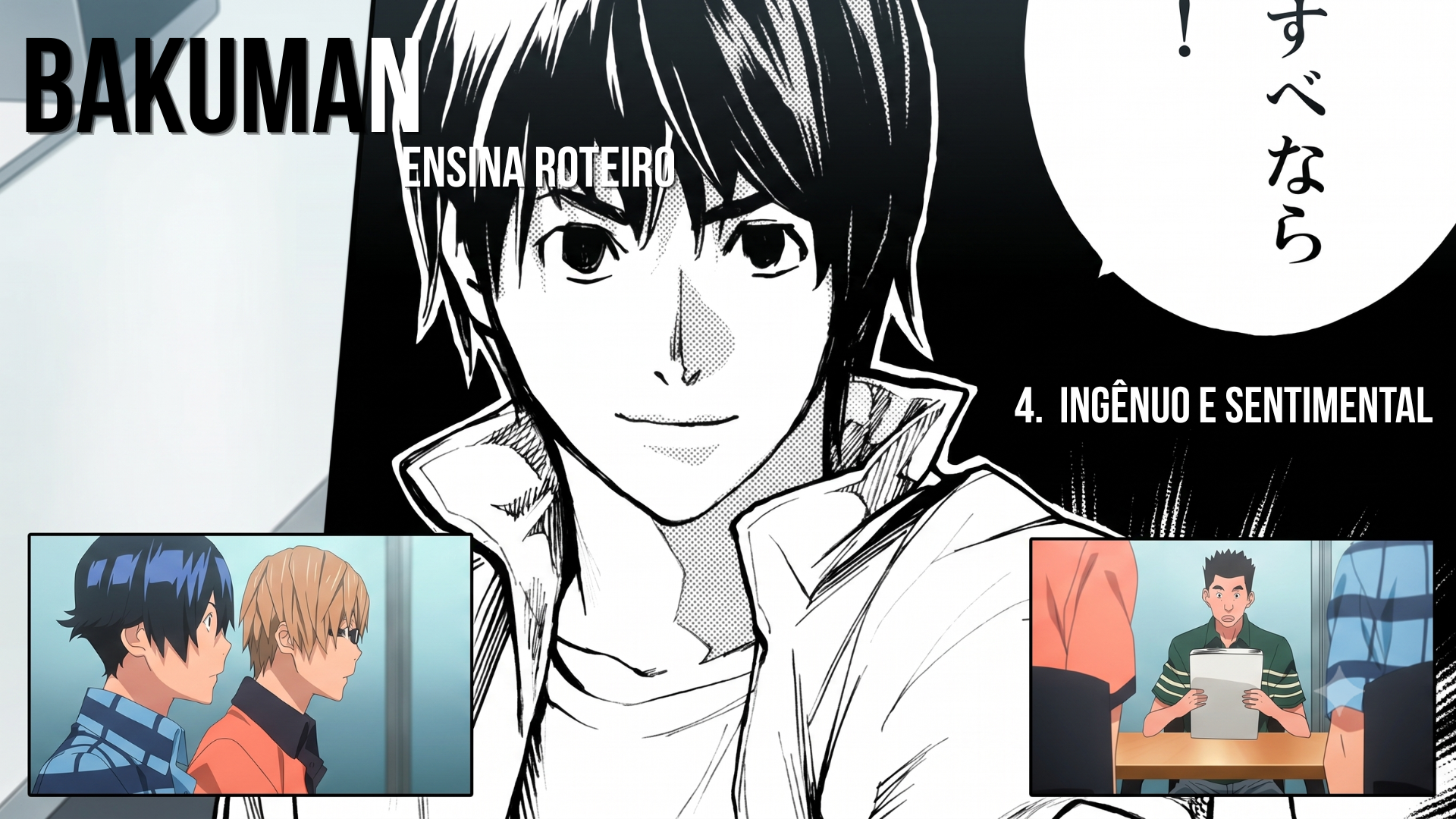
No 6º episódio de Bakuman, conhecemos Hattori Tetsu, editor da Shōnen Jack — versão ficcional da Shōnen Jump, publicação japonesa especializada em mangás — que acompanhará o início da jornada de Saiko e Takagi como mangakás. É ele quem recebe o manuscrito de “As Duas Terras”, o lê rapidamente (para a surpresa de Saiko) e deixa o gancho do meio do episódio quando diz “deixe-me lê-lo outra vez”. Na volta dos comerciais, as tiras da ficção científica escrita por Takagi e ilustrada por Saiko tomam a tela, sobrepostas pela leitura/narração de Hattori.
A palavra “sobrepostas” não está aqui à toa: é a voz over de Hattori que nos apresenta o que há de primordial em “As Duas Terras”: o universo onde o mundo em que vivemos é um clone da Terra Real, e o protagonista Hayato, que descobre essa realidade — e se descobre Outro (isto é, um clone) — após perder a namorada. Ao longo da trama, que parece se inspirar em Matrix e Star Wars, o Outro Hayato se junta à resistência que se contrapõe aos humanos da Terra Real, assassina seu doppelgänger (o Hayato real) e acaba por “reencontrar” Amy; entre aspas porque não se trata mais da namorada morta, mas do duplo, que jura amor verdadeiro ao Outro Hayato. A voz de Hattori encerra sublinhando a temática de As Duas Terras: “real e falso; verdadeira Terra e Outra Terra. Qual é a verdadeira realidade?”.
Um fade out — transição editorial que pode ser prevista desde o roteiro — nos transporta do universo fictício de As Duas Terras ao escritório em que Saiko e Takagi esperam os comentários de Hattori, que reconhece — “é muito bem-feito”. Mas é durante um café que o editor desdobra a percepção dessa leitura crítica. Hattori diz que o manuscrito traz uma boa ficção (científica), mas que o excesso de narração e de explicações no diálogo o torna mais próximo de uma novela, gênero literário mais longo que o conto e mais curto do que um romance. O trabalho de Saiko é, inicialmente, deixado de lado, e o editor explica: “se não usar os personagens e as ilustrações para contar a história, fazer um mangá é inútil”. Hattori, então, reconhece que a arte é incrível, mas completa que não são ilustrações de um mangá; os traços são espessos e não há diferenciação entre forma e fundo.
Essa observação de Hattori é especialmente curiosa, uma vez que, ao retomar um fundamento das artes visuais — o de que toda forma depende de um fundo —, acaba por metaforizar a incompatibilidade entre forma e conteúdo, que não são “duas Terras”, mas um mundo só. O traço de Saiko deveria narrar tanto quanto as palavras de Takagi, inclusive para que Takagi possa economizar palavras e exposição desnecessárias. E embora um mangá não componha exatamente uma dramaturgia — nós não vemos ações completas, mas decalques de momentos-chave da ação — a interdependência entre narrativa e visualidade nos faz retornar a uma velha máxima da escrita de roteiro — mostre, não conte.
Autor de Roteiro de Curta-metragem, Diogo Cronemberger intitula um capítulo inteiro de seu livro como “Mostrar, em vez de contar”, elencando “a narração em forma de resumo” como um “problema recorrente” e lembrando que “diálogos são apenas um recurso entre vários” possíveis a um roteiro de cinema. São passagens que poderiam estar na boca de Hattori sobre As Duas Terras, afinal, ainda que no impresso haja apenas a sugestão de movimento (das personagens, já que o movimento do olhar sobre a página é efetivo), a linguagem se alicerça sobre uma visualidade concreta, inexistente em novelas ou romances. Assim, a articulação dessa escrita dupla — em imagens e sons (recodificados na escrita) — aprofunda o parentesco com o audiovisual; não à toa, o destino que Saiko e Takagi desejam é chegar completamente a essa linguagem através da adaptação em anime.
Em seu livro sobre diálogos, Robert McKee também cita a regra de ouro “mostre, não conte” ao lembrar que todo diálogo é ação, e que, portanto, seu objetivo principal é o conflito, com as personagens agindo umas sobre as outras (ação e reação, como ressalta Luiz Carlos Maciel em O Poder do Clímax). A partir da cena, podemos inferir que Hattori concorda com a ideia de McKee de que o roteirista deve sempre privilegiar o visual, deixando o diálogo como última camada adicionada; o autor do famoso Story assume que a exposição (de fatos, da internalidade das personagens) sempre existe em alguma medida, mas faz parte do desafio do roteirista invisibilizá-la. Nesse sentido, as fragilidades do roteiro de Takagi como meio acabam afetando o mangá como um todo, inclusive em sua visualidade.
Das palavras à imagem, um outro ponto curioso: Saiko desenha Hayato parecido com ele próprio, mas as semelhanças entre criador e criatura não param por aí — o espelhamento do tio mangaká e o distanciamento da mulher amada são conflitos que ecoam em As Duas Terras. O ilustrador, no entanto, nos revela — através de um monólogo mental — que a não interferência no trabalho de Takagi talvez tenha sido um erro de ambos, indicando que o diálogo entre eles precisa ser orgânico e indissociável, o que não necessariamente reduz a autonomia artística de cada um (até porque logo eles farão a “fusão” que os tornará uma assinatura só). Hattori, então, faz a pergunta incontornável — “vocês dois gostam desse tipo de história?”.
É Takagi quem responde que a revista “nunca teve esse tipo de história”, expondo a visão pragmática de um roteirista que tenta suprir uma lacuna de mercado (o que o ajudaria a se destacar — pelo menos inicialmente — num pitch ou rodada de negócios). “Há dois tipos de mangakás de sucesso”, diz Hattori, “os que escrevem o que desejam”, chamados de gênios ou ingênuos, “e os que calculam para criar um êxito”, que costumam ter que enfrentar mais obstáculos para serem bem-sucedidos. Essa dicotomia observada pelo editor remete à proposta por Friedrich Schiller e adaptada por Orhan Pamuk no livro O Romancista Ingênuo e o Sentimental; segundo Pamuk, os primeiros “escrevem espontaneamente, como se executassem um ato perfeitamente natural, alheios às operações e aos cálculos que seus cérebros efetuam e ao fato de que estão usando as marchas, os freios e os botões que a arte do romance lhes fornece”. Já os sentimentais, também chamados de reflexivos, mantêm-se conscientes de que o texto é uma construção com métodos e planejamentos, e, por isso, vivem intensamente a jornada de dúvidas e angústias do gesto criativo.
No que diz respeito ao romance, Pamuk defende que a autoria deve se equilibrar entre esses dois vieses, entre o ímpeto e o rigor, a ingenuidade e a reflexão. Em Bakuman, já tivemos vislumbres da personagem aderente às primeiras características — é Niizuma Eiji, o mangaká que escreve e desenha sozinho, quase como se psicografasse sua arte. A jornada de Saiko e Takagi será a de descobrir a sua verdadeira Terra, o centro que os reequilibrará, levando-os da lucidez excessiva a uma descoberta da paixão (emprestando a equação do crítico Jean Douchet). A jornada desse duplo heroísmo demandará uma fusão (não como em Dragon Ball, apesar da referência) que os leve a descobrir, nas profundezas de si, um pouco da sombra, aquilo que seu antagonista tem em excesso. Através de suas obras, Saiko e Takagi se tornarão um para descobrirem em si Niizuma Eiji e conseguirem escrever-desenhar aquilo que amam.
In English
4. Naive and Sentimental
In the 6th episode of Bakuman, we meet Hattori Tetsu, an editor at Shōnen Jack — the fictional version of Shōnen Jump, the Japanese publication specialized in manga — who will accompany the beginning of Saiko and Takagi’s journey as mangakas. It is he who receives the manuscript of “The Two Lands”, reads it quickly (to Saiko’s surprise) and leaves the cliffhanger in the middle of the episode when he says, “let me read it again.” After the commercial break, the strips of the science fiction written by Takagi and illustrated by Saiko take over the screen, overlaid by Hattori’s reading/narration.
The word “overlaid” is not used here by chance: it is Hattori’s voice-over that introduces us to what is most essential in “The Two Lands”: the universe where the world we live in is a clone of the Real Earth, and the protagonist Hayato, who discovers this reality — and discovers himself as an Other (that is, a clone) — after losing his girlfriend. Throughout the plot, which seems to draw inspiration from The Matrix and Star Wars, the Other Hayato joins the resistance that opposes the humans of the Real Earth, murders his doppelgänger (the real Hayato), and ends up “reuniting” with Amy; in quotation marks because it is no longer the dead girlfriend, but her double, who swears true love to the Other Hayato. Hattori’s voice ends by underlining the theme of The Two Lands: “real and fake; true Earth and Other Earth. What is the true reality?”
A fade out — an editorial transition that can be foreseen from the script itself — transports us from the fictional universe of The Two Lands to the office where Saiko and Takagi await Hattori’s comments, who acknowledges — “it’s very well done.” But it is over coffee that the editor unfolds his perception from that critical reading. Hattori says the manuscript brings good (science) fiction, but that the excess of narration and explanations in the dialogue makes it closer to a novella, a literary genre longer than a short story and shorter than a novel. Saiko’s work is, initially, set aside, and the editor explains: “if you don’t use the characters and illustrations to tell the story, making a manga is useless.” Hattori then acknowledges that the art is incredible, but adds that they are not illustrations for a manga; the lines are thick and there is no differentiation between figure and ground.
This observation by Hattori is especially curious, since, by revisiting a fundamental principle of the visual arts — that every figure depends on a ground — he ends up metaphorizing the incompatibility between form and content, which are not “two Earths”, but one single world. Saiko’s lines should narrate as much as Takagi’s words, including so that Takagi can save on words and unnecessary exposition. And although a manga does not exactly constitute a dramaturgy — we do not see complete actions, but tracings of key moments of action — the interdependence between narrative and visuality makes us return to an old maxim of screenwriting — show, don’t tell.
Author of Roteiro de Curta-metragem, Diogo Cronemberger titles an entire chapter of his book as “Showing, instead of telling,” listing “narration in the form of summary” as a “recurring problem” and reminding us that “dialogue is just one resource among several” possible in a film script. These are passages that could be coming from Hattori’s mouth about The Two Lands, after all, even though in print there is only the suggestion of movement (of the characters, since the movement of the gaze over the page is effective), the language is grounded in a concrete visuality, non-existent in novellas or novels. Thus, the articulation of this dual writing — in images and sounds (recoded in writing) — deepens its kinship with the audiovisual; not for nothing, the destiny that Saiko and Takagi desire is to fully reach this language through an anime adaptation.
In his book on dialogue, Robert McKee also cites the golden rule “show, don’t tell” when he reminds us that all dialogue is action, and that, therefore, its main objective is conflict, with characters acting upon one another (action and reaction, as Luiz Carlos Maciel highlights in O Poder do Clímax). From the scene, we can infer that Hattori agrees with McKee’s idea that the screenwriter should always privilege the visual, leaving dialogue as the last layer added; the author of the famous Story assumes that exposition (of facts, of characters’ inner lives) always exists to some extent, but it is part of the screenwriter’s challenge to make it invisible. In this sense, the weaknesses of Takagi’s script as a medium end up affecting the manga as a whole, including its visuality.
From words to image, another curious point: Saiko draws Hayato looking like himself, but the similarities between creator and creature do not stop there — the mirroring of the mangaka uncle and the distance from the beloved woman are conflicts that echo in The Two Lands. The illustrator, however, reveals to us — through an internal monologue — that not interfering in Takagi’s work may have been a mistake on both their parts, indicating that the dialogue between them needs to be organic and inseparable, which does not necessarily reduce each one’s artistic autonomy (especially since soon they will undergo the “fusion” that will make them a single signature). Hattori then asks the unavoidable question — “do you two like this kind of story?”
It is Takagi who replies that the magazine “has never had this kind of story,” exposing the pragmatic vision of a screenwriter trying to fill a market gap (which would help him stand out — at least initially — in a pitch or business round). “There are two types of successful mangakas,” says Hattori, “those who write what they wish,” called geniuses or naive ones, “and those who calculate to create a success,” who usually have to face more obstacles to achieve success. This dichotomy observed by the editor refers to the one proposed by Friedrich Schiller and adapted by Orhan Pamuk in the book The Naive and the Sentimental Novelist; according to Pamuk, the former “write spontaneously, as if performing a perfectly natural act, oblivious to the operations and calculations their brains carry out and to the fact that they are using the gears, brakes, and buttons that the art of the novel provides them.” The sentimental ones, also called reflective, remain aware that the text is a construction with methods and plans, and therefore intensely live the journey of doubts and anxieties inherent to the creative gesture.
With regard to the novel, Pamuk argues that authorship should balance itself between these two biases, between impulse and rigor, naivety and reflection. In Bakuman, we have already had glimpses of the character adhering to the former characteristics — it is Nizuma Eiji, the mangaka who writes and draws alone, almost as if psychographing his art. The journey of Saiko and Takagi will be to discover their true Earth, the center that will rebalance them, leading them from excessive lucidity to a discovery of passion (borrowing the equation of critic Jean Douchet). The journey of this dual heroism will demand a fusion (not like in Dragon Ball, despite the reference) that leads them to discover, in the depths of themselves, a bit of the shadow, that which their antagonist has in excess. Through their works, Saiko and Takagi will become one to discover Nizuma Eiji within themselves and be able to write-draw what they love.
3. Deadlines e outros alinhavos
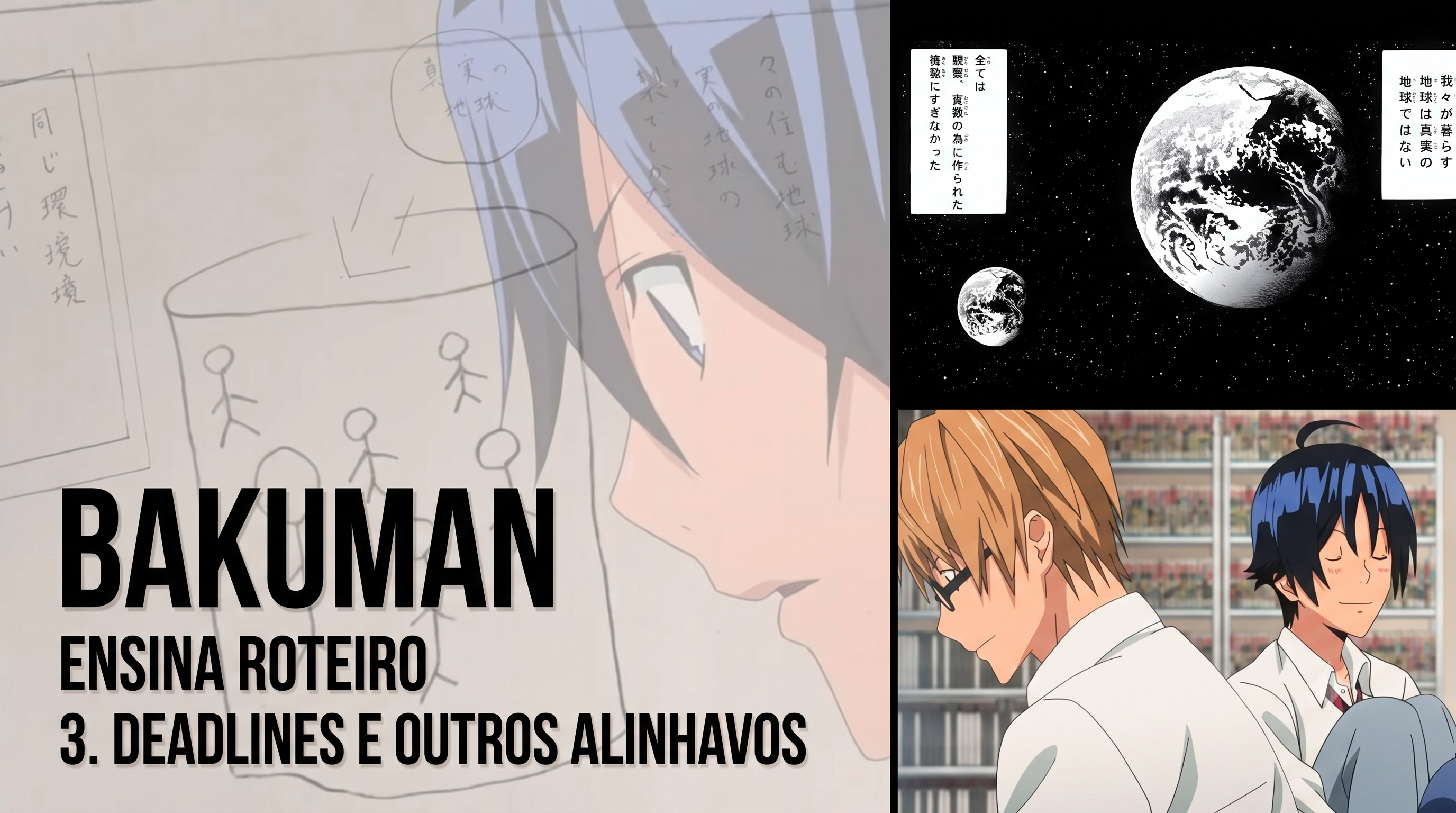
O plano/pacto entre Saiko e Azuki — de se casarem quando ela dublar o futuro anime do “namorado” — e o surgimento do jovem e talentoso Nizuma Eiji no horizonte dos protagonistas representam para Saiko e Takagi um marcador importante na vida de qualquer roteirista — o deadline. Sim, deadline é um conhecido recurso narrativo, que obriga as personagens a correrem contra o tempo (alcançar o crush antes do embarque no aeroporto é um clássico), mas é também uma realidade de todo e qualquer roteirista, que tem prazos a cumprir nas entregas de um roteiro. E se o cinema costuma ter prazos mais flexíveis, a televisão, nos diz Flávio de Campos (em Roteiro de Cinema e Televisão), “opera com uma fornalha aberta, a exigir para alimento diário centenas de páginas de roteiro com data e hora para irem ao ar”. A rotina desses nossos mangakás não será diferente, afinal, no Japão, muitos mangás têm periodicidade semanal.
Mas, apesar de aparentemente aterrorizantes, deadlines têm seu lado positivo: eles costumam afastar o roteirista da procrastinação, impondo os 90% de transpiração aos 10% de inspiração. O roteirista consciente de seu deadline (e de que o trabalho de outras pessoas depende disso) se obriga a fazer o exercício de criação incontornável, aquele que envolve sentar o bumbum na cadeira, estender os braços e dedilhar as teclas com letras estampadas (de preferência dando algum sentido a isso). Leandro Saraiva e Newton Cannito seguem essa linha (com o perdão do trocadilho exaustivo) quando aconselham que jovens roteiristas se imponham datas e demandas, para que “a disciplina do trabalho seja, justamente, o caminho da espontaneidade”. Em Bakuman, Saiko e Takagi traçam uma maratona de três anos, mas o roteirista define o final de verão como um deadline intermediário para ter seu primeiro manuscrito.
É no quinto episódio de Bakuman que surgem as primeiras linhas e traços da história esboçada, intitulada “As Duas Terras”. Quando Takagi entrega as cinco páginas iniciais para que o parceiro as leia, o manuscrito toma a tela e nos lembra de algo fundamental — Takagi é roteirista de um mangá. Nesse sentido, ainda que os ensinamentos de Bakuman sirvam a qualquer arte narrativa, não se pode perder de vista que escrever um mangá envolve esboçar uma visualidade e uma diagramação. Se no audiovisual a natureza da imagem envolve o movimento e tem a tela como fim, no mangá nossos heróis permanecem no terreno do papel, onde a ilustração divide espaço com as palavras. Assim, o que Takagi entrega a Saiko é muito próximo do que chamaríamos de um storyboard, já que escrita vem com esboços que insinuam também detalhes da composição visual.
Apesar de, hoje, parecer estranho um roteirista ter tanta autonomia sobre a composição da imagem, isso já aconteceu no cinema: antes do atual modelo de roteiro — batizado de master scenes — se popularizar, era também tarefa dos roteiristas decupar o roteiro, isto é, descrever enquadramentos, movimentos de câmera e outros aspectos técnicos. Segundo Steven Price, no livro A History of the Screenplay, isso se dava, sobretudo, num cinema industrial dominado por produtores, que, ao obrigarem os roteiristas a planejarem toda a imagem, diminuíam os poderes dos diretores. Ainda segundo Price, a mudança em direção ao atual modelo foi gradual: a passagem ao cinema falado e, posteriormente, o caso anti-trust (o Caso Paramount), que separou os departamentos de roteiro e produção, fez com que esses documentos passassem do shooting script (roteiro de gravação) ao formato master scenes, preocupado com as ações, o cenário dramático, o tempo e os diálogos.
Isso não quer dizer que um roteirista não tenha suas artimanhas para sugerir, por exemplo, um enquadramento; se o roteiro diz que os olhos da personagem umedecem ou que os dedos tremem, está subentendido que são ações pensadas para planos mais fechados. Cabe ao diretor decidir se vai fazê-los e como vai fazê-los. No manuscrito de “As Duas Terras”, Takagi é mais contundente, pois posiciona as peças no papel. Contudo, caberá a Saiko lapidar e dar acabamento a cada uma delas, dos esboços ao traçado final dessa trama em que tanto a Terra quanto os humanos que a habitam são cópias de uma Terra Real. “E se nosso planeta e nós mesmos fôssemos clones e também ratos de laboratório de um planeta matriz?”. Eis a premissa da trama, aqui formulada a partir do “se mágico” — que Robert McKee empresta do método de atuação de Stanislavski — para pensar uma pergunta hipotética como um disparador narrativo: “e se dois adolescentes com talentos complementares decidissem virar mangakás?”.
A premissa, aliás, já é o bastante para inserir a história de Takagi no gênero da ficção científica, que, segundo o pesquisador Alfredo Suppia (no artigo Notas para uma história crítica da ficção científica no cinema brasileiro), traz uma novidade/inovação ficcional que se descola do mundo como o conhecemos (duas Terras!), mas tem uma validação lógica proposta internamente pela própria trama. O sci-fi apresentado nesse breve pitch a Saiko se desdobra a partir do universo narrativo. Cabe ao ilustrador ter um vislumbre do conflito: em algum momento deve haver o confronto entre os habitantes das duas Terras, diz Saiko, consciente do gênero. Mas uma história serializada precisa ter boas personagens; como diz William Rabkin no livro Writing the Pilot, é por elas que voltamos semanalmente à trama. Em “As Duas Terras”, as personagens, por ora, estão à mercê do universo. Resta saber o que o editor Akira Hattori irá achar quando essa história chegar às mãos dele…
In English
3. Deadlines and Other Stitchings
The plan/pact between Saiko and Azuki — to marry when she dubs the future anime of her “boyfriend” — and the emergence of the young and talented Nizuma Eiji on the protagonists’ horizon represent for Saiko and Takagi an important marker in any screenwriter’s life — the deadline. Yes, the deadline is a well-known narrative device, which forces characters to race against time (catching the crush at the airport before boarding is a classic move.), but it is also a reality for every screenwriter, who has deadlines to meet when delivering a script. And if cinema tends to have more flexible deadlines, television, as Flávio de Campos tells us (in Roteiro de Cinema e Televisão), “operates with an open furnace, requiring hundreds of pages of script with a date and time to air as daily sustenance.” The routine of our mangakas will be no different, after all, in Japan, many mangas are published weekly.
But, despite being apparently terrifying, deadlines have their positive side: they tend to keep the screenwriter away from procrastination, imposing the 90% perspiration on the 10% inspiration. The screenwriter aware of their deadline (and that other people’s work depends on it) forces themselves to do the unavoidable creative exercise, the one that involves sitting their butt in the chair, stretching their arms, and tapping keys with printed letters (preferably making some sense of it). Leandro Saraiva and Newton Cannito follow this line (forgive the exhausted pun) when they advise young screenwriters to impose dates and demands on themselves, so that “the discipline of work is, precisely, the path to spontaneity.” In Bakuman, Saiko and Takagi map out a three-year marathon, but the screenwriter sets the end of summer as an intermediate deadline to have their first manuscript.
It is in the fifth episode of Bakuman that the first lines and strokes of the sketched story, titled “The Two Lands”, appear. When Takagi delivers the initial five pages for his partner to read, the manuscript takes over the screen and reminds us of something fundamental — Takagi is the screenwriter of a manga. In this sense, although the teachings of Bakuman serve any narrative art, one cannot lose sight of the fact that writing a manga involves sketching out a visuality and a layout. If in audiovisual the nature of the image involves movement and has the screen as its end, in manga our heroes remain on paper, where illustration shares space with words. Thus, what Takagi delivers to Saiko is very close to what we would call a storyboard, since the writing comes with sketches that also hint at details of the visual composition.
Although, today, it seems strange for a screenwriter to have so much autonomy over image composition, this has happened in cinema: before the current script model — dubbed master scenes — became popular, it was also the screenwriters’ task to decoupage the script, that is, to describe framings, camera movements, and other technical aspects. According to Steven Price, in the book A History of the Screenplay, this happened mainly in an industrial cinema dominated by producers, who, by forcing screenwriters to plan the entire image, diminished the directors’ powers. Still according to Price, the shift towards the current model was gradual: the transition to sound cinema and, later, the anti-trust case (the Paramount Case), which separated the screenwriting and production departments, caused these documents to shift from the shooting script to the master scenes format, concerned with actions, dramatic setting, time, and dialogue.
This does not mean that a screenwriter doesn’t have their tricks to suggest, for example, a framing; if the script says the character’s eyes moisten or their fingers tremble, it is implied that these are actions thought out for closer shots. It is up to the director to decide whether to do them and how to do them. In the manuscript of “The Two Lands”, Takagi is more forceful, as he positions the pieces on the page. However, it will be up to Saiko to refine and finish each one of them, from sketches to the final linework of this plot in which both the Earth and the humans inhabiting it are copies of a Real Earth. “What if our planet and ourselves were clones and also laboratory rats of a parent planet?” Here is the premise of the plot, here formulated from the “magical if” — which Robert McKee borrows from Stanislavski’s acting method — to think of a hypothetical question as a narrative trigger: “what if two teenagers with complementary talents decided to become mangakas?”
The premise, by the way, is already enough to insert Takagi’s story into the science fiction genre, which, according to researcher Alfredo Suppia (in the article Notes for a critical history of science fiction in Brazilian cinema), brings a fictional novelty/innovation that detaches itself from the world as we know it (two Earths!), but has a logical validation proposed internally by the plot itself. The sci-fi presented in this brief pitch to Saiko unfolds from the narrative universe. It is up to the illustrator to get a glimpse of the conflict: at some point, there must be a confrontation between the inhabitants of the two Earths, says Saiko, aware of the genre. But a serialized story needs good characters; as William Rabkin says in the book Writing the Pilot, it is for them that we return weekly to the plot. In “The Two Lands”, the characters, for now, are at the mercy of the universe. It remains to be seen what editor Akira Hattori will think when this story reaches his hands…
2. Confiança, Esforço e Sorte

Como em qualquer obra serializada — isto é, que se divide em capítulos ou episódios para provocar a curiosidade do leitor/espectador e trazê-lo de volta —, cabe uma recapitulação: estamos debatendo narrativa e roteiro a partir de Bakuman, mangá e anime que narra a jornada de dois adolescentes para se tornarem mangakás. Saiko desenha, Takagi escreve. O objetivo dos dois é ter um mangá bem-sucedido a ponto de ser adaptado em anime, mas Saiko não parou por aí: vinculou esse desejo pragmático a uma necessidade profunda — casar-se com seu primeiro amor, tendo uma vida diferente da do tio, um mangaká famoso que não conseguiu conciliar a vida amorosa à profissional.
Se Taro Kawaguchi segue como o ídolo que motiva o sobrinho a seguir seus sonhos, a morte precoce desse tio será uma sombra sobre a família do garoto ao longo da série. Ainda que a mãe de Saiko — primeira força externa antagonista ao desejo — seja momentaneamente apaziguada, a preocupação com o filho persistirá, uma vez que a experiência passada envolve uma vida sacrificada para dar vida à ficção. É o avô quem, ao entender o destino de Saiko, o presenteia com a chave do antigo estúdio do tio, que agrega também uma biblioteca de mangás.
Esse pequeno novo mundo só surge no terceiro episódio, quando Saiko começa um intensivo para refinar seu traço como ilustrador, enquanto Takagi coloca em palavras uma história cujo título não poderia ser mais emblemático: “As Duas Terras”. Nesse microcosmo, com tantos universos entre prateleiras, surge um novo mundo, que, tal qual o protagonismo, é duplicado. Mas “As Duas Terras” é história para mais tarde; por agora, Takagi enche os dedos de band-aids, e Saiko ensina ao amigo os preceitos que, segundo o tio, são indispensáveis a um mangaká; e que podemos pensar também aos roteiristas: “arrogância, esforço e sorte”.
Comecemos pelo mais óbvio: o esforço, que já aparece em cena, uma vez que os garotos viram dias e noites para criarem esse primeiro mangá. Ilustram o aforismo lembrado por Doc Comparato — “o artista é composto por 10% de talento e 90% de trabalho duro” —, e começam já a demonstrar características batizadas por Robert McKee como “disciplina de um sargento” e “dom da resistência” (“escrever roteiros não é como uma corrida rasa, e sim como uma maratona”, diz o autor de Story). E, claro, Saiko e Takagi vislumbram, desde já, um dos preceitos fundamentais a quem escreve: “reescrever, reescrever, reescrever”, batem na tecla Leandro Saraiva e Newton Cannito em seu Manual/Manuel de roteiro.
Ainda que esteja na boca de muitos roteiristas (e de tantos outros artistas) que refletem sobre o ofício, a sorte não é exatamente um consenso: enquanto Syd Field destaca que a sorte pode ser útil no início de uma carreira (sobretudo a sorte de encontrar um bom agente), Comparato é mais abrangente (e pessimista) ao descrever a profissão como “uma roleta-russa”, “instável” e “repleta de altos e baixos”. Em contrapartida — e discordando de Taro Kawaguchi —, McKee crê que a ideia de sorte é um mito; ele até admite que não é possível prever sucessos, mas defende que o roteirista que consegue atingir a excelência é inevitavelmente assimilado pela indústria. Nossos heróis contam com a possibilidade da sorte, mas enquanto ela não vem, se esforçam.
A arrogância foi propositalmente deixada por último porque, num ato-falho, Takagi a corrige para um termo melhor — confiança. Se a criação está atrelada ao ato da imaginação — cuja etimologia recupera “imagem mental” —, é preciso reconhecer a pessoalidade dessa ação, comum a todo ser humano — “faculdade mestra do espírito”, diz Jean-Claude Carrière —, mas também singular, no sentido de que compartilha algo que nasce de dentro de um indivíduo. Desta forma, em quem mais poderíamos confiar, se não em nós mesmos, se essa criação existe primordialmente em nós e se só nós temos a autonomia de exteriorizá-la, transformá-la ou não? É por essas e outras que Syd Field diz “se você criou o problema, você pode resolvê-lo”, e que Carrière defende que o roteirista deve exercitar a imaginação para que ela se revele e adquira confiança em si mesma. McKee, mais uma vez, é categórico: se o escritor não acreditar no que escreve, o público perceberá a falsidade.
Sem querer, Saiko e Takagi começam sua jornada reposicionando os mandamentos do tio: confiança (ao invés de arrogância), esforço e sorte. A mudança da palavra é pertinente a essa primeira empreitada: Saiko confia na trama de Takagi, e Takagi no traço de Saiko, mas logo eles irão descobrir que a confiança que têm um no outro não os obriga a renunciar a crítica. Até porque eles vão precisar somar a autocrítica a essa equação se quiserem competir com com Nizuma Eiji, um gênio do mangá que, com apenas 15 anos, escreve e desenha suas histórias. O esforço dobrado tentará fazer frente ao dom de Eiji, que poderíamos colocar na categoria sobre a qual o escritor Orhan Pamuk discorre, chamando-a de “romancista ingênuo”. Mas isso é história para o próximo episódio…
In English
2. Confidence, Effort, and Luck
As in any serialized work — that is, one divided into chapters or episodes to pique the reader’s/viewer’s curiosity and bring them back — a recap is in order: we are debating narrative and screenwriting based on Bakuman, the manga and anime that narrates the journey of two teenagers to become mangakas. Saiko draws, Takagi writes. Their goal is to have a manga successful enough to be adapted into an anime, but Saiko didn’t stop there: he tied this pragmatic desire to a deep necessity — marrying his first love, living a life different from that of his uncle, a famous mangaka who couldn’t reconcile his love life with his professional one.
If Taro Kawaguchi remains the idol who motivates his nephew to follow his dreams, his uncle’s early death will cast a shadow over the boy’s family throughout the series. Although Saiko’s mother — the first external antagonistic force to his desire — is momentarily appeased, her concern for her son will persist, since the past experience involved a life sacrificed to bring fiction to life. It is the grandfather who, upon understanding Saiko’s fate, gifts him the key to his uncle’s old studio, which also includes a manga library.
This small new world only appears in the third episode, when Saiko begins an intensive course to refine his drawing style as an illustrator, while Takagi puts into words a story whose title could not be more emblematic: “As Duas Terras”. In this microcosm, with so many universes between shelves, a new world emerges, which, like the protagonist himself, is duplicated. But “As Duas Terras” is a story for later; for now, Takagi covers his fingers in Band-Aids, and Saiko teaches his friend the precepts that, according to his uncle, are indispensable to a mangaka — and which we might also think of for screenwriters: “arrogance, effort, and luck.”
Let’s start with the most obvious: effort, which already appears on the scene, as the boys spend days and nights creating this first manga. They illustrate the aphorism recalled by Doc Comparato — “the artist is composed of 10% talent and 90% hard work” — and are already beginning to demonstrate characteristics dubbed by Robert McKee as “the discipline of a sergeant” and “the gift of endurance” (“writing screenplays is not like a sprint, but rather a marathon,” says the author of Story). And, of course, Saiko and Takagi already glimpse one of the fundamental precepts for anyone who writes: “rewrite, rewrite, rewrite,” Leandro Saraiva and Newton Cannito hammer home in their Manual/Manuel de roteiro.
Although it is on the lips of many screenwriters (and many other artists) who reflect on the craft, luck is not exactly a consensus: while Syd Field highlights that luck can be useful at the beginning of a career (especially the luck of finding a good agent), Comparato is more comprehensive (and pessimistic) when describing the profession as “Russian roulette,” “unstable,” and “full of ups and downs.” In contrast — and disagreeing with Taro Kawaguchi — McKee believes that the idea of luck is a myth; he even admits that it is impossible to predict successes, but he argues that the screenwriter who manages to achieve excellence will inevitably be assimilated by the industry. Our heroes count on the possibility of luck, but while it doesn’t come, they strive.
Arrogance was purposely left for last because, in a Freudian slip, Takagi corrects it to a better term — confidence. If creation is linked to the act of imagination — whose etymology recovers “mental image” — it is necessary to recognize the personal nature of this action, common to all human beings — “the master faculty of the spirit,” says Jean-Claude Carrière — but also singular, in the sense that it shares something that is born from within an individual. Thus, in whom else could we trust, if not ourselves, if this creation exists primarily within us and only we have the autonomy to externalize it, transform it, or not? It is for these and other reasons that Syd Field says “if you created the problem, you can solve it,” and that Carrière argues that the screenwriter must exercise imagination so that it reveals itself and gains confidence in itself. McKee, once again, is categorical: if the writer does not believe in what he writes, the public will perceive the falsehood.
Unwittingly, Saiko and Takagi begin their journey by repositioning their uncle’s commandments: confidence (instead of arrogance), effort, and luck. The change of word is pertinent to this first endeavor: Saiko trusts Takagi’s plot, and Takagi trusts Saiko’s art, but soon they will discover that the trust they have in each other does not obligate them to renounce criticism. Especially because they will need to add self-criticism to this equation if they want to compete with Nizuma Eiji, a manga genius who, at just 15 years old, writes and draws his own stories. The doubled effort will try to rival Eiji’s gift, which we could place in the category about which the writer Orhan Pamuk discourses, calling it the “naive novelist.” But that is a story for the next episode…
1. O Percebedor Profissional

Bakuman é um mangá criado por Tsugumi Ohba e adaptado em anime pela NHK. É também uma boa oportunidade para aprender e discutir roteiro — e este é o objetivo deste novo projeto Pós-créditos, BAKUMAN ENSINA ROTEIRO.
Mas o que Bakuman tem a ver com roteiro? (para além do fato de que todo mangá/anime tem roteiro). Bem, a trama de Bakuman é justamente sobre fazer mangás, desenhá-los e… escrevê-los. O traço fica por conta de Moritaka Mashiro — ou, simplesmente, Saiko —, um aluno do 9º ano que, certo dia, esquece o caderno de matemática na sala de aula. Não haveria problema se o caderno de Saiko não estivesse lotado de desenhos de Miho Azuki, a colega de sala por quem Saiko tem um crush. Ele corre de volta à escola, mas…
Tarde demais. Akito Takagi já está com o caderno em mãos e justifica: está com ele porque se senta no fundo da sala. Ele viu quando o colega esqueceu o material, diz que sabe que Saiko gosta de Azuki e decreta — Azuki também gosta de Saiko. E quando Saiko pergunta como Takagi poderia saber de tudo isso, o colega repete a fala anterior: “Eu já te disse. É porque eu me sento atrás”. Na verdade, Takagi sabe do desencontro amoroso porque ele é um roteirista.
Ele se senta ao fundo da sala para observar as ações, os dramas, as vidas que compartilham aquele espaço. Takagi é (como diz Flávio Campos em Roteiro de Cinema e Televisão) um “percebedor profissional”, ou um “colecionador de figuras humanas” (como prefere Doc Comparato em Da Criação ao Roteiro), que exercita o músculo da imaginação através da observação do cotidiano; exercício que Jean-Claude Carrière (em sua Prática do Roteiro Cinematográfico) defende como primordial à função do roteirista. É “o pão nosso de cada dia” do roteirista, resumem Leandro Saraiva e Newton Cannito em seu Manual/Manuel de Roteiro.
O esquecimento de Saiko funciona como incidente incitante (como diz Robert McKee em seu Story) de Bakuman, uma vez que oportuniza esse encontro que disparará a aventura. Takagi faz uma proposta a Saiko: que, juntos, eles se tornem mangakás. Takagi escreve; Saiko desenha. Só que Saiko não tem certeza; dá uma desculpa a Takagi e recusa o chamado à aventura. Contudo, Takagi tem uma carta na manga: ele convence Saiko a ir à casa de Azuki porque sabe de algo mais — que o sonho de Azuki é ser dubladora de animes. A circunstância arquitetada pelo roteirista faz Saiko, o desenhista, agir impetuosamente: confiante, ele propõe que Azuki seja a dubladora do anime que, um dia, será adaptado a partir de um mangá da dupla. Mas Saiko não para por aí — diz a Azuki que, depois disso, podem se casar!
O ímpeto de Saiko revela uma intenção que visa um objetivo externo, pragmático, caracterizado por uma tarefa — escrever um mangá de sucesso que se torne um anime. John Truby (em seu Anatomia da História) prefere chamar isso de desejo, mas ao pedir Azuki em casamento, Saiko revela uma necessidade: ele quer uma vida diferente da do tio, um mangaká famoso que teve que renunciar ao amor em prol do trabalho. A lembrança do tio tem um papel ambíguo para Takagi, já que ele era um grande contador de histórias que não pôde viver a sua própria.
Para a surpresa de Saiko e Takagi, Azuki aceita o pedido de casamento, mas dobra a aposta ao impor um típico sacrifício melodramático: ela e Saiko só voltarão a se falar quando atingirem seus objetivos. É o que o já citado Doc Comparato e Luiz Carlos Maciel (em O Poder do Clímax) chamam de “autossacrifício por um ideal”, o que Saraiva e Cannito definem como uma superioridade moral baseada na renúncia e na “fidelidade ao próprio coração”. E é justamente isso que nos faz sentir empatia e identificação pelas personagens de Bakuman.
Personagens e desejos apresentados, conflito insinuado. Assim começa a jornada de Saiko e Takagi, aquela que desafia todo contador de histórias — preencher a página em branco. Para além das provações de todo autor-roteirista, haverá ainda as pressões externas, que ainda nem começaram. A primeira virá do passado, da memória do tio que assombra a família de Saiko… ah, sim, isto é um gancho. Até a próxima!
In English
1. The Professional Perceiver
Bakuman is a manga created by Tsugumi Ohba and adapted into an anime by NHK. It’s also a great opportunity to learn about and discuss screenwriting — and that’s the aim of this new Post-credits project, BAKUMAN TEACHES SCREENWRITING.
But what does Bakuman have to do with screenwriting? (Apart from the fact that every manga/anime has a script.) Well, the plot of Bakuman is precisely about making manga, drawing them and… writing them. The artwork falls to Moritaka Mashiro — or simply Saiko —, a 9th grader who, one day, forgets his math notebook in the classroom. It wouldn’t be a problem if Saiko’s notebook weren’t crammed with drawings of Miho Azuki, the classmate he has a crush on. He races back to school, but…
Too late. Akito Takagi already has the notebook in his hands and justifies it: he has it because he sits at the back of the room. He saw when Saiko left the material behind, says he knows Saiko likes Azuki, and declares — Azuki likes Saiko too. And when Saiko asks how Takagi could know all that, Takagi repeats his earlier line: “I already told you. It’s because I sit in the back.” In truth, Takagi knows about this missed romantic connection because he is a screenwriter.
He sits at the back of the classroom to observe the actions, the dramas, the lives that share that space. Takagi is (as Flávio Campos puts it in Roteiro de Cinema e Televisão) a “professional perceiver,” or a “collector of human figures” (as Doc Comparato prefers in Da Criação ao Roteiro), someone who exercises the muscle of imagination through the observation of everyday life; an exercise that Jean-Claude Carrière (in his Prática do Roteiro Cinematográfico) champions as essential to the screenwriter’s role. It is the screenwriter’s “daily bread,” as Leandro Saraiva and Newton Cannito sum it up in their Manual/Manuel de Roteiro.
Saiko’s forgotten notebook acts as the inciting incident (as Robert McKee calls it in Story) of Bakuman, since it sets up the encounter that will launch the adventure. Takagi makes Saiko a proposition: that together they become manga artists. Takagi writes; Saiko draws. But Saiko isn’t sure; he makes an excuse to Takagi and refuses the call to adventure. However, Takagi has an ace up his sleeve: he convinces Saiko to go to Azuki’s house because he knows something else — that Azuki’s dream is to be an anime voice actress. The circumstance engineered by the screenwriter makes Saiko, the artist, act impetuously: brimming with confidence, he proposes that Azuki become the voice actress for the anime that will one day be adapted from their manga. But Saiko doesn’t stop there — he tells Azuki that, after that, they can get married!
Saiko’s impulse reveals an intention aimed at an external, pragmatic goal, defined by a task — to write a hit manga that becomes an anime. John Truby (in The Anatomy of Story) prefers to call this a desire, but by proposing marriage to Azuki, Saiko reveals a need: he wants a life different from his uncle’s, a famous manga artist who had to renounce love for work. The memory of his uncle plays an ambiguous role for Takagi, since he was a great storyteller who couldn’t live his own story.
To Saiko and Takagi’s surprise, Azuki accepts the marriage proposal, but raises the stakes by imposing a typical melodramatic sacrifice: she and Saiko will only speak to each other again once they both achieve their goals. This is what the aforementioned Doc Comparato and Luiz Carlos Maciel (in O Poder do Clímax) call “self-sacrifice for an ideal,” and what Saraiva and Cannito define as a moral superiority rooted in renunciation and “faithfulness to one’s own heart.” And it is precisely this that makes us feel empathy and identification with the characters in Bakuman.
Characters and desires presented, conflict hinted at. Thus begins the journey of Saiko and Takagi, the one that challenges every storyteller — filling the blank page. Beyond the trials every author-screenwriter faces, there will also be external pressures, which haven’t even started yet. The first will come from the past, from the memory of the uncle that haunts Saiko’s family… ah, yes, that’s a cliffhanger. Until next time!

