
por Álvaro André Zeini Cruz
Pela subjetiva, a câmera encampa o olhar de um lutador de MMA golpeado até o corner pelo oponente brutamontes. Corporificado, esse ponto de vista zonzo-zureta tem vislumbres do adversário e vê os arredores desse picadeiro se tornarem borrões. Assim, entre lampejos e apagões se forma a imagem de abertura de Dia D, mais recente abdução spielbergiana, em que o cineasta escolhe iniciar este retorno ao subgênero “filme de ETs” olhando por meio de uma barbárie nocauteada. Mas se o coliseu contemporâneo — espetáculo da aniquilação do outro, anticomunicação per se — antecipa simbolicamente a iminência de uma 3ª Guerra Mundial, constitui-se também a partir de uma contradição: centraliza os olhares desse microcosmo quando, na verdade, é uma ação paralela; os registros dos eventos capazes de mudar a humanidade — talvez vislumbrando-lhe uma possibilidade — encontram-se na plateia, não trancafiados em traquitanas ou em invólucros sofisticados, mas numa mochila esportiva, objeto que, por si só, carrega um imaginário acerca daqueles que se contrapõem a um sistema.
Elliot Taylor — que, de certa forma, já havia reaparecido no recente Devoradores de Estrelas — reencarna em Daniel Kellner (Josh O’Connor), um hacker que ameaça a massa falida dessa sociedade do “ver para crer” com provas da existência de vida extraterrestre. Mais do que isso, as imagens que Kellner carrega reiteram o que se sabe desde a luta inicial — se a barbárie nos é ordinária, por que não seria com aquilo que nos extrapola, que nos é extraordinário? É Noah Scanlon (Colin Firth) quem comanda a bestialidade institucionalizada, o Keys que sai à caça de Kellner usando um aparato extraterrestre como chave para trancar a humanidade numa arca de espelhos e sem janelas — que os seres terrestres sucumbam diante do horror narcísico e não do terror de uma alteridade incógnita e intergaláctica.
Cabe recuperar a síntese de Stephen King: o terror é antecipatório; o horror, o depois. O primeiro, portanto, está envolto pela bruma da incerteza, é a ansiedade pelo desconhecido; já a aproximação de uma 3ª Guerra evidencia um horror que aparece de experiências banalizadas, espetáculos renegociados cotidianamente sentido à insensibilidade e à cegueira. Nesse contexto, forma-se um mundo de imagens abstraídas tanto da capacidade de maravilhar quanto da de causar espanto; imagens que, desatreladas das coisas terrenas, deixam de comover corpos e espíritos, esvaziando essa comunhão una dos sentidos como contato imediato e do ser como estar-aí supremo.
A namorada de Kellner teme: se as imagens desses corpos estranhos vierem à luz, desfaz-se o breu que isola e abençoa a humanidade e seu habitat; suspende-se também a condição humana de se agarrar às hipóteses no escuro — essa coisa chamada fé. Mas a chaga perfurada por um crucifixo lhe abre os olhos: analogamente oposta à peça extraterrestre, o símbolo cristão atravessa a carne de Jane (Eve Hewson) enquanto ela é telepaticamente atacada por Noah. O invasor de corpos/controlador de mentes não veio do espaço; pelo contrário, é um homem cuja violência se justifica na batalha por conservar o mundo como está, ainda que à deriva, rumo ao fim. Mas Spielberg acredita que, desde o Big Bang, há outros, e retorna a essa substância universal primeira, que é também matéria-prima de todo o cinema; e, em especial, de seu cinema — a luz.
“As luzes mudam a aparência de tudo”, diz o Sr. Fabelman (Paul Dano) — versão fictícia do pai de Spielberg — em Os Fabelmans, prevendo (na diegese) e revendo (além da diegese) um cinema que vai das peles resplandecentes (Contatos Imediatos, Inteligência Artificial, Minority Report, Jogador Número Um) aos corações luminosos (E.T.). Se a aparência é a face à vista de todas as coisas, a luz é a mediação reveladora, responsável por expor sujeitos e objetos, por — a um só tempo — vinculá-los (eu vejo o outro) e desconectá-los (eu não sou o outro). Spielberg a compreende como um facho voltado à alteridade, cujos limites, no entanto, não são simples ou inocentes: a mesma luz que o encanta em Os Fabelmans é a que revela o desejo extraconjugal e pulveriza a família. Assim — e como já disse em outra ocasião —, a luz, para Spielberg, é um elemento a ser controlado para que não cegue nem revele demais.
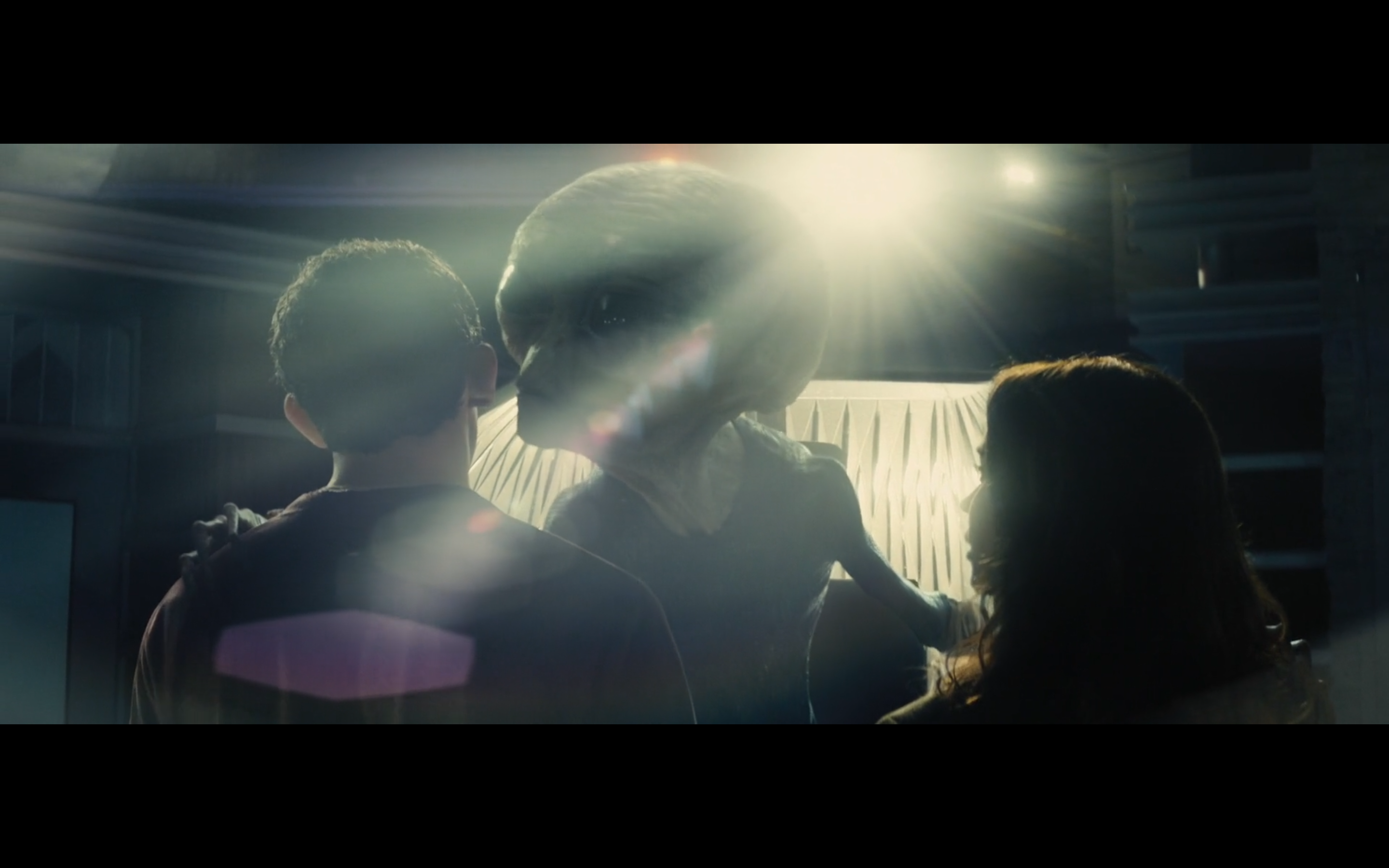
Em Dia D, a luz tem dois vieses: desdobra-se num low-key desde o ringue, que abre ao hacker e à namorada uma jornada pelas sombras — os faróis os cercam como em E.T., as lanternas os perseguem como em Guerra dos Mundos; por vezes, encontram a lente da câmera, produzindo flares — que nada mais são do que OVNIs luminosos — como os de Minority Report (a luz que explode pela janela enquanto Jane vê os vídeos dos extraterrestres). No embate entre Jane e Noah, a luz se torna uma névoa contraposta à solidez das sombras, remetendo às nuances luminosas das sequências metafísicas de Kiyoshi Kurosawa (ou às de Clint Eastwood em Além da Vida), com a diferença de que o sobrenatural aqui é usufruto das mãos e do medo humanos. E se a luz desenhada pela cortina de um quarto de hotel é hitchcockiana — assim como a música em vários momentos —, Spielberg se afasta da revisitação mais comum a essa referência: Dia D não é sobre o olhar fetichista, instrumento da crença, mas sobre o olhar num sentido mais amplo e primordial em direção à verdade. Nessa perspectiva, o interesse por Hitchcock é mais atmosférico, fazendo-se através desses limiares luminosos movediços, que dilatam o tempo enquanto passam, delineando a distância entre suspense e a surpresa, o terror e o horror.
Se a jornada de Kellner é sombria (a casa se torna mal-assombrada, o quarto de hotel é engolido pelo noir), a de sua contraparte é bem iluminada: desde o apartamento atravessado por janelas, lugar de onde Margaret Fairchild (Emily Blunt) deseja se mudar, movida por uma inquietação inexplicável, tal qual a de Delphine, protagonista rohmeriana que termina por encontrar O Raio Verde. Aqui, o encontro de Margaret acontece às claras: ela encara o pássaro que invade a sala e devolve esse olhar, revelando-se estranho no comportamento, mas, sobretudo, na plasticidade duvidosa, fazendo questão de revelar que aquilo não é o animal, a coisa em si, mas mera aparência. Dali, essa repórter do tempo parte para o high-key de um estúdio televisivo, onde desmaia após fazer desmoronar a Torre de Babel — Margaret agora tem a dádiva de um poliglotismo que vai além da língua dos homens.
É em outro estúdio que Margaret, como E.T., volta para casa, ainda que — aqui sim — através da ilusão arquitetada e cenografada por Hugo Wakefield (Colman Domingo). É nessa reconstituição do lar da infância que ela regressa à “criança justa” de outrora, merecedora dos contatos imediatos ocorridos sob as peles de avatares — os alienígenas transmutados em animais para minguar o medo dessa comunicação. Então, Margaret é guiada não ao mundo dos mitos — fabulação ética-existencial —, mas à casa de João e Maria, reino da fábula moral (especialidade de Spielberg) que, por si só, carrega valores comunitários e, consequentemente, comunicacionais. Afinal, a fala demanda a escuta do outro e é sobre isso que Spielberg joga luz; nesse diálogo, compomos menos uma sociedade do que uma pequena comunidade, perdida em meio a uma imensidão cujos olhos e sentidos são incapazes de tocar. A fé volta a ser uma questão.
Cientes de que personificam a capacidade de transcendência de duas linguagens, Daniel e Margaret voltam ao estúdio televisivo, local onde Spielberg situa o clímax deste conto cinematográfico. É sob a chama da fogueira de uma emissora local que Margaret anuncia e exibe as imagens, que de tão extraordinárias, reconstituem a aldeia global em plena contemporaneidade de pulverizações comunicacionais. Quando o extraterrestre é televisionado não como arquivo, mas ao vivo, ele sussurra ao ouvido do matemático que, por sua vez, brinca de telefone sem fio com a linguista. Spielberg, então, apresenta a antítese que Blake Snyder (em Save the Cat) defende como necessária entre a imagem inicial e a final. Se Spielberg começa Dia D pela subjetiva cambaleante de um homem bárbaro e incógnito em plena luta corporal, termina com a objetiva centrada dessa mulher que sobe ao púlpito, quebra a quarta parede — o que implica um outro imaginado — e recobra um sentido tão central quanto o olhar ao fazer cinematográfico e comunicacional: “escutem” é a palavra que encerra o filme daquele que crê que as luzes mudam tudo.
Listen!
By Álvaro André Zeini Cruz
Subjectively, the camera adopts the gaze of a battered MMA fighter driven into the corner by a brutish opponent. Embodied, this woozy, dizzy point of view catches glimpses of the adversary and sees the surroundings of this arena blur into smears. Thus, between flashes and blackouts, the opening image of Dia D is formed — Spielberg’s most recent extraterrestrial abduction — in which the filmmaker chooses to begin this return to the “alien film” subgenre by looking through a knocked-out barbarism. But if the contemporary coliseum — a spectacle of the annihilation of the other, anticommunication per se — symbolically anticipates the imminence of a Third World War, it also constitutes itself through a contradiction: it centralizes the gazes of this microcosm when, in fact, it is a parallel action; the records of events capable of changing humanity — perhaps glimpsing a possibility for it — are found in the audience, not locked away in gadgets or sophisticated casings, but in a sports backpack, an object that, in itself, carries an imaginary about those who oppose a system.
Elliot Taylor — who, in a way, had already reappeared in the recent Devourers of Stars — reincarnates in Daniel Kellner (Josh O’Connor), a hacker who threatens the bankrupt mass of this “seeing is believing” society with proof of extraterrestrial life. More than that, the images Kellner carries reiterate what has been known since the opening fight — if barbarism is ordinary to us, why wouldn’t it be so with that which surpasses us, that which is extraordinary to us? It is Noah Scanlon (Colin Firth) who commands institutionalized bestiality, the Keys who hunts Kellner using an extraterrestrial device as a key to lock humanity in an ark of mirrors and no windows — may earthly beings succumb before narcissistic horror and not before the terror of an unknown, intergalactic otherness.
It is worth recovering Stephen King’s synthesis: terror is anticipatory; horror is the aftermath. The former, therefore, is enveloped in the mist of uncertainty; it is anxiety about the unknown; while the approach of a Third World War evidences a horror that emerges from banalized experiences, renegotiated spectacles, daily felt as insensitivity and blindness. In this context, a world of images is formed, abstracted both from the capacity to marvel and from the capacity to cause astonishment; images that, unmoored from earthly things, cease to move bodies and spirits, emptying that unified communion of the senses as immediate contact and of being as supreme being-there.
Kellner’s girlfriend fears: if the images of these strange bodies come to light, the darkness that isolates and blesses humanity and its habitat will dissolve; the human condition of clinging to hypotheses in the dark — that thing called faith — will also be suspended. But the wound pierced by a crucifix opens her eyes: analogously opposed to the extraterrestrial piece, the Christian symbol pierces the flesh of Jane (Eve Hewson) as she is telepathically attacked by Noah. The body-snatcher/mind-controller did not come from space; on the contrary, he is a man whose violence is justified in the battle to preserve the world as it is, even if adrift, heading toward the end. But Spielberg believes that, since the Big Bang, there are others, and he returns to this first universal substance, which is also the raw material of all cinema — and, especially, of his cinema — light.
“Lights change the appearance of everything,” says Mr. Fabelman (Paul Dano) — the fictional version of Spielberg’s father — in The Fabelmans, foreseeing (within the diegesis) and reviewing (beyond the diegesis) a cinema that goes from resplendent skins (Close Encounters of the Third Kind, A.I. Artificial Intelligence, Minority Report, Ready Player One) to luminous hearts (E.T.). If appearance is the visible face of all things, light is the revealing mediation, responsible for exposing subjects and objects — for, at once, linking them (I see the other) and disconnecting them (I am not the other). Spielberg understands it as a beam directed at otherness, whose limits, however, are not simple or innocent: the same light that enchants him in The Fabelmans is the one that reveals extramarital desire and shatters the family. Thus — and as I have said on another occasion — for Spielberg, light is an element to be controlled so that it does not blind or reveal too much.
In Dia D, light has two biases: it unfolds into a low-key since the ring, which opens for the hacker and his girlfriend a journey through the shadows — the headlights surround them as in E.T., the lanterns chase them as in War of the Worlds; at times, they find the camera lens, producing flares — which are nothing more than luminous UFOs — like those of Minority Report (the light that bursts through the window as Jane watches the videos of the extraterrestrials). In the clash between Jane and Noah, light becomes a mist contrasted with the solidity of shadows, recalling the luminous nuances of Kiyoshi Kurosawa’s metaphysical sequences (or Clint Eastwood’s in Hereafter), with the difference that the supernatural here is the fruition of human hands and fear. And if the light drawn by the curtain of a hotel room is Hitchcockian — as is the music at various moments — Spielberg moves away from the most common revisitation of this reference: Dia D is not about the fetishistic gaze, the instrument of belief, but about the gaze in a broader and more primordial sense toward truth. In this perspective, the interest in Hitchcock is more atmospheric, manifesting itself through these shifting luminous thresholds, which dilate time as they pass, delineating the distance between suspense and surprise, terror and horror.
If Kellner’s journey is dark (the house becomes haunted, the hotel room is swallowed by noir), his counterpart’s journey is brightly lit: from the apartment crossed by windows, the place from which Margaret Fairchild (Emily Blunt) wishes to move, driven by an inexplicable restlessness, much like Delphine, the Rohmerian protagonist who ends up finding The Green Ray. Here, Margaret’s encounter happens in broad daylight: she faces the bird that invades the room and returns its gaze, revealing itself as strange in behavior but, above all, in its doubtful plasticity, making a point of revealing that it is not the animal, the thing itself, but mere appearance. From there, this weather reporter heads to the high-key of a television studio, where she faints after bringing down the Tower of Babel — Margaret now has the gift of a polyglottism that goes beyond the language of men.
It is in another studio that Margaret, like E.T., goes back home, even if — here, yes — through the illusion architected and scenographed by Hugo Wakefield (Colman Domingo). It is in this reconstruction of her childhood home that she returns to the “righteous child” of yore, deserving of the close encounters that occurred under the skins of avatars — aliens transmuted into animals to lessen the fear of this communication. So Margaret is guided not to the world of myths — ethical-existential fabulation — but to the house of Hansel and Gretel, the realm of moral fable (Spielberg’s specialty) which, in itself, carries communal values and, consequently, communicational ones. After all, speech demands the listening of the other, and that is what Spielberg sheds light on; in this dialogue, we compose less a society than a small community, lost in the midst of an immensity whose eyes and senses are incapable of touching. Faith becomes an issue once again.
Aware that they personify the capacity for transcendence of two languages, Daniel and Margaret return to the television studio, the place where Spielberg situates the climax of this cinematic tale. It is under the flame of a local station’s bonfire that Margaret announces and displays the images, which are so extraordinary that they reconstitute the global village in the full contemporaneity of communicational pulverizations. When the extraterrestrial is televised not as an archive but live, it whispers in the mathematician’s ear, who, in turn, plays broken telephone with the linguist. Spielberg then presents the antithesis that Blake Snyder (in Save the Cat) defends as necessary between the opening and closing images. If Spielberg begins Dia D with the shaky subjective shot of a barbaric, unknown man in the midst of hand-to-hand combat, he ends with the objective shot centered on this woman who ascends the pulpit, breaks the fourth wall — which implies an imagined other — and recovers a sense as central as the gaze to the cinematic and communicational craft: “listen” is the word that closes the film of one who believes that lights change everything.

