
Álvaro André Zeini Cruz
Primeiro ato: tableau
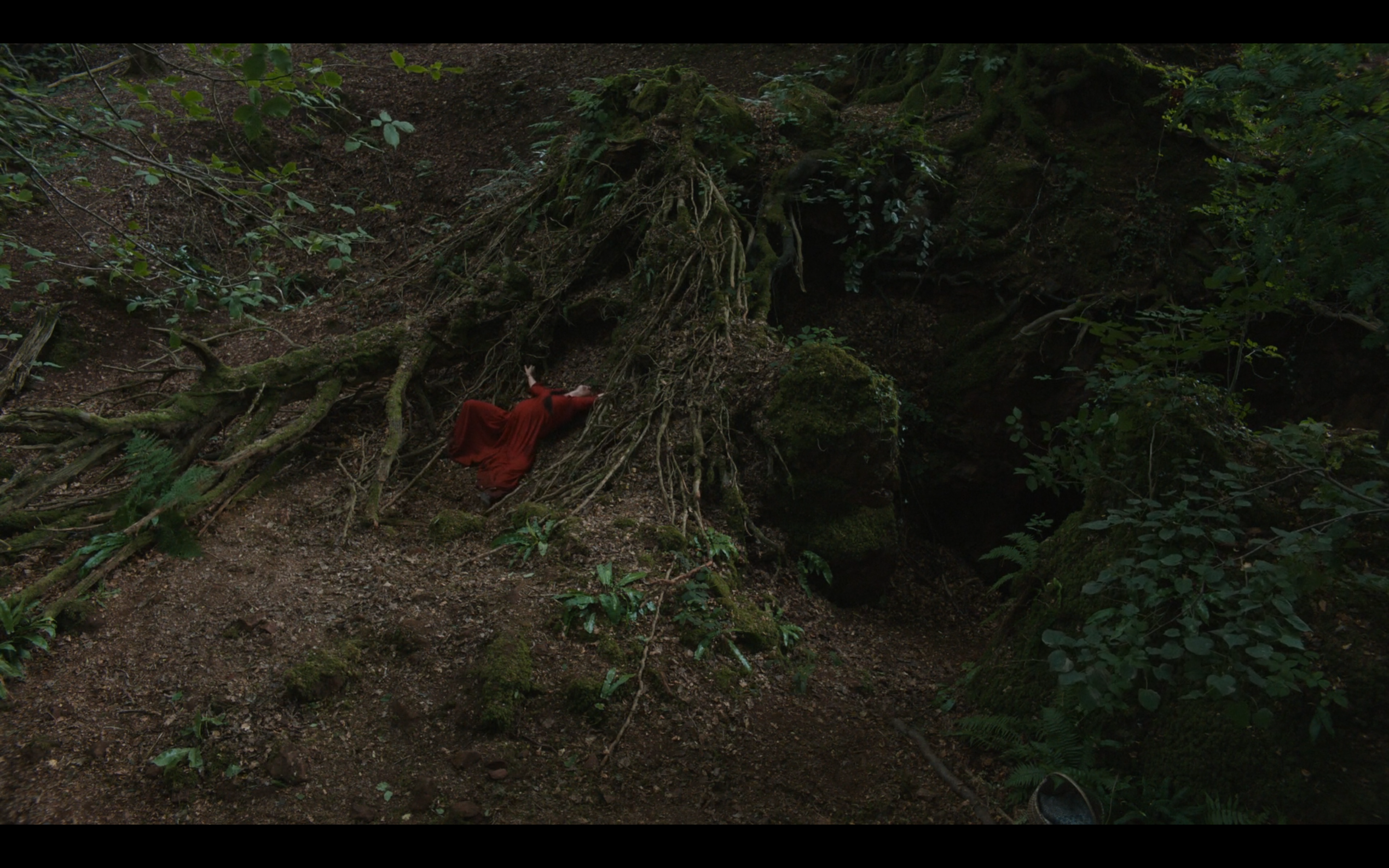
Hamnet começa margeando a desdramatização, com Chloe Zhao mais interessada na composição de enquadramentos e ecos visuais (como os fracassos e frustrações pesando sobre os planos das costas de Shakespeare). A floresta é o espaço que melhor compreende esse primeiro movimento, com Zhao emulando Naomi Kawasi numa visualidade háptica, que, no entanto, se acovarda e retrocede para que o plano culminante desponte — o parto posto em vermelho e vazio entre à floresta verdejante.
O buraco na encosta — o vazio que Agnes vê ou prevê acerca de Shakespeare — é apenas um dos vários simbolismos (paradoxalmente) rasos que vão tomando Hamnet, tal qual a água da chuva que invade a casa no momento em que a bolsa estoura (soprada, talvez, pelo vento do mau-agouro melodramático, pois nem ele escapa da equação). Quando chega ao terceiro ato, o filme já está encharcado. Emoção, dirão alguns, mas eu não descartaria a possibilidade de que os olhos são abertos à fórceps, para ver e para ler.
Segundo ato: tragédia
A composição se aquieta (ou se acanha), uma vez que o punctum agora é o grito, a convulsão, o choro copioso. Desmascarada a desdramatização, o drama se despe em melodrama, ainda que as personagens registrem apenas o traço trágico desse destino incontornável e inconsolável (aparentemente). É o melhor momento da dramaturgia: confinadas a ambientes domésticos áridos, as atuações correm soltas, tendendo ao exagero, mas também a alguma verdade. As trocas entre Agnes e a sogra (que a desdenhava) têm papel importante nesse sentido, já que, do abraço na cadeira de parto à encenação em profundidade no leito de morte, instala-se uma sensorialidade que a protagonista jamais partilha com o marido, peregrino entre as letras e a mimesis. É nesse lar de permanências femininas que a dor transborda com realismo e realidade, completando uma subordinação de orações e ontologias.
Terceiro ato: farsa
Mas o filme precisa redimir Shakespeare e, se o segundo ato é, genuinamente, trágico, o terceiro é uma tragédia — no mau sentido. A impressão é que Zhao assina, mas terceiriza a direção para um Spielberg dos mais piegas. Hamlet entra em cena, emergindo no monólogo de Shakespeare à margem do rio — que deveria ter sido cortado rente ao primeiro “to be…”, nos permitindo mergulhar no vazio e na lacuna — até se materializar na peça, que surge a Agnes como uma possível expurgação. Seria o momento propício para que Jessie Buckey se desvencilhasse da encarnação traumática e acionasse uma interpretação mais imaginativa, baseada numa suposição que a conduziria à despedida do filho morto. No entanto, cabe a ela o papel constrangedor de traduzir as entrelinhas, o subtexto — “Ele tomou o lugar do nosso filho”, Agnes explica ao irmão (e a nós, como se precisássemos), quando Shakespeare (interpretando o Rei Hamlet) descreve a morte do personagem tal como a do filho.
Assim, em Hamnet, a encenação de Hamlet surge como na famosa citação de Karl Marx: a tragédia se repete como farsa, porque, na plateia, Agnes é impedida de imaginar para além do fantasma maquiado e do breve momento em que o filho cruza a porta do cenário (não sem antes derrubar uma lágrima). A transparência é atravancada pelo didatismo dos comentários (não basta ver Hamlet, é preciso explicá-lo) e pelos simbolismos, mais semelhantes à floresta pintada na tapadeira do que a vista no primeiro ato. A catarse fica pelo meio do caminho, assim como a verdade dramática ficou lá pelo meio do filme. Ah, mas, pelo menos, marido e esposa se reconciliam: o olhar dela sugere o perdão ao companheiro ausente e o entendimento de que a dor masculina/paterna é outra. A farsa envenena a tragédia. Sobra o melodrama conciliatório.
Em tempo: no que concerne aos Oscares, Jessie Buckley vai bem, mas sua concorrente, Rose Byrne, tem performance e personagem infinitamente mais complexas em Se Eu tivesse pernas, eu te chutaria. Hamnet, ao menos, é um melodrama mais honesto do que o outro concorrente do gênero, o norueguês Valor Sentimental.
Hamnet
by Álvaro André Zeini Cruz
First act: tableau
Hamnet begins by bordering on de-dramatization, with Chloe Zhao more interested in the composition of frames and visual echoes (such as the failures and frustrations weighing on shots of Shakespeare’s back). The forest is the space that best understands this first movement, with Zhao emulating Naomi Kawase in a haptic visuality, which, however, cowers and retreats so that the culminating shot may emerge — childbirth set in red and emptiness amid the verdant forest.
The hole in the hillside — the void that Agnes sees or foresees about Shakespeare — is merely one of several (paradoxically) shallow symbolisms that take over Hamnet, much like the rainwater that invades the house at the moment her water breaks (blown, perhaps, by the wind of melodramatic ill omen, for not even that escapes the equation). By the time it reaches the third act, the film is already soaked. Emotion, some will say, but I would not rule out the possibility that the eyes are pried open with forceps, to see and to read.
Second act: tragedy
The composition quiets down (or becomes timid), since the punctum now is the scream, the convulsion, the copious weeping. Once the de-dramatization is unmasked, the drama strips down into melodrama, even though the characters register only the tragic trace of this unavoidable and inconsolable fate (apparently). This is the best moment of the dramaturgy: confined to arid domestic settings, the performances run free, tending toward exaggeration but also toward some truth. The exchanges between Agnes and her mother-in-law (who looked down on her) play an important role in this sense, since, from the embrace in the birthing chair to the staging in depth at the deathbed, a sensoriality is installed that the protagonist never shares with her husband, a pilgrim between letters and mimesis. It is in this home of female permanences that pain overflows with realism and reality, completing a subordination of clauses and ontologies.
Third act: farce
But the film needs to redeem Shakespeare, and if the second act is genuinely tragic, the third is a tragedy — in the bad sense. The impression is that Zhao signs her name but outsources the direction to a most mawkish Spielberg. Hamlet enters the scene, emerging in Shakespeare’s monologue by the riverbank — which should have been cut right after the first “to be…”, allowing us to plunge into the void and the gap — until he materializes in the play, which appears to Agnes as a possible purgation. This would have been the opportune moment for Jessie Buckley to free herself from traumatic embodiment and activate a more imaginative performance, based on a supposition that would lead her to bid farewell to her dead son. However, she is given the embarrassing role of translating between the lines, the subtext — “He took the place of our son,” Agnes explains to her brother (and to us, as if we needed it), when Shakespeare (playing King Hamlet) describes the character’s death as that of their son.
Thus, in Hamnet, the staging of Hamlet appears as in Karl Marx’s famous quotation: tragedy repeats itself as farce, because, in the audience, Agnes is prevented from imagining beyond the made-up ghost and the brief moment when the son crosses the door of the set (not without first shedding a tear). Transparency is obstructed by the didacticism of the commentary (it’s not enough to see Hamlet, you have to explain it) and by the symbolisms, more akin to the painted forest on the backdrop than the one seen in the first act. Catharsis is left halfway, just as the dramatic truth was left somewhere in the middle of the film. Ah, but at least husband and wife reconcile: her gaze suggests forgiveness for the absent partner and an understanding that male/paternal pain is different. Farce poisons tragedy. What remains is conciliatory melodrama.
In brief: As far as the Oscars go, Jessie Buckley does well, but her competitor, Rose Byrne, has an infinitely more complex performance and character in If I Had Legs, I’d Kick You. Hamnet, at least, is a more honest melodrama than the other competitor in the genre, the Norwegian Sentimental Value.

