
por Álvaro André Zeini Cruz
Carlito (Al Pacino) reencontra Gail (Penelope Ann Miller) na pista de dança do El Paraiso, boate na qual ele acabara de se tornar sócio, numa transação no fio do bigode. Mulher do passado de Carlito, Gail é vista, mas não o vê; ela tenta levar um figurão para a pista, enquanto Carlito assiste tudo de uma mesa lateral. A própria visão de Carlito é concorrida: Steffie (Ingrid Rogers) vai até ele, insinuante, e dá a deixa — “Nunca vê ninguém de quem goste aqui?”. No contracampo, o olhar de Carlito titubeia entre direcionar-se a essa interlocutora invasiva e a dança de Gail que acontece na profundidade do campo. “Ninguém. Só você, Stef”, ele mente com gentileza.
A cena seguinte impõe o azul violento da tempestade noturna, que contrasta com as luzes aquecidas do clube. A essa altura, a narração de Carlito já nos expôs a relação passada, antes de ele pegar cinco anos de cana por tráfico. O sujeito que a segue agora é outro; ou, ao menos, tenta ser. Assim como Scottie de James Stewart acompanha Judy Barton/Kim Novak pelas ruas como um voyeur audacioso, Carlito segue Gail. Na impossibilidade de acompanhá-la prédio adentro, esse anti-herói vivido por Al Pacino vai ao espaço que Hitchcock inveja — porque não consegue chegar lá — em Janela Indiscreta: a laje do prédio vizinho.
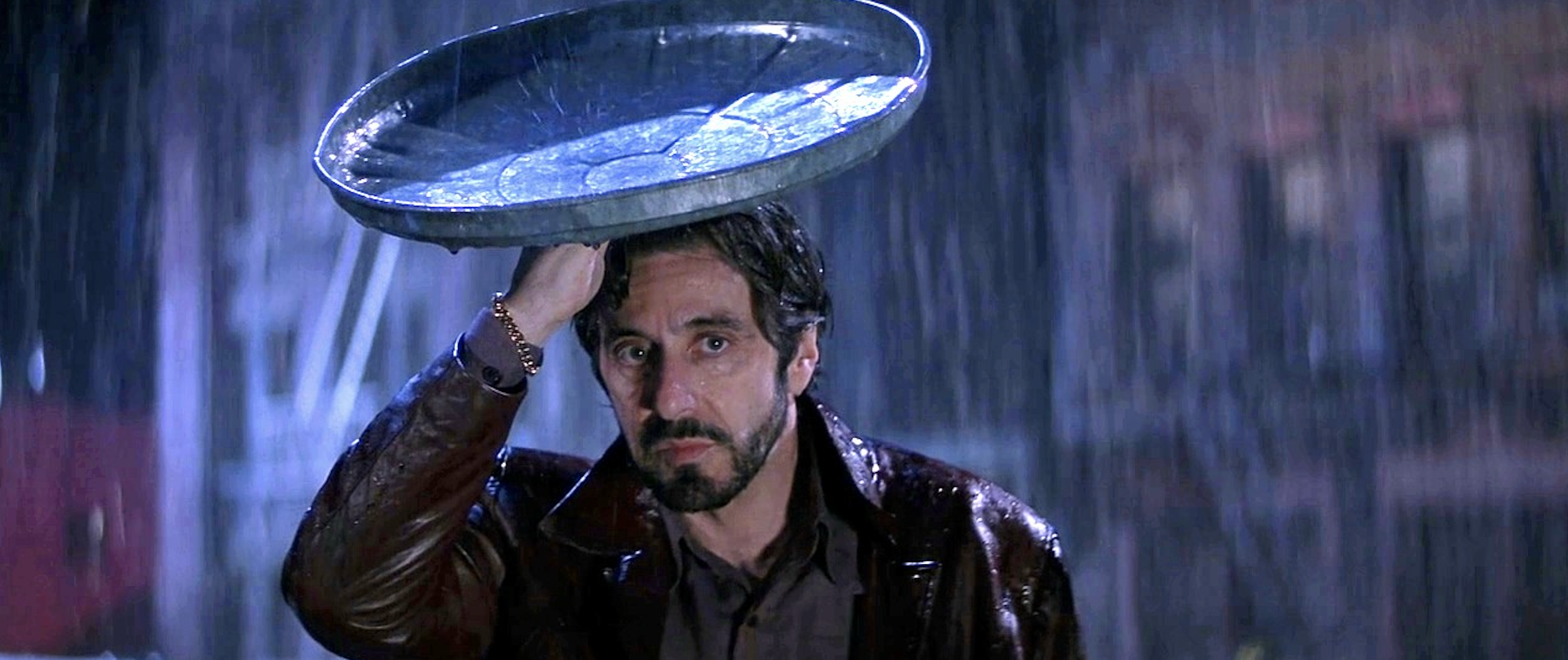
É lá que Carlito apanha a tampa metálica de uma lata de lixo para proteger a cabeça, não para manter-se seco — até porque ele já está ensopado —, mas para aparar a chuva que escorre dos cabelos aos olhos. Com o pedaço de lata posto como uma parabólica, esse homem-antena sintoniza a janela vizinha, onde Gail, de collant e coque no cabelo, e outras moças em movimentos síncronos têm um ensaio de balé. Desta vez, a cor não é o elemento contrastante, e sim a dança — fluida, suave, controlada — contraposta ao movimento contingente das grossas gotas que tornam essa vista ruidosa. A música clássica Duo des Flowers atravessa o vidro da janela para lutar com o ruído da chuva, enquanto, no campo imagético, um dueto de zooms flagra o embasbacamento do sujeito do olhar e reenquadra Gail, cuja dança transmuta do belo ao sublime. Não se trata de uma dança qualquer, mas de uma que, no caso, é milimétricamente ensaiada para anular os movimentos relativos (ainda que a chuva tenha a audácia de desafiá-la), um balé, cuja suavidade dos movimentos não raramente culmina numa pausa, numa brincadeira de estátua. Em um retrato.
A janela de Carlito revela sua Madeleine Ester; não à toa, na cena seguinte, o encontro no restaurante reelabora numa perspectiva espacial espelhada a cena de Vertigo — a câmera, no entanto, segue num travelling entre as cadeiras em direção à mulher de vestido verde. O restaurante é chinfrim, a mesa, apertada, e o vestido, de tecido aveludado aparentemente barato, mas é justamente isso que Carlito quer para essa nova vida em que tenta se redimir. Ficara tão absorto diante da janela que não reparou no simbolismo desse reencontro em que Gail está quase sempre distante, fora do alcance. No encontro seguinte, ela refaz e reitera essa distância, ainda que a dança seja outra: seminua num clube de strip-tease, ela dá de cara com Carlito à beira do palco e, surpreendida, se cobre com a echarpe que tem nas mãos. Então, ela recua ao fundo do palco para, aí sim, virar-se de novo, desta vez não surpresa ou envergonhada, mas provocando-o; jogo que repete quando Carlito vai vê-la em casa. Pela fresta da porta, ela o seduz e o provoca a arrebentar a corrente (que só recai sobre o rosto dele), ainda que ele se diga velho ou “sem gás” para isso. O convencimento vem quando ela, de novo, se afasta e se despe para ser vista não diretamente, mas sobreenquadrada entre a moldura de um espelho.
Um paradoxo se coloca em O Pagamento Final: o desejo corpóreo e a tentativa de uma vida banal se comunicam, mas acabam atravancados por esse jogo de espelhos, em que Gail se recalibra como imagem para que Carlito, de alguma forma, a alcance (mas imagens nunca estão completamente ao alcance). O movimento dela revela o misbehavior dele — a fraqueza de não conseguir se desvencilhar da própria imagem do passado, reconstituída como farsa (distorcida, portanto) pelo personagem de Sean Penn, que o leva de volta ao crime. O destino, portanto, é selado não na intrincada sequência entre trens e estações, mas diante do espelho em que ele e Gail se encaram, enquanto ela vislumbra o futuro (até ser interrompida pelo velho Carlito, que estilhaça o espelho com o próprio punho). A tragédia anunciada se efetiva por um subplot que, de alguma forma, refrata o principal: Carlito é traído por um dos seus, por aquele que acredita ser sua imagem e semelhança. A vista que lhe resta é, ironicamente, a mais banal das janelas contemporâneas: o outdoor de publicidade turística em que ele avista Gail dançando não como um corpo detalhado, mas como uma silhueta estilizada, pequena e distante. Uma Madeleine dos tempos em que a publicidade venceu e as imagens são o mundo.
Carlito’s Gaze
by Álvaro André Zeini Cruz
Carlito (Al Pacino) reencounters Gail (Penelope Ann Miller) on the dance floor of El Paraiso, a nightclub in which he has just become a partner, in a deal hanging by a thread. A woman from Carlito’s past, Gail is seen but does not see him; she tries to drag a big shot onto the floor, while Carlito watches it all from a side table. Carlito’s own vision is contested: Steffie (Ingrid Rogers) goes up to him, insinuatingly, and gives the cue — “Never see anyone you like here?” In the reverse shot, Carlito’s gaze wavers between directing itself toward this intrusive interlocutor and Gail’s dance taking place in the depth of the field. “No one. Just you, Stef,” he lies gently.
The next scene imposes the violent blue of the night storm, which contrasts with the heated lights of the club. By this point, Carlito’s narration has already exposed their past relationship to us, before he did five years for drug trafficking. The man who follows her now is another; or, at least, tries to be. Just as James Stewart’s Scottie follows Judy Barton/Kim Novak through the streets as a bold voyeur, Carlito follows Gail. Unable to follow her into the building, this anti-hero played by Al Pacino goes to the space that Hitchcock envies — because he cannot get there — in Rear Window: the rooftop of the neighboring building.
It is there that Carlito grabs the metal lid of a garbage can to protect his head, not to keep himself dry — especially since he is already soaked — but to ward off the rain dripping from his hair into his eyes. With the piece of metal positioned like a parabolic antenna, this man-antenna tunes into the neighboring window, where Gail, in a leotard and hair bun, and other women in synchronous movements are having a ballet rehearsal. This time, color is not the contrasting element, but rather the dance — fluid, smooth, controlled — counterposed to the contingent movement of the thick raindrops that make this view noisy. The classical piece Duo des Fleurs crosses the windowpane to wrestle with the noise of the rain, while, in the image field, a duo of zooms captures the protagonist’s dazed expression and reframes Gail, whose dance transmutes from the beautiful to the sublime. This is no ordinary dance, but one that, in this case, is meticulously rehearsed to nullify relative movements (even though the rain has the audacity to challenge it), a ballet, whose smoothness of movement not infrequently culminates in a pause, a game of statues. In a portrait.
Carlito’s window reveals his Madeleine Elster; not for nothing, in the next scene, the encounter at the restaurant re-elaborates, in a mirrored spatial perspective, the scene from Vertigo — the camera, however, follows in a tracking shot between the tables toward the woman in the green dress. The restaurant is seedy, the table is cramped, and the dress is of apparently cheap velvety fabric, but that is precisely what Carlito wants for this new life in which he tries to redeem himself. He had become so absorbed before the window that he did not notice the symbolism of this reunion in which Gail is almost always distant, out of reach. In the next encounter, she redoes and reiterates this distance, even though the dance is different: semi-nude in a strip club, she comes face to face with Carlito at the edge of the stage and, surprised, covers herself with the scarf she has in her hands. Then she retreats to the back of the stage only to turn around again, this time not surprised or ashamed, but provoking him; a game she repeats when Carlito goes to see her at home. Through the crack in the door, she seduces him and provokes him to break the chain (which only falls back on his face), even though he claims to be old or “out of gas” for that. The persuasion comes when she, again, steps back and undresses to be seen not directly, but over-framed within the frame of a mirror.
A paradox arises in Carlito’s Way: bodily desire and the attempt at a banal life communicate, but end up obstructed by this game of mirrors, in which Gail recalibrates herself as an image so that Carlito might, somehow, reach her (but images are never completely within reach). Her movement reveals his misbehavior — the weakness of being unable to shake off his own image of the past, reconstituted as a farce (and thus distorted) by Sean Penn’s character, who leads him back into crime. Destiny, therefore, is sealed not in the intricate sequence between trains and stations, but before the mirror in which he and Gail face each other, while she glimpses the future (until she is interrupted by the old Carlito, who shatters the mirror with his own fist). The announced tragedy comes to pass through a subplot that, somehow, refracts the main one: Carlito is betrayed by one of his own, by the one he believes to be his image and likeness. The view that remains for him is, ironically, the most banal of contemporary windows: the tourist advertising billboard on which he spots Gail dancing not as a detailed body, but as a stylized silhouette, small and distant. A Madeleine for times when advertising has won and images are the world.

