
por Álvaro André Zeini Cruz
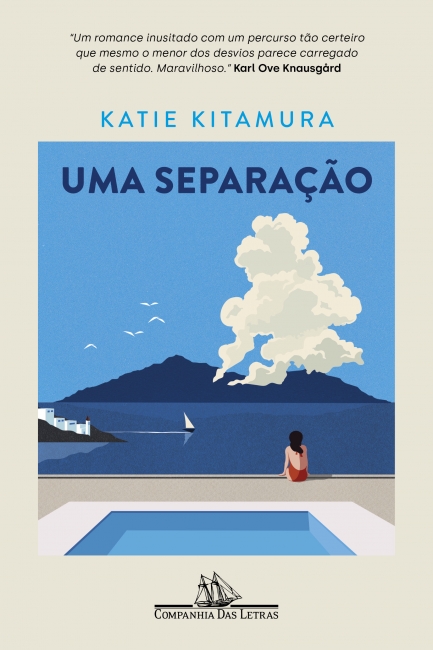
Uma mulher narra sua inesperada ida à Grécia. Ela parte à procura do ex-marido depois de um telefonema da sogra, Isabella, que não sabe da separação dos dois. Havia sido um pedido de Christopher que o fim do casamento fosse mantido em segredo; agora, ele estava desaparecido no destino paradisíaco onde, ao menos aparentemente, pesquisava seu próximo livro. Pressionada por um status matrimonial que só persiste socialmente, esta narradora sem nome deixa o novo companheiro e os novos rumos de sua vida e parte para buscar esse passado ainda próximo num luxuoso e esvaziado hotel em meio a uma ilha que acabara de ser incendiada.
Christopher é autor de um livro só, mas, ainda assim, de relativo sucesso; a protagonista é tradutora, profissão que, segundo ela, é marcada pela passividade e pela invisibilidade – “[…] tradutora ou médium, tanto uma como outra teriam sido profissões perfeitas para mim”, diz a certa altura. Nesse sentido, a invisibilidade dessa mulher é uma questão contraditória, já que, além de narradora autodiegética (que narra e protagoniza a narração), ela baliza um discurso indireto livre que, não contente em se apropriar das falas alheias, parte delas para fazer as imensas digressões que expõem a subjetividade dessa personagem e dão corpo à dilatação desconfortável do romance. É nesse embaralhamento de ações (pequenas), acontecimentos e pensamentos que a trama se dilata num suspense atmosférico, em que o espaço – ironicamente quase todo transformado em fumaça e pó – abriga o conflito que orbita a invisibilidade oposta à protagonista: Christopher, figura imaterial, mas paradoxalmente assentada pelas palavras da narração e concretizada no resort, espaço que serve de extensão, especulação e memória.
Uma ambiguidade emerge dessa trama de casamento que se dá a partir de um ponto de vista só: embora a narração seja evidentemente parcial, a narradora vai passando por uma epifania processual, uma gradual tomada de consciência de que pouco, quase nada, sabia sobre o antigo companheiro. Essa consciência perturbadora desponta indiretamente quando, por exemplo, ela fala da escolha dele pelo resort: “Christopher gostava de acomodações luxuosas, e luxo e romance são praticamente sinônimos para certos tipos de pessoa – e isso me deixava inquieta”. Ainda mais contundentes são duas passagens, distantes no texto, que se contrapõem: se num primeiro momento ela conta que Christopher “distribuía seu charme tão generosamente que corria o risco de esgarçá-lo”, mais adiante, diz que o ex “era um homem charmoso, e o charme é feito de superfícies – todo homem charmoso é um impostor”. Se o esgarçamento é a dilatação de uma determinada matéria até que ela perca sua malha e se rompa, revelando assim as camadas mais profundas, por outro lado, a manutenção da ideia da superfície como uma camada impostora revela que, embora os poros estivessem evidentes e constatados, a relação entre ela o marido permanecera no raso, no nível da farsa. A culpa? Dos dois, de algum, de nenhum? Pouco importa, uma vez que, embora a ruptura primordial aqui envolva um casamento, esta não é a separação que sustenta, atravessa e rasga o romance de Katie Kitamura.
Pois se num primeiro momento a personagem não tem pressa de encontrar o ex-marido – aproveitando o tempo para conviver com os locais, colhendo pequenos relatos e, a partir disso, alimentando hipóteses acerca do homem que nunca apareceu a ela –, a chegada de dois personagens faz com que sinta a necessidade de deixar o terreno da imaginação supositiva. É chegado o momento em que a narradora precisa de fatos. Mas os fatos pragmáticos, aqueles que se revelam como verdades propulsoras das decisões, das superações, não vem; só o que se apresenta à protagonista é a vida como espaço-tempo da ignorância e dos enigmas, da vista esfumaçada que turva as aparições e desaparecimentos, dos solavancos que fazem com que as viagens sejam movimentos disformes, com tangenciamentos, sincronicidades breves, mas marcados principalmente pelas separações, essas sim, fatídicas. A tradutora, que não mais consegue decifrar seus próprios sentimentos, é alçada ao entendimento de que a autoria é inescapável, uma vez que só o que resta é elucubrar sobre a própria passividade, conjecturar sobre a inevitável submissão aos mistérios.
A Separation by Katie Kitamura
by Álvaro André Zeini Cruz
A woman narrates her unexpected trip to Greece. She sets off in search of her ex-husband after a phone call from her mother-in-law, Isabella, who is unaware of their separation. It had been Christopher’s request that the end of their marriage be kept a secret; now, he was missing from the paradisiacal destination where, at least apparently, he was researching his next book. Pressured by a marital status that only persists socially, this unnamed narrator leaves her new partner and the new directions of her life behind and sets out to find this still-recent past in a luxurious and empty hotel on an island that had just been ravaged by fire.
Christopher is the author of only one book, but nonetheless a relatively successful one; the protagonist is a translator, a profession which, according to her, is marked by passivity and invisibility – “[…] translator or medium, either one would have been the perfect profession for me,” she says at one point. In this sense, this woman’s invisibility is a contradictory issue, since, besides being an autodiegetic narrator (one who narrates and stars in the narration), she marks out a free indirect discourse that, not content with appropriating the speech of others, uses it as a springboard for the immense digressions that expose this character’s subjectivity and give shape to the novel’s uncomfortable expansion. It is in this blurring of (minor) actions, events, and thoughts that the plot expands into an atmospheric suspense, in which the space – ironically almost entirely transformed into smoke and ash – harbors the conflict that orbits the invisibility opposite the protagonist: Christopher, an immaterial figure, but paradoxically grounded by the words of the narration and made concrete in the resort, a space that serves as extension, speculation, and memory.
An ambiguity emerges from this plot of marriage, presented from a single point of view: although the narration is evidently partial, the narrator undergoes a gradual epiphany, a growing awareness that she knew little, almost nothing, about her former partner. This disturbing awareness emerges indirectly when, for example, she speaks of his choice of the resort: “Christopher liked luxurious accommodations, and luxury and romance are practically synonymous for certain types of people – and that made me uneasy.” Even more striking are two passages, distant in the text, that contrast with each other: if at first she tells us that Christopher “dispensed his charm so generously that he risked fraying it,” later she says that her ex “was a charming man, and charm is made of surfaces – every charming man is an impostor.” If fraying is the stretching of a certain material until it loses its weave and tears, thus revealing deeper layers, on the other hand, the maintenance of the idea of the surface as an imposturous layer reveals that, although the pores were evident and confirmed, the relationship between her and her husband remained on the surface, at the level of farce. Whose fault? Both, one, neither? It matters little, since, although the primary rupture here involves a marriage, this is not the separation that sustains, permeates, and tears through Katie Kitamura’s novel.
For if at first the character is in no hurry to find her ex-husband – taking the time to interact with the locals, gathering small stories and, from them, fueling hypotheses about the man who never appeared to her – the arrival of two characters makes her feel the need to leave the terrain of suppositional imagination. The moment arrives when the narrator needs facts. But pragmatic facts, those that reveal themselves as truths that propel decisions and overcoming, do not come; all that presents itself to the protagonist is life as the space-time of ignorance and enigmas, of the smoky view that blurs appearances and disappearances, of the jolts that make journeys into formless movements, with tangents, brief synchronicities, but marked mainly by separations – these, indeed, fateful. The translator, who can no longer decipher her own feelings, is elevated to the understanding that authorship is inescapable, since all that remains is to elaborate on her own passivity, to conjecture about the inevitable submission to mysteries.
 Pós-créditos