
por Álvaro André Zeini Cruz
Boa parte do episódio 7 da quarta temporada de The Bear acontece debaixo da mesa de doces de um casamento. Isso porque a filha de Richie (Ebon Moss-Bachrach) se enfia ali para se desvencilhar da dança na festa da mãe e do padrasto; a tentativa carinhosa dos adultos de desvelarem a menina acaba se tornando uma terapia coletiva, onde todos abrem seus medos sob essa inesperada redoma de pano.
Seguindo uma tradição de outras temporadas, o episódio é uma espécie de longa que retira os personagens de The Bear da cozinha do restaurante, obrigando-os a confrontarem uma comunidade estendida de familiares e amigos que escapam à gastronomia. Antecipa e ecoa o season finale, onde essa verbalização dos medos se torna promessa de ação e coloca esse microcosmo de regras, procedimentos e sacrifícios em fervura.
O Adeus — nome do episódio — começa com Syd (Ayo Edebiri) às voltas com a notícia de que Carmy (Jeremy Allen White), com quem mantém uma relação de sociedade e mentoria mútua, pretende deixar o restaurante. Ela própria cogitou deixá-lo ao longo da temporada, mas a lealdade a fez ficar e a faz, agora, sentir-se traída. Carmy não demora a aparecer nesse galpão dos fundos, confinamento áspero bem diferente das paredes feitas de toalhas de mesa no episódio 7. Inicia-se então o confronto vococêntrico em que as vozes — as tentativas de cobrança e de explicação — se sobrepõem, numa tensão que assombra toda a cena. Mais do que nunca esse é um episódio de atores e da energia que eles dispõem ao encontrar/encarar o outro (ator e personagem), às vezes, esvaziando-se a si mesmos.
Os planos se alongam e se despojam de qualquer meticulosidade composicional, deixando para trás o voyeurismo clássico e a estilização maneirista. A mise en scène se dá na busca pela ação bruta — às vezes brutal, ainda que nas palavras —, permitindo entender que olhar não significa ver o todo, e que o extracampo não significa ausência; pelo contrário, contém e promete presenças. A câmera oscila em correções orgânicas nessa disputa entre argumentos e rostos, nesse espaço em que nada é degustado a não ser o amargor do cigarro, que, em algum momento, fará Syd tossir.
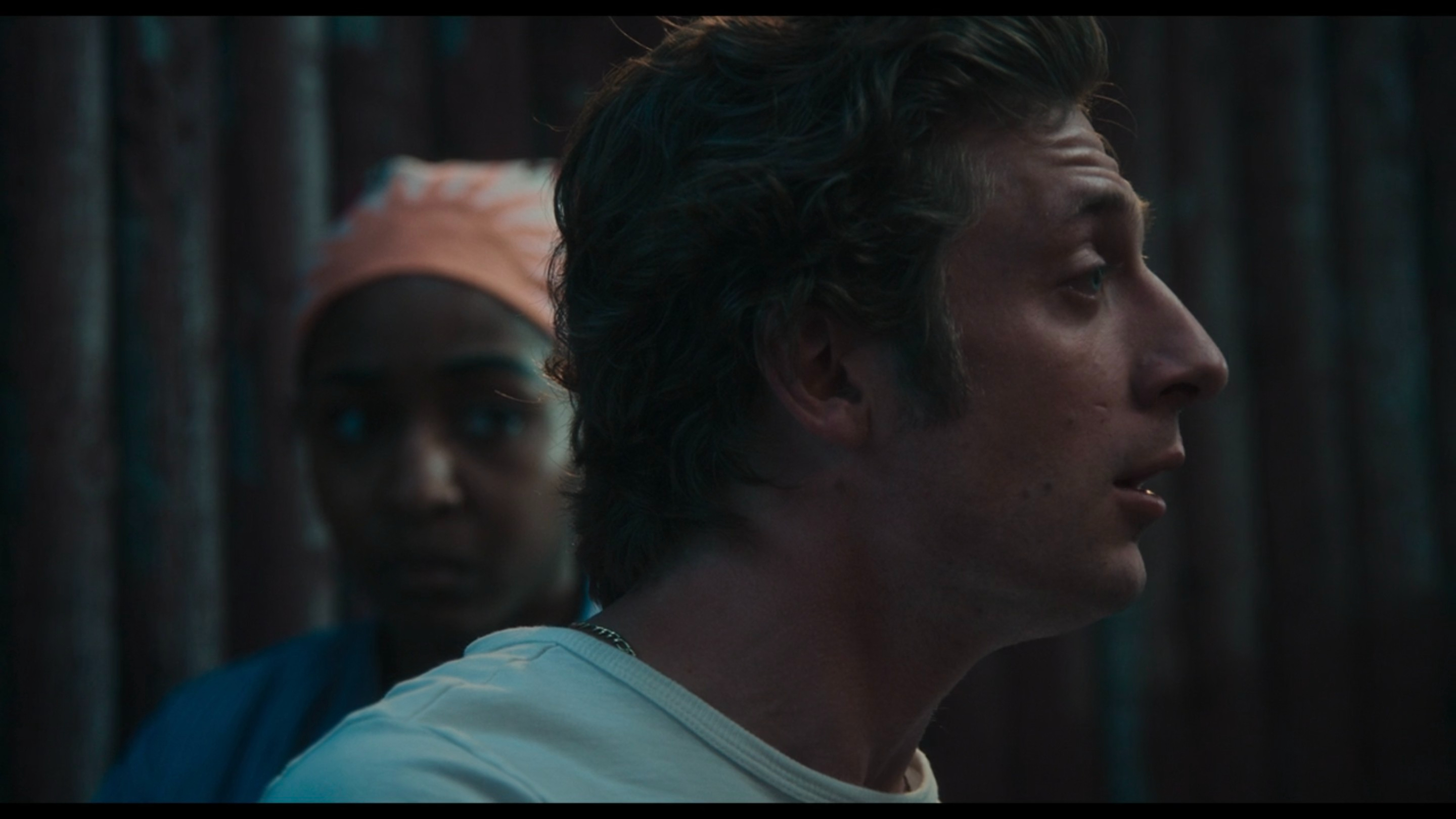
O drama escala e a ação se redistribui numa marcação triangular quando Richie entra em cena e recebe a notícia. O caldeirão de mágoas faz emergir um trauma da vida pregressa desses dois primos, enquanto Syd se resigna a ouvir, olhar e digerir, mesmo de estômago vazio, só com esse cigarro com o qual não sabe lidar. Enquadrada sob uma angulação de 45°, ela é sempre a face mais exposta da cena, talvez porque — como reconhece o próprio Carmy — seja um ser mais humano, um humano melhor do que ele. Tanto Carmy quanto Richie são rostos ao meio durante boa parte da ação, perfis que entregam o mínimo para que se saiba que se tratam de sujeitos eclipsados, repletos de esconderijos internos (e é desconcertante ver a expressão de Syd, mesmo desfocada ao fundo de Carmy, sublinhada pela nuca dele, que ativa um jogo de velar e desvelar). O diálogo se dilata a ponto de Carmy confessar o que Robert McKee colocaria na esfera do indizível, isto é, o impronunciável encerrado nas profundezas do personagem — ele não sabe quem é para além da persona que perfoma como chef de cozinha.
O entorpecimento de Carmy é contraposto à fúria/frustração de Richie e à sensibilidade de Syd neste episódio árido, de culminância das verdades — cozinhar camufla, cansa e consome. Nesse sentido, dom e esforço se conjugam numa única farsa de alienações, que apontam pequenas tragédias cotidianas, num tempo (ou a uma geração) em que não há promessa de mundos futuros, tampouco louros de dias passados. A pergunta que se instala é: é possível fazer arte, atingir em cheio o sensível alheio, quando não se sente nada? A resposta vem de Syd, que, em sua demanda para seguir — ela não quer, ela precisa de Nat e Richie —, rebate Sartre: o inferno são os outros, mas outros são precisos para que sobrevivamos ao inferno de nós mesmos. Num de seus episódios menos palatáveis, a comédia The Bear lembra que existir é engolir o amargo de cada dia, digerindo-o a palo seco.
The Bear, the tragedy
by Álvaro André Zeini Cruz
Much of episode 7 of The Bear‘s fourth season takes place under the dessert table at a wedding. That’s because Richie’s (Ebon Moss-Bachrach) daughter crawls under there to escape dancing at her mother and stepfather’s celebration; the adults’ tender attempt to coax the girl out ends up turning into a kind of group therapy, where everyone opens up about their fears under that unexpected cloth dome.
Following a tradition from previous seasons, the episode plays like a kind of standalone feature that pulls The Bear‘s characters out of the restaurant kitchen, forcing them to face an extended community of family and friends outside the world of food. It anticipates and echoes the season finale, where this verbalizing of fears turns into a promise of action and brings this whole microcosm of rules, procedures, and sacrifices to a boil.
The Goodbye — the episode’s title — opens with Syd (Ayo Edebiri) grappling with the news that Carmy (Jeremy Allen White), her partner in both business and mutual mentorship, plans to leave the restaurant. She herself had considered leaving at points throughout the season, but loyalty kept her there, and now that same loyalty makes her feel betrayed. Carmy soon shows up in that back storage room, a harsh, confined space quite different from the walls made of tablecloths in episode 7. What follows is a voice-centered confrontation in which the voices — the attempts to hold each other accountable, to explain — pile on top of one another, in a tension that haunts the entire scene. More than ever, this is an episode about actors and the energy they bring to meeting/facing the other (actor and character), at times emptying themselves out completely.
The shots stretch out and shed any compositional meticulousness, leaving behind the classic voyeurism and mannerist stylization of earlier episodes. The mise-en-scène here chases raw — at times brutal, if only in words — action, making clear that to look is not to see the whole, and that off-screen space doesn’t mean absence; on the contrary, it holds and promises presences. The camera shifts in organic corrections through this clash of arguments and faces, in a space where nothing is savored except the bitterness of the cigarette that, at some point, makes Syd cough.
The drama escalates and the action redistributes itself into a triangular blocking as Richie enters and receives the news. The cauldron of resentment brings up a long-buried trauma between the two cousins, while Syd resigns herself to listening, watching, and digesting it all, even on an empty stomach, with nothing but that cigarette she doesn’t know how to handle. Framed at a 45-degree angle, she’s always the most exposed face in the scene, perhaps because — as Carmy himself admits — she’s a more human being, a better human than he is. Both Carmy and Richie spend much of the scene in half-shadowed faces, profiles that give away just enough to signal they’re eclipsed subjects, full of internal hiding places (and it’s unsettling to see Syd’s expression, even out of focus in the background behind Carmy, underscored by the back of his neck, which sets off a game of concealing and revealing). The dialogue stretches out to the point where Carmy confesses something Robert McKee would place in the realm of the unspeakable — the unutterable, locked deep inside the character — he doesn’t know who he is beyond the persona he performs as a chef.
Carmy’s numbness stands in contrast to Richie’s fury/frustration and Syd’s sensitivity in this stark episode, a culmination of hard truths — cooking disguises, exhausts, and consumes. In this sense, talent and effort merge into a single farce of alienation, pointing to small everyday tragedies, in a time (or a generation) with no promise of future worlds, nor any glory from days gone by. The question that settles in is: can you make art, can you truly hit someone else’s feelings, when you feel nothing yourself? The answer comes from Syd, who, in her need to keep going — she doesn’t want, she needsNat and Richie — pushes back against Sartre: hell is other people, but other people are necessary if we’re to survive the hell of ourselves. In one of its least palatable episodes, the comedy series The Bear reminds us that to exist is to swallow the bitterness of each day, choking it down dry.

