
por Álvaro André Zeini Cruz
(English translation below the original text)
No subterrâneo de Hawkins, Indiana, a cidade é espelhada num upside down, produzindo uma réplica quase idêntica, diferenciada apenas pela atmosfera azul-rançosa e pelos tentáculos dúbios (pertencem ao reino animal ou vegetal?), que se esgueiram pelas superfícies. É dessa reconstituição sombria que emergem os monstros — corpos antropomorfizados e cabeças de flores carnívoras, conjugando, num só ser, pisantes e enraizados, duas relações com a pele do mundo. Demogorgons são as criaturas que perfuram portais e escapam para essa cidade-pastiche, lugar-comum do enraizamento do melodrama (Vidor, Sirk, Minnelli) ao trânsito do insólito (King, Spielberg, Burton, Carpenter, Dante, Lynch). Não se trata exatamente de um novo destino: Hawkins é essa cidadela re-conhecida por imagens cinematográficas e televisivas, existente entre variações que corroboram a moral burguesa (“meet me in St. Louis, Louis…”), que negociam hegemonia e contracultura (E.T.) ou que produzem retratos mais insurgentes (Gremlins, Edward Mãos de Tesoura, Twin Peaks).
É por esse fim de mundo — Frankenstein espacial, que costura retalhos dos Estados Unidos interiorano e suburbano — que o mundo começa a acabar. Mais especificamente, pela pele. O solo é a pele, o limiar que separa o mundo de superfícies genéricas — lares, escolas, praças e hospitais, popularizados pela reprodutibilidade técnica do cinema hollywoodiano — e o submundo grotesco que impregna esses espaços terrenos da comédia e do melodrama com uma aura sobrenatural. O mesmo chão que alicerça a cidade — película de uma normalidade adulta, cristalização do american way of life — esconde mistérios inimagináveis, que contornam o mundo adulto para assombrar primeiro a infância. Poderia ser a Derry da série vizinha (e, de certa forma, é, já que a sombra de IT é tão forte quanto a de E.T.), mas a camada que diferencia esses mundos tem maior importância, é a chave que estabelece um duplo por toda a série, maleabilizando o limiar entre sonho e pesadelo.
Porque se, como nos ensina Antonio Candido, o sonho é inalienável à natureza humana, é também verdade que ele assume diferentes formas na infância e na idade adulta. Aos últimos, o sonho indomado é quase sempre inerente ao sono, restando ao sonhar acordado a autorregulação pragmática do que é possível, o que, no caso americano (e ocidental), tem como recorrência o paraíso terrestre do lar tranquilo, ocupado por vidas domésticas de pequenos causos e grandes coisas (no sentido material). Contra esse sonho conformado, coloca-se o sonho desenfreado, criado pela imaginação infantil, mais afeita à ideia sartreana da imaginação como ato, como tipo de consciência e não como mera produtora de imagens, de cópias das coisas. A propensão em criar aquilo que inexiste, em agir em prol do fantástico possibilita que essa imaginação crie sínteses daquilo que os adultos desviam ou recalcam: o mal existe porque nos é subcutâneo. O inferno são os outros, e a infância reelabora essa subconsciência não como cópia, mas como um horror peculiar e particular encarnado — monstros. É a partir dessa divisão entre a imagem-ação e a imagem-cópia que se distribui o duplo entre Will (Noah Schnapp) e Eleven (Millie Bobby Brown), a criança raptada e a restituída, a que compartilha a mente e a que compartilha o sangue do monstro, a que expande mundos e a que os intercomunica.
A bíblia de Stranger Things diz que Eleven é o E.T. de Spielberg, a criatura que, com poderes sobrenaturais, dá forma e força ao que antes orbitava entre o tabuleiro e as campanhas, sonhos compartilhados por Mike (Finn Wolfhard), Dustin (Gaten Matarazzo), Lucas (Caleb McLaughlin) e Will. Ela vem não de outro mundo (ainda que, agora, saibamos que seu poder deriva de Henry e, consequentemente, da rocha que caiu do espaço), e, sim, de um laboratório de ficção científica, onde tentavam, justamente, canalizar seu poder de telecinese, controlando a transmutação das imagens mentais em ações. Ela escapa quando Will é aprisionado, ou Will é aprisionado porque Eleven escapa: Eleven abre portais, cortes e cicatrizes sobre a pele do mundo, enquanto Will é levado para arquitetar túneis, construir os vasos que ampliam isso que, descobrimos há pouco, é um buraco de minhoca, estrutura que interliga o mundo das coisas (as concretizações da racionalidade humana) ao abismo da irracionalidade, do caos, do mal. A sina dessas duas crianças é operarem iludidas por uma antítese entre força e fraqueza, baseada, paradoxalmente, numa única culpa: a crença de que as imaginações indomadas são desvios (do que se é, do que se teme) que liberam monstros. No entanto, seja pela ação factual ou pela imagin-ação (imagem + ação), a monstruosidade é, primordialmente, humana: Henry (Jamie Campbell Bower) nos mostra que ela pode ser uma aparição oportunista, mas é também uma escolha persistente que, contrariando a nova leva dos filmes Disney, nem sempre tem redenção. Para suprir a falha natureza humana, Henry se deixa apossar por um mal inumano. Cresce, é transformado na experiência “1”, mas descobre que aquela que deveria ser sua réplica (numérica, inclusive, dois “1” emparelhados) não é mera imagem: 11 age e bane 1 ao abismo. Lá, ele se duplica: na memória, essa imagem mental permanece como o esguio e excêntrico Henry; na materialidade do corpo, torna-se uma criatura antromorfizada, mistura de Freddy Krueger (de A Hora do Pesadelo) com Lord Zed (da série Power Rangers), que ora parece constituído de músculos à mostra, ora de viscos lovecraftianos. Uma coisa é certa: na transformação, corrói-se a pele.
Vecna é revelado na 4ª temporada; justamente quando a adolescência desponta, esse vilão slasher surge para assassinar adolescentes traumatizados, usando essas fissuras emocionais-psicológicas para produzir um trauma físico maior — partir a crosta terrestre que sustenta Hawkins, iniciando seu plano de costurar as peles dos dois mundos. Em mais de uma oportunidade, Vecna diz que o sequestro de Will e das demais crianças (nesta 5ª temporada) se explica por elas terem mentes frágeis e influenciáveis; uma mentira que esconde o fato de que ele busca a força dessas imaginações irrestritas — o homem-monstro precisa de Will para criar túneis; de Holly, Derek (Jake Connelly) e os outros para mover os mundos. É também do grupo de crianças/adolescentes que surgem as grandes ideias para a derrocada do Mal: numa inversão do jogo, Max (Sadie Sink) e Holly (Nell Fisher) exploram os labirintos da memória de Henry/Vecna; de Lucas, vem a ideia de “fritar” um demogorgon para que Will acesse a mente de Vecna; de Dustin, a descoberta dos mundos sustentados por buracos de minhoca; de Steve (Joe Keery), o insight de usar a antena da estação de rádio como uma agulha hipodérmica, meio de transporte/comunicação para a propagação da mensagem/ação final ao reino do abismo. Joyce (Winona Ryder), a mãe que se comunicava pelas luzes dos pisca-piscas, primeira não-infante a crer na materialidade desse mundo de Dungeons & Dragons, é a única adulta admitida nessa incursão final, em que a derradeira batalha, de novo, se dá pelo duplo.
Quando a cripta se revela carne final do Devorador de Mentes, Vecna indica uma relação de simbiose entre sua monstruosidade mista (parte humana, parte insólita) e a da criatura sobrenatural. É no âmago do monstro — espécie de Caverna de Platão, onde as crianças são mantidas imersas em imagens — que Vecna e Eleven travam a batalha entre o vilão disforme e a heroína que o “depelou”. Invisível aos olhos, dá-se, portanto, a luta daqueles cujos poderes produzem erupções, enquanto, do lado de fora, a “mente colmeia” é enfrentada por um heroísmo baseado na alteridade, no compartilhamento das ideias e tarefas, no ataque conjugado entre a imaginação infantil e a rebeldia adolescente, ambas pulsando um “coração colmeia”; não à toa, a caminhada pelo desfiladeiro oportuniza que palavras importantes sejam ditas, bem como pistas ao enfrentamento que se aproxima (a aliança entre o sinalizador de Mike e o estilingue de Lucas). Montada em paralelo, a ação encadeia uma costura causal entre a barriga da baleia e carapaça do Kaiju, num combate que produz grandes imagens, mas cujo tempo emocional se assemelha à construção conceitual dada por David Yates à conclusão da série Harry Potter: diante desse heroísmo coletivo, a derrocada do horror é uma consequência mais natural do que sobrenatural. Os golpes finais veem, de novo, pelo duplo, das mãos da família perturbada: primeiro, Will, o Feiticeiro, invade a mente de Vecna para concluir a ação de Eleven sobre o corpo monstruoso, perfurando-o com um espinho da própria besta-caverna que o estende. Depois, cabe a Joyce, a mãe, desconjuntar a criatura, decapitando Vecna, atacando, de uma só vez, pele e mente, matéria palpável e força insólita. Quando a cabeça rola, o coração do monstro para e petrifica. Resta ainda cerca de uma hora até que Heroes soe nos créditos finais de Stranger Things.
A derrocada desse Mal supremo no meio do episódio pode parecer estranha, mas Stranger Things entende que o espetáculo por espetáculo (herdeiro de um cinema de atrações) já está bem representado pela Marvel, DC e cia; sua fonte é outra, é de um cinema com epiderme espetacular e musculatura narrativa. Se ao longo das cinco temporadas, a série dos irmãos Duffer criou imagens extraordinárias — entre a fantasia, a ficção científica e o horror — cada vez mais tímidas no cinema hollywoodiano atual (Max levitando em transe, Will possuído, o show de rock de Eddie [Joseph Quinn], Dustin cantando Neverending Story), elas não configuram exibicionismos soltos ou isolados, mas cenas e sequências alicerçadas numa narrativa mais atenta até nas relações e afetos entre personagens do que na articulação dos eventos (e se, por um lado, a acusação de reciclagem de conflitos é legítima, por outro, dá forma a uma trama de desafios negociados entre a reiteração e a progressão, típicos de narrativas infantis como A História sem Fim e Ponte para Terabítia). É preciso, portanto, dar os devidos fins — com os tempos precisos — e lidar ainda com um mal sem fim: sob a película de uma normalidade americana, corre um pulso bélico, que se reconfigura em slogans como Make America Great Again. Se Dra. Kay (Linda Hamilton) é uma personagem plana é porque ela não demanda complexidade, é mera alegoria da eficiência e sanha estadunidense em converter forças e promessas em armas. Nesse sentido, o sacrifício de Eleven vem da compreensão da existência sociocultural dessa outra “mente colméia”, produtora de mitoses implacáveis como Dr. Kay e Dr. Brenner (Matthew Modine), figuras capazes de explorar sangue, ventres e infâncias em prol de guerras quentes e frias.
Eleven segue o destino sugerido por Kali (Linnea Berthelsen), não sem antes se despedir de Mike — ao som de Purple Rain — naquele espaço mental feito de fundo preto infinito e uma superfície refletora úmida, tal qual no filme de Jonathan Glazer, intitulado… Sob a Pele. É nesse lugar de conexões mentais e emocionais que o rapaz perde a namorada, e o garoto se despede da heroína, esse E.T. cuja infância arruinada proveu a tantas outras a aventura da crença. Quando a roda de jovens regride à infância e encerra uma última campanha de D&D, Max questiona “é só isso? Conforto e felicidade?” e se indigna com o final típico do melodrama — “mais clichê impossível”. Ela desafia Mike, o contador de histórias, que, então, os convida a uma última especulação: aquela que os tira da conformidade melodramática adulta e restaura um regime de imagin-ação supositiva ligada à fantasia infantil — ele jura que esse epílogo é uma história real incontável, mas todos os narradores juram esse tipo de coisa, e a regressão ao tabuleiro da infância não ajuda a confiar a narração ao terreno do factual. Pouco importa: ainda que a peripeteia narrada seja improvável (teria Kali sobrevivido por tanto tempo para produzir a ilusão que liberta a irmã?), o ato derradeiro cabe aos ouvintes, restando a Lucas, Dustin, Max e Will vincular imaginação e crença à narração que imagina um final feliz a Eleven — numa localidade longínqua, distante dos perigos da “Mão Sombria” (esse Estados Unidos que, na ficção, assombra suas pequenas cidades, como Hawkins), a salvo dessa felicidade de interiores e subúrbios assentados sobre masmorras e dragões.
Escrachado numa contemporaneidade que consome narrativas — cobrando delas a velocidade da informação e a satisfação do produto —, o final de Stranger Things pontua uma narrativa que parece um corpo estranho dentro de um streaming que — cada vez mais, acredito — odeia o cinema como ritual. Depois do discurso didaticamente rebelde de Dustin na colação, e da insurgência que começa a se desfazer, negociando com um american way of life no subtexto da conversa de Jonathan, Nancy, Steve e Robin, a série culmina nesse último duplo, em que as almas regridem à infância ainda que a peles tenham crescido ao tamanho adulto. Como Bill, em IT, Gordie, em Conta Comigo (mas também Kevin Arnold, em Anos Incríveis, Takeru Takashi, em Digimon Adventure, e tantos outros personagens que tomam para si a narração mostrada), Mike imagina a felicidade de Eleven não como um desfecho covarde e acomodado, mas tal qual sugere Byung-Chul Han em A Crise da narração: como uma “salvação do passado”, “uma resiliência narrativa que prende o passado ao presente e permite que aquele continue atuando sobre este, até mesmo para ressurgir”. No seio do storytelling (que, para Han, restringe-se a comércio e consumo), Stranger Things ousa ao evocar a pele de outras histórias para constituir-se como narrativa, exercício de “milagre e mistério” (Han, novamente).
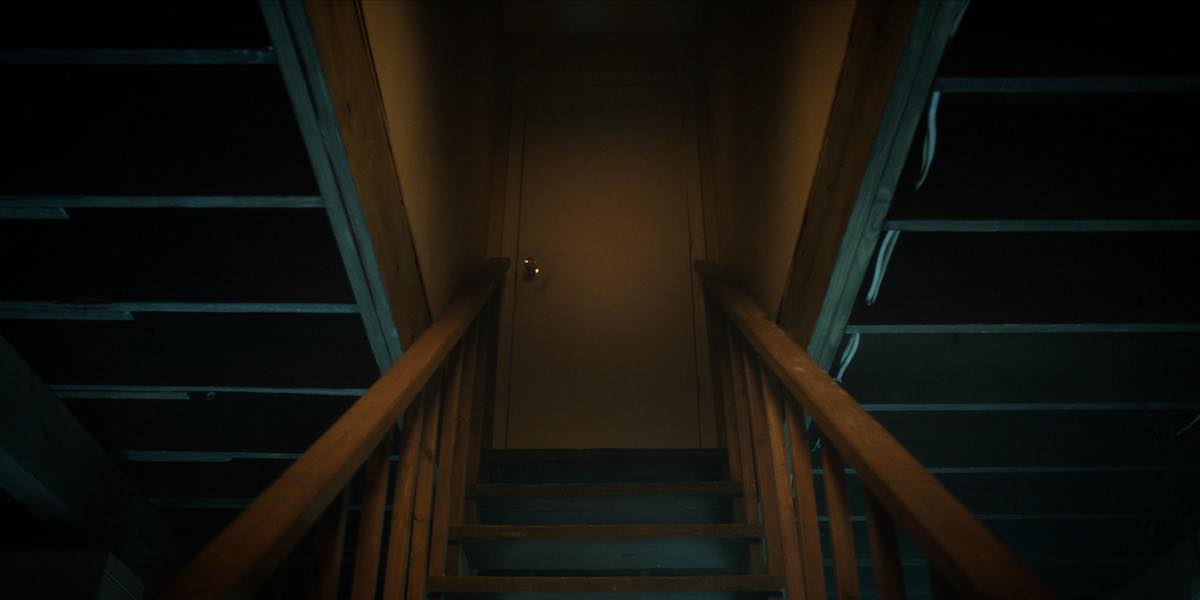
Um por um, Max, Lucas, Dustin e Will sobem as escadas do porão. Mike, o narrador, é o último, mas, antes de sair, vislumbra a mesa de RPG ser ocupada por outras crianças e outras histórias possíveis entre tabuleiros e peças analógicas (em imagens que, paradoxalmente, pertencem a uma dessas grandes corporações atentas a uma homogeneização das visualidades e à possibilidade de roteiros escritos por IA). Mike sai e sua derradeira ação antes de deixar esses mundos tecidos entre jogos no porão é fechar a porta, estabelecendo o plano final de Stranger Things: a porta centralizada numa composição simétrica, sob uma luz amarelada que a destaca ao olhar em comparação ao teto, contrastado pelo mesmo azul do upside down. Nesse intervalo entre a superfície das imagens espetaculares e o coração da narrativa, o fechar dessa porta banal atende o mandamento de encerrar a narrativa, trazendo o senso de completude, mas sem apagar o tema, reiterado no juramento final — “eu acredito”. Numa contemporaneidade em que tudo precisa ser mostrado, Stranger Things termina mostrando que toda a narrativa é uma pele — cobertura orgânica e íntegra que, mesmo quando fechada, segue admitindo lacunas, hipóteses e mistérios. Sua subversão é pontuar que a narrativa não existe para nos servir, no sentido de se ajustar para nos atender, de nos envolver comodamente, mas para nos desafiar e até desagradar, lembrando que, sob a pele da narração, muita coisa nos permanecerá estranha.
Stranger Things: Under the Skin of the Image
by Álvaro André Zeini Cruz
In the underbelly of Hawkins, Indiana, the town is mirrored in an Upside Down, producing an almost identical replica, distinguished only by its rancid-blue atmosphere and dubious tentacles (do they belong to the animal or plant kingdom?) that slither across surfaces. It is from this dark reconstruction that the monsters emerge – anthropomorphized bodies with heads of carnivorous flowers, combining in a single being the treaders and the rooted, two relationships with the skin of the world. Demogorgons are the creatures that pierce portals and escape into this pastiche town, the commonplace rooting of melodrama (Vidor, Sirk, Minnelli) in the transit of the uncanny (King, Spielberg, Burton, Carpenter, Dante, Lynch). It is not exactly a new destination: Hawkins is this citadel re-cognized by cinematic and televisual images, existing among variations that corroborate bourgeois morality (“meet me in St. Louis, Louis…”), that negotiate hegemony and counterculture (E.T.), or that produce more insurgent portraits (Gremlins, Edward Scissorhands, Twin Peaks).
It is through this end of the world – a spatial Frankenstein, stitching together patches of America’s heartland and suburbs – that the world begins to end. More specifically, through the skin. The soil is the skin, the threshold separating the world of generic surfaces – homes, schools, squares, and hospitals, popularized by the technical reproducibility of Hollywood cinema – and the grotesque underworld that impregnates these earthly spaces of comedy and melodrama with a supernatural aura. The same ground that underpins the town – the film of adult normality, the crystallization of the American way of life – hides unimaginable mysteries, which circumvent the adult world to haunt childhood first. It could be the Derry of the neighboring series (and, in a way, it is, since the shadow of IT is as strong as that of E.T.), but the layer that differentiates these worlds is of greater importance; it is the key that establishes a double throughout the series, making malleable the threshold between dream and nightmare.
Because if, as Antonio Candido teaches us, dream is inalienable to human nature, it is also true that it assumes different forms in childhood and adulthood. For the latter, the untamed dream is almost always inherent to sleep, leaving to daydreaming the pragmatic self-regulation of what is possible, which, in the American (and Western) case, recurrently takes the form of the earthly paradise of the quiet home, occupied by domestic lives of small incidents and big things (in the material sense). Against this conformist dream stands the unbridled dream, created by the child’s imagination, more akin to the Sartrean idea of imagination as an act, as a type of consciousness and not as a mere producer of images, copies of things. The propensity to create that which does not exist, to act in favor of the fantastic, enables this imagination to synthesize what adults avoid or repress: evil exists because it is subcutaneous to us. Hell is other people, and childhood re-elaborates this subconsciousness not as a copy, but as a peculiar and particular incarnated horror – monsters. It is from this division between the image-action and the image-copy that the double is distributed between Will (Noah Schnapp) and Eleven (Millie Bobby Brown), the kidnapped child and the restored one, the one who shares the mind and the one who shares the monster’s blood, the one who expands worlds and the one who intercommunicates them.
The bible of Stranger Things says that Eleven is Spielberg’s E.T., the creature that, with supernatural powers, gives form and strength to what once orbited between the game board and campaigns, dreams shared by Mike (Finn Wolfhard), Dustin (Gaten Matarazzo), Lucas (Caleb McLaughlin), and Will. She comes not from another world (although, now, we know her power derives from Henry and, consequently, from the rock that fell from space), but from a science fiction laboratory, where they were precisely trying to channel her telekinesis power, controlling the transmutation of mental images into actions. She escapes when Will is captured, or Will is captured because Eleven escapes: Eleven opens portals, cuts, and scars on the skin of the world, while Will is taken to architect tunnels, to build the vessels that amplify what, we recently discovered, is a wormhole, a structure linking the world of things (the concretizations of human rationality) to the abyss of irrationality, chaos, evil. The fate of these two children is to operate under the illusion of an antithesis between strength and weakness, based, paradoxically, on a single guilt: the belief that untamed imaginations are deviations (from what one is, from what one fears) that release monsters. Yet, whether through factual action or imagin-action (image + action), monstrosity is, primarily, human: Henry (Jamie Campbell Bower) shows us it can be an opportunistic apparition, but it is also a persistent choice that, contrary to the new wave of Disney films, does not always have redemption. To compensate for flawed human nature, Henry lets himself be possessed by an inhuman evil. He grows, is transformed into experiment “1”, but discovers that the one who should be his replica (numerically, even, two “1”s paired) is not a mere image: 11 acts and banishes 1 to the abyss. There, he duplicates himself: in memory, this mental image remains as the slender and eccentric Henry; in the materiality of the body, he becomes an anthropomorphized creature, a mix of Freddy Krueger (from A Nightmare on Elm Street) and Lord Zedd (from the Power Rangers series), sometimes seeming made of exposed muscles, sometimes of Lovecraftian slime. One thing is certain: in the transformation, the skin corrodes.
Vecna is revealed in the 4th season; precisely when adolescence emerges, this slasher villain appears to murder traumatized teenagers, using these emotional-psychological fissures to produce a greater physical trauma – cracking the earth’s crust that sustains Hawkins, beginning his plan to stitch together the skins of the two worlds. On more than one occasion, Vecna says the kidnapping of Will and the other children (in this 5th season) is explained by their fragile and impressionable minds; a lie that hides the fact that he seeks the strength of these unrestricted imaginations – the man-monster needs Will to create tunnels; needs Holly, Derek (Jake Connelly) and the others to move worlds. It is also from the group of children/teenagers that the great ideas for the downfall of Evil arise: in an inversion of the game, Max (Sadie Sink) and Holly (Nell Fisher) explore the labyrinths of Henry/Vecna’s memory; from Lucas comes the idea to “fry” a demogorgon so Will can access Vecna’s mind; from Dustin, the discovery of worlds sustained by wormholes; from Steve (Joe Keery), the insight to use the radio station’s antenna as a hypodermic needle, a means of transport/communication for spreading the final message/action to the realm of the abyss. Joyce (Winona Ryder), the mother who communicated through Christmas lights, the first non-infant to believe in the materiality of this Dungeons & Dragons world, is the only adult admitted to this final incursion, where the ultimate battle, again, takes place through the double.
When the crypt reveals itself as the final flesh of the Mind Flayer, Vecna indicates a symbiotic relationship between his mixed monstrosity (part human, part uncanny) and that of the supernatural creature. It is in the monster’s core – a kind of Plato’s Cave, where the children are kept immersed in images – that Vecna and Eleven wage the battle between the misshapen villain and the heroine who “de-skinned” him. Invisible to the eye, therefore, takes place the struggle of those whose powers produce eruptions, while, on the outside, the “hive mind” is faced by a heroism based on otherness, on the sharing of ideas and tasks, in the joint attack between childhood imagination and adolescent rebellion, both pulsating a “hive heart”; not by chance, the walk through the gorge allows important words to be said, as well as clues for the approaching confrontation (the alliance between Mike’s flare gun and Lucas’s slingshot). Mounted in parallel, the action weaves a causal stitch between the whale’s belly and the Kaiju’s carapace, in a combat that produces grand images, but whose emotional timing resembles the conceptual construction given by David Yates to the conclusion of the Harry Potter series: faced with this collective heroism, the downfall of horror is a more natural than supernatural consequence. The final blows come, again, through the double, from the hands of the troubled family: first, Will, the Mage, invades Vecna’s mind to conclude Eleven’s action on the monstrous body, piercing it with a thorn from the very beast-cave that stretches him. Then, it falls to Joyce, the mother, to dismember the creature, decapitating Vecna, attacking at once skin and mind, palpable matter and uncanny force. When the head rolls, the monster’s heart stops and petrifies. There is still about an hour left until “Heroes” plays over the final credits of Stranger Things.
The downfall of this supreme Evil in the middle of the episode may seem strange, but Stranger Things understands that spectacle for spectacle’s sake (heir to a cinema of attractions) is already well represented by Marvel, DC, and co.; its source is another, it is from a cinema with spectacular epidermis and narrative musculature. If over the course of five seasons, the Duffer brothers’ series has created extraordinary images – among fantasy, science fiction, and horror – increasingly rare in current Hollywood cinema (Max levitating in a trance, Will possessed, Eddie’s [Joseph Quinn] rock show, Dustin singing Neverending Story), they do not constitute loose or isolated exhibitionisms, but scenes and sequences grounded in a narrative more attentive even to the relationships and affections between characters than to the articulation of events (and if, on one hand, the accusation of recycled conflicts is legitimate, on the other, it shapes a plot of challenges negotiated between reiteration and progression, typical of children’s narratives like The NeverEnding Story and Bridge to Terabithia). It is necessary, therefore, to give the due endings – with precise timing – and still deal with an endless evil: beneath the film of an American normality, runs a warlike pulse, which reconfigures itself in slogans like Make America Great Again. If Dr. Kay (Linda Hamilton) is a flat character, it is because she does not demand complexity; she is a mere allegory of U.S. efficiency and zeal in converting forces and promises into weapons. In this sense, Eleven’s sacrifice stems from the understanding of the sociocultural existence of this other “hive mind,” producer of relentless mitoses like Dr. Kay and Dr. Brenner (Matthew Modine), figures capable of exploiting blood, wombs, and childhoods in the name of hot and cold wars.
Eleven follows the destiny suggested by Kali (Linnea Berthelsen), not without first saying goodbye to Mike – to the sound of Purple Rain – in that mental space made of infinite black background and a wet reflective surface, just like in Jonathan Glazer’s film, titled… Under the Skin. It is in this place of mental and emotional connections that the young man loses his girlfriend, and the boy bids farewell to the heroine, this E.T. whose ruined childhood provided so many others with the adventure of belief. When the group of youngsters regresses to childhood and concludes a final D&D campaign, Max questions “is that all? Comfort and happiness?” and is outraged by the typical melodrama ending – “couldn’t be more cliché.” She challenges Mike, the storyteller, who then invites them to one last speculation: the one that pulls them out of adult melodramatic conformity and restores a regime of suppositional imagin-action linked to childhood fantasy – he swears this epilogue is an uncountable true story, but all narrators swear that kind of thing, and the regression to the childhood game board doesn’t help to trust the narration to the realm of the factual. It matters little: even if the narrated peripeteia is improbable (would Kali have survived so long to produce the illusion that frees her sister?), the ultimate act belongs to the listeners, leaving it to Lucas, Dustin, Max, and Will to link imagination and belief to the narration that imagines a happy ending for Eleven – in a distant locality, far from the dangers of the “Shadow Hand” (this United States that, in fiction, haunts its small towns, like Hawkins), safe from that happiness of interiors and suburbs settled upon dungeons and dragons.
Flayed in a contemporaneity that consumes narratives – demanding from them the speed of information and product satisfaction – the ending of Stranger Things punctuates a narrative that seems like a foreign body within a streaming service that – I believe increasingly – hates cinema as ritual. After Dustin’s didactically rebellious speech at the graduation, and the insurgency that begins to dissolve, negotiating with an American way of life in the subtext of the conversation between Jonathan, Nancy, Steve, and Robin, the series culminates in this last double, where the souls regress to childhood even though the skins have grown to adult size. Like Bill in IT, Gordie in Stand by Me (but also Kevin Arnold in The Wonder Years, Takeru Takashi in Digimon Adventure, and so many other characters who take upon themselves the shown narration), Mike imagines Eleven’s happiness not as a cowardly and settled ending, but as Byung-Chul Han suggests in The Crisis of Narration: as a “salvation of the past,” “a narrative resilience that ties the past to the present and allows the former to continue acting upon the latter, even to reemerge.” At the heart of storytelling (which, for Han, is restricted to commerce and consumption), Stranger Things dares to evoke the skin of other stories to constitute itself as narrative, an exercise in “miracle and mystery” (Han, again).
One by one, Max, Lucas, Dustin, and Will go up the basement stairs. Mike, the narrator, is the last, but before leaving, he glimpses the RPG table being occupied by other children and other possible stories between boards and analog pieces (in images that, paradoxically, belong to one of those large corporations attentive to a homogenization of visuals and the possibility of AI-written scripts). Mike leaves and his final action before leaving these worlds woven between games in the basement is to close the door, establishing the final shot of Stranger Things: the door centered in a symmetrical composition, under a yellowish light that highlights it to the eye compared to the ceiling, contrasted by the same blue of the Upside Down. In this interval between the surface of spectacular images and the heart of the narrative, the closing of this banal door fulfills the commandment to end the narrative, bringing a sense of completeness, but without erasing the theme, reiterated in the final vow – “I believe.” In a contemporaneity where everything needs to be shown, Stranger Things ends by showing that all narrative is a skin – an organic and integral covering that, even when closed, continues to admit gaps, hypotheses, and mysteries. Its subversion is to punctuate that narrative does not exist to serve us, in the sense of adjusting to attend to us, to comfortably involve us, but to challenge and even displease us, reminding us that, beneath the skin of narration, many things will remain strange to us.
 Pós-créditos