
por Álvaro André Zeini Cruz
Em Typhoon Club, uma tempestade isola um grupo de crianças na escola. Love Hotel tem como cenário recorrente a beira de um rio e acaba com a chegada da neve. Em A Mudança, a menina adentra a água, movendo essa superfície refletora de um espetáculo de luzes e fogos, que concebem uma atmosfera metafísica. Os Amigos começa com a chuva que cai sobre a pelada no campinho, sem lavar uma ambiência amarelo-rançosa que impregna todo o filme.
É essa mesma cor que resplandece da cidade sob as janelas do monorail, trazendo à tona a temática da morte entre os amigos Atsushi, Yasutaka e Yamashita; enquanto o último acabara de perder a avó, os outros dois perguntam, curiosos, sobre os rituais do velório e da cremação, revelando uma consciência da infância (cuja etimologia remete à incompletude da linguagem, ainda em formação) sobre a outra ponta, quando todas as capacidades findam rumo ao mistério. Um dos meninos imagina o calor do corpo morto, exposto por duas horas, às chamas. A imagem é de arder os olhos.
Mas a casa do Vovô — como os garotos passam a chamar um velhinho a quem espionam — abre um frescor verdejante. É, justamente, o mato alto que vai aproximá-los; os meninos ajudam o velho a dar um trato na casa, caindo aos pedaços. As marcas de uma vida postergada, parada em seu último tempo, abrem brecha a outro, skholé, tempo dessa formação feita pelo lazer, pela não obrigação, pelos encontros desinteressados. A infância se instala e se completa pelo jardim, ainda que a morte continue à espreita, impregnada em cada poro dessa imagem bafienta, que insiste em brigar com a folhagem verdejante.
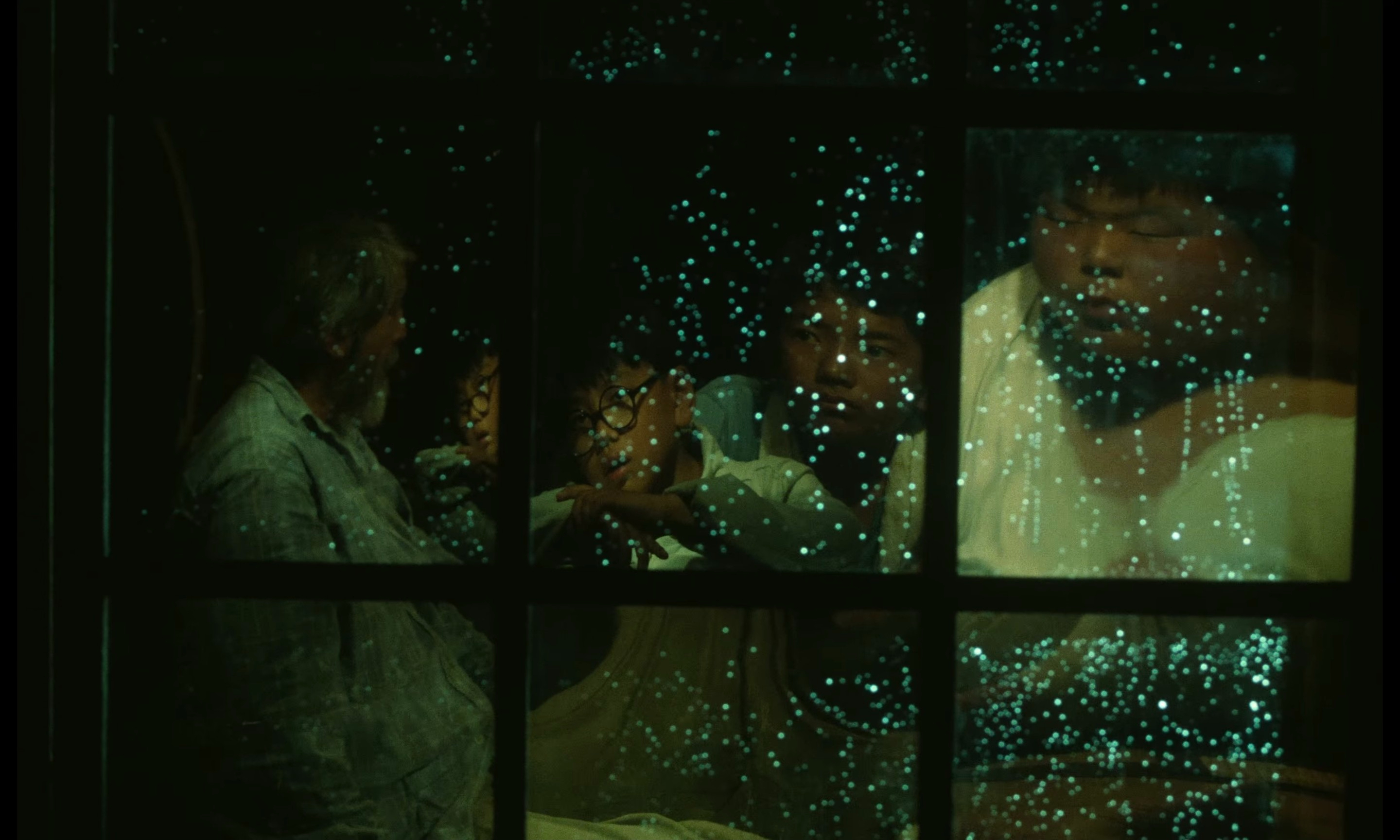
Numa noite, quando o sol cede, a tempestade (sempre ela) cai impiedosa, fazendo essa camada presente escorrer sentido ao passado. Ojiisan lembra de quando esteve na Guerra, período em que, segundo ele, só andou e sobreviveu. Lembra de quando invadiu a casa de uma família e matou todos os moradores. Kawabe, o garoto franzino com óculos fundo de garrafa, se levanta para brincar com uma metralhadora feita do indicador, sem perceber que está em outro tempo, que a tempestade é monstruosa. Mas a câmera nota e opta por manter intactos os rostos infantis originais, investindo sobre a imagem das crianças refletidas nas folhas espelhadas da janela. As feições infantis se distorcem diante da história macabra do velho, mas se sustentam, já que as palavras trazem a curiosidade incontornável sobre aquilo que sempre esteve e está à espreita. O detalhe na janela amplia distorções e interesses, salpicando, sobre as faces, uma poesia intrusa das gotas que formam um falso céu estrelado. Então, o rosto contador de causos toma a tela para narrar o ato sempre injustificável — mas quase sempre cercado por falsas justificativas — de tirar uma vida; a da mulher que corria, cuja gravidez só fora percebida pelo atirador de perto. Lembrada sob um gotejar incessante (afinal, o que tanto se esvai?), a vida dentro da barriga — presentificada pela narração — havia dado seu derradeiro espasmo sob as mãos que atiraram, bem diferentes da mãozinha do menino, que, minutos antes, empunhara uma arma imaginária. A câmera corta para fora, para encerrar a cena com o silêncio estupefato, cercado pelas sombras, emoldurado pelos vidros, numa composição digna de Mizoguchi, Sirk ou Hooper. A tempestade segue.
A cena seguinte é de sol, e, embora a morte agora esteja colocada (o afogamento na piscina), a infância é persistente e teimosa. O melodrama faz das suas artimanhas para reativar essa vida suspensa e penitenciada pela Guerra, para que os olhos vejam, mesmo que de longe, o amor perdido, a outra vida desperdiçada. Quando é chegada a vez de Vovô se tornar um corpo inerte, os amigos se desesperam em prantos, e Atsuki, o líder, tenta prover o corpo morto, velado pela mesa, com as uvas compradas para um lanche entre avô e netos. Em vão. Não bastasse a contundência do choro infantil, o velório culmina a mise en scène cortante de Shinji Somai: a esposa perdida, agora uma senhora, é trazida pela neta para se despedir, mas, com uma espécie de demência, não reconhece o rosto do ex-companheiro, de quem se perdeu na Guerra. Ela faz um gesto respeitoso, mas convencional, contorna o caixão e, só então, se dá conta de algo. Volta e o vê, se ajoelha e estremece. A voz também treme, exprimindo a frase guardada e aguardada: “bem-vindo à casa”.
A casa restaurada pelos meninos, pelos amigos, para esses últimos dias de sol e a derradeira tempestade. Para, de novo, sucumbir ao tempo, ao mato alto, aos olhares impiedosos dos prédios que a cercam, desejos por parirem um irmão ali. Antes de deixarem o terreno, Atsuki, Kawabe e Yamashita atravessam o verde entrecortado pelas flores, em planos que lembram pinturas impressionistas de Monet, Renoir e, talvez, os Sonhos de Akira Kurosawa.
Natsu no niwa: The Friends
by Álvaro André Zeini Cruz
In Typhoon Club, a storm isolates a group of children at school. Love Hotel features a recurring riverside setting and ends with the arrival of snow. In Moving, a girl enters the water, setting this reflective surface in motion with a spectacle of lights and fireworks, creating a metaphysical atmosphere. The Friends begins with rain falling on a game of pickup soccer in an empty lot, failing to wash away the yellow-tinged, rusty atmosphere that permeates the entire film.
This same color gleams from the city below the windows of the monorail, bringing the theme of death to the fore among the friends Atsushi, Yasutaka, and Yamashita. While the latter has just lost his grandmother, the other two curiously inquire about the rituals of the wake and cremation, revealing childhood’s awareness—its etymology pointing to the incompleteness of language still taking shape—of the other end, when all capacities fade into mystery. One of the boys imagines the heat of the lifeless body, exposed to flames for two hours. The image burns the eyes.
But Grandpa’s house—as the boys come to call the old man they spy on—offers a lush, verdant freshness. It is precisely the tall weeds that draw them closer; the boys help the old man clean up the house, which is falling to pieces. Traces of a life postponed, halted in its final stretch, give way to another time—skholé—time shaped by leisure, freedom from obligation, and disinterested encounters. Childhood settles in and finds fulfillment in the garden, even as death continues to lurk, soaked into every pore of this musty image, which insists on clashing with the lush foliage.
One night, as the sun yields, the storm—always the storm—descends mercilessly, causing this present layer to slip toward the past. Ojiisan remembers his time in the War, a period in which, he says, he only walked and survived. He recalls breaking into a family’s home and killing all its occupants. Kawabe, the frail boy with bottle-thick glasses, stands up to play with a machine gun made from his index finger, unaware that he has slipped into another time, that the storm is monstrous. But the camera notices and chooses to preserve the children’s faces intact, focusing instead on their reflections in the mirrored leaves of the window. Their childish features contort before the old man’s macabre story, yet they hold fast—for the words awaken an inevitable curiosity about that which has always lurked, and still does. The detail of the window magnifies distortions and fascinations, splashing across their faces an intrusive poetry of droplets that form a false starry sky. Then, the storyteller’s face fills the screen to narrate the always-unjustifiable—yet almost always falsely justified—act of taking a life: that of the woman who ran, whose pregnancy was noticed only by the shooter up close. Remembered under an incessant drip (what, after all, drains away so endlessly?), the life inside her belly—made present by the telling—had given its final spasm under the hands that fired, so unlike the boy’s small hand that, minutes earlier, had wielded an imaginary gun. The camera cuts outside, ending the scene with stunned silence, framed by shadows, enclosed within the glass, in a composition worthy of Mizoguchi, Sirk, or Hooper. The storm continues.
The next scene is sunny, and though death is now present (a drowning in a pool), childhood proves persistent and stubborn. The melodrama works its narrative sleight-of-hand to reawaken this life suspended and punished by the War, so that the eyes might glimpse, even from afar, a lost love, another life wasted. When Grandpa’s turn comes to become an inert body, the friends weep in despair, and Atsuki, their leader, tries to feed the dead body, laid out on the table, with the grapes bought for a snack shared between grandfather and grandsons. In vain. As if the rawness of the children’s weeping weren’t enough, the wake culminates in Shinji Somai’s incisive mise-en-scène: the long-lost wife, now an old woman, is brought by her granddaughter to say farewell. But in a kind of dementia, she does not recognize the face of her former companion, lost to her during the War. She makes a respectful, yet conventional gesture, circles the coffin, and only then realizes something. She turns back, sees him, kneels, and trembles. Her voice trembles, too, uttering the saved and long-awaited phrase: “Welcome home.”
The house restored by the boys, by the friends, for these last days of sun and the final storm. Only to succumb once again to time, to the tall grass, to the pitiless gaze of the buildings that surround it—structures that seem to long for a sibling to be born there. Before leaving the grounds, Atsuki, Kawabe, and Yamashita make their way through the green, interspersed with flowers, in shots that recall the Impressionist paintings of Monet and Renoir, and perhaps the Dreams of Akira Kurosawa.
 Pós-créditos