
por Álvaro André Zeini Cruz
(English version below)
Tubarões farejam sangue à distância. Como aqueles, que param a viatura em um posto de beira de estrada para averiguar não o defunto sob um pedaço vacilante de jornal, mas o sangue pulsante do motorista, que garante ali a circulação de um Fusca amarelo. A intimidação, como sempre, começa pelos detalhes burocráticos (posso ver o extintor de incêndio?), artifício para que esse tipo de situação escale até que, num mínimo escorregão, abra a brecha esperada para que ordem seja reimposta à força. Afinal, após mostrar os dentes, é preciso esfacelar todos os dutos do corpo alheio, uma lição-mordição histórica, replicada desde que os tubarões desembarcaram das caravelas. Mas o peixe que está ali é vivo, bem vivo: contorna o sujeito que, por sua vez, reorganiza a dentição para pedir a caixinha dos policiais. Sai com meio maço de cigarros e as guelras murchas pela bocada incipiente de tubarão mal adestrado e de pequeno porte. Fosse num carnaval contemporâneo, poderia fantasiar-se de “Tubacão”. Mas é 1977, e Armando (Wagner Moura) segue vivo sentido à Recife, onde, em plena folia, se mascara de Marcelo.
O tubarão não demora a voltar. Na verdade, ele atravessa O Agente Secreto, de Kleber Mendonça Filho. Na maioria das vezes, reaparece nos pôsteres do filme de Steven Spielberg, mas, antes de ser essa gravura (reprodução codificada sob certos códigos do cinema de gênero) ou suas variações em traços infantis, surge como corpo aberto sobre a mesa da universidade. O monstro, que aterroriza os pesadelos do menino, é exposto logo no começo do filme com uma peculiaridade: do bucho do bicho, sai uma perna humana. A conjugação entre dedos, nadadeiras, tripas e pelos cria, por um instante, uma monstruosidade esfrangalhada. Mas a perna se separa para percorrer o filme de outra forma: como um fait divers plantado, a excentricidade do sangue coagulado escamoteando o sangue derramado diariamente, em violências deflagradas numa bem-sucedida parceria entre público e privado. É sobre essa segunda esfera que O Agente Secreto se debruça.
KMF faz um filme sobre ditadura a partir do ponto de vista das vítimas desses tubarões meio invisíveis, que (até hoje) se nutrem da coisa pública, mas afiam os dentes e mastigam por meios e motivos particulares. Com os espaços públicos expostos (a universidade, a repartição burocrática transformada em delegacia), resta se abrigar nos lugares restritos (a sala de projeção) ou privados. Um prédio, de novo, surge como uma espécie de aquário, mas, ao contrário do que ocorre no filme em que Sônia Braga é o derradeiro alicerce daquele edifício, aqui, o Ofir resguarda diferentes tipos, justamente porque permanece insuspeito sob a gestão da octogenária Dona Sebastiana (Tânia Maria); ela é o acabamento que invisibiliza o refúgio onde Marcelo se instala.
A partir daí, o filme se estrutura pela natureza da mordida (empresto o título de Carla Madeira), isto é, escorrendo como uma aventura desse “agente” que tem que esperar (ou seja, ser paciente); enquanto isso, esbarra com outros como ele, esfarrapados que insistem em viver, apesar das abocanhadas. São figuras misteriosas (o filme nos nega essas histórias), que se encontram, circunstancialmente, nesse vórtice de barbáries, cujo escape — também circunstancial — é o carnaval (um dos planos mais belos é aquele em que Udo Kier, triturado pelo nazismo, agora se deleita, engolido pelo bloco). Nesse sentido, é, de fato, um filme de participações especiais (as exceções são Sebastiana e Seu Alexandre, interpretado por Carlos Francisco), com figuras que vem e vão, sempre em cenas incisivas — Alice Carvalho e Maria Fernando Cândido, sobretudo.
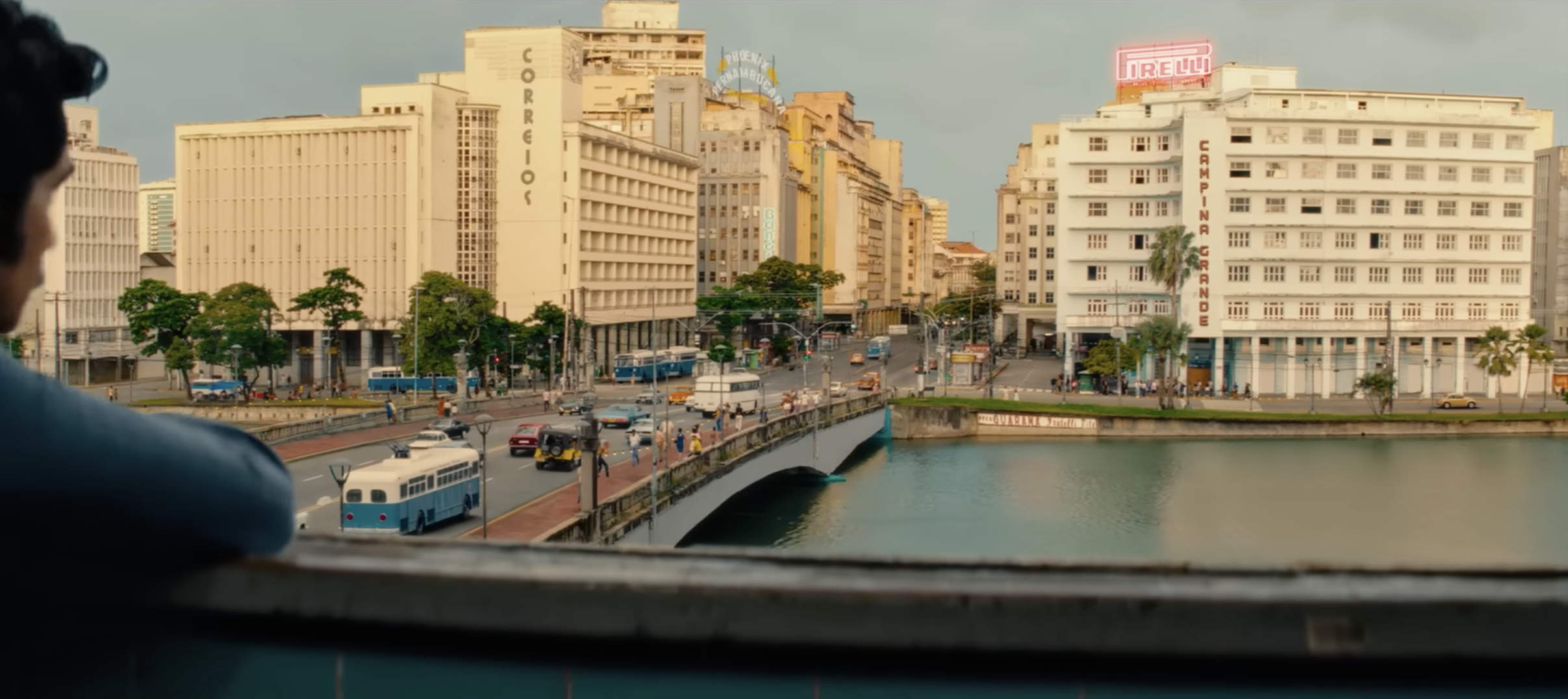
Cândido — cuja personagem me traz a Heloísa de Anos Rebeldes, caso tivesse chegado à maturidade —, é quem deflagra a ação de gravar o áudio que projeta a sequência de flashbacks de Armando (ironicamente, a ação ocorre numa salinha anexa à sala de projeção do São Luiz). Os gritos gerados pela exibição de A Profecia vêm de baixo (como o Tubarão); sob o piso, irrompem ao longo da conversa, menos como mau-agouro do que como um fato (ou um tempo) a se ter que encarar. Antes, o próprio Armando/Marcelo espiara uma cena do filme de Richard Donner. É o começo de um plano complexo e, simbolicamente, avesso ao filme: (se não me falha a memória) inicia com uma subjetiva (a tela vista a partir da sala de projeção) que, então, se desloca para efetuar não só o trânsito entre ambientes, mas mudar o status do olhar da subjetividade à objetividade. É quando Wagner Moura entra em quadro, carregando a câmera às costas, produzindo, através do travelling, um “corte” sem elipse, sem ausência, sem supressão dos “tempos mortos”; um plano-antítese a toda uma estrutura fílmica baseada, justamente, nas lacunas deixadas pelos dentes, nos vazios assombrosos (e assombrados) onde antes havia carne. Ao final do movimento, a câmera reenquadra Moura diante de outra tela: não mais o espelho revelador de monstros invisíveis, mas a janela, aberta para uma Recife que se ergue. Entre passados e futuros impalpáveis, o presente ganha esse átimo de materialidade em que o agente não age, nem espera; simplesmente existe ali.
Assim como costura perna e tubarão, Kleber Mendonça Filho parece evocar esses dois monstros cinematográficos — o Tubarão de Spielberg e o Anticristo da franquia de horror — para dar forma a seu filme de agente secreto; o primeiro como besta do espaço, o segundo como entidade de certo tempo. Quando a quebra narrativa traz a trama ao presente, explicita que tudo o que vemos/ouvimos é a sobra da mordida: inevitavelmente, a investigação paralisará diante de alguma falta insolúvel, cujo paradoxo é vir acompanhada desse Zeitgeist maléfico, que ora recua, ora irrompe, mas segue ali, onipresente (e me pergunto se não teria sido essa a sensação de trabalhar na Comissão da Verdade). Quando o destino de Armando aparece numa fotografia jornalística, a pesquisadora amplia a imagem, mas não estamos em Blow-up, de Antonioni, em que a imagem dá base a uma investigação, mas num filme em que os registros são fins, evidências limítrofes de existências transformadas em serpentinas, com rasgos e lacunas insolucionáveis.
Se O Agente Secreto começa com o corpo palpável do algoz (simbólico) sobre a mesa, termina com essa imagem de um corpo vitimado, que acumula as ausências próprias a outras, anteriores, não resolvidas ao longo da vida (como a identidade da mãe, que Armando buscava). Nesse sentido, o título é irônico, pois, além de não desvendar nada, o agente secreto suscita outras dúvidas (o que matou Fátima, afinal?). Só o que revela é o modus operandi, a natureza da mordida do Tubarão em tempos anticristãos; ato não só de ceifar vidas, mas de apartá-las dos seus e de suas histórias, de desfigurá-las, torná-las irreconhecíveis, indecifráveis, irreconstituíveis. Ao se movimentar de uma janela à outra, Armando proíbe a montagem, evitando o corte na hora de conectar a tela ao mundo. É seu gesto de maior agência, num filme que entende que a mordida não produz somente cortes, meras elipses temporais, mas buracos e traumas profundos, dilacerantes, que O Agente Secreto faz questão de devolver a nós, rêmoras, como se todos seguíssemos alimentados pelas sobras, em falta com esse passado que se reconstitui de tempos em tempos. Mais do que uma provocação narrativa, cada ausência é uma proposição moral. Lidemos com isso, sabendo que, pelas bandas de cá, o mar nunca está para peixe. Nem para perna sem sapato.
The Secret Agent
written by Álvaro André Zeini Cruz
Sharks can smell blood from a distance. Like those who stop their patrol car at a roadside gas station to investigate not the corpse under a wobbly piece of newspaper, but the pulsating blood of the driver, who ensures the circulation of a yellow Volkswagen Beetle. The intimidation, as always, begins with bureaucratic details (can I see the fire extinguisher?), a tactic to escalate the situation until, with the slightest slip, the expected opening is created for order to be forcibly imposed. After all, after showing their teeth, it’s necessary to tear apart all the body’s ducts, a historical biting lesson, replicated since sharks disembarked from their caravels. But the fish that’s there is alive, very much alive: it circles the man who, in turn, rearranges his teeth to ask for the police’s bribe. He leaves with half a pack of cigarettes and his gills shrunken from the incipient bite of a poorly trained, small shark. If it were a contemporary carnival, he could dress up as “Sharkdog”. But it’s 1977, and Armando (Wagner Moura) is still alive and heading to Recife, where, in the midst of the festivities, he disguises himself as Marcelo.
The shark doesn’t take long to return. In fact, it appears throughout Kleber Mendonça Filho’s The Secret Agent. Most often, it reappears on the posters for Steven Spielberg’s film, but before becoming that image (a coded reproduction under certain genre film codes) or its variations in childlike drawings, it emerges as an open body on the university table. The monster, which terrorizes the boy’s nightmares, is exposed right at the beginning of the film with a peculiarity: a human leg emerges from the creature’s belly. The combination of fingers, fins, guts, and hair creates, for a moment, a ragged monstrosity. But the leg separates to traverse the film in another way: like a planted fait divers, the eccentricity of coagulated blood concealing the blood spilled daily, in violence unleashed in a successful partnership between public and private. It is on this second sphere that The Secret Agent focuses.
KMF makes a film about dictatorship from the point of view of the victims of these somewhat invisible sharks, who (even today) feed off public resources, but sharpen their teeth and chew for private means and motives. With public spaces exposed (the university, the bureaucratic office transformed into a police station), the only option is to take refuge in restricted (the projection room) or private places. A building, once again, emerges as a kind of aquarium, but, unlike in the film where Sônia Braga is the ultimate foundation of that building, here, the Ofir shelters different types of people, precisely because it remains unsuspected under the management of the octogenarian Dona Sebastiana (Tânia Maria); she is the finishing touch that makes the refuge where Marcelo settles invisible.
From there, the film is structured by the nature of the bite (I borrow the title from Carla Madeira’s book), that is, flowing like an adventure of this “agent” who has to wait (that is, be patient); meanwhile, he stumbles upon others like him, ragged figures who insist on living, despite the bites. They are mysterious figures (the film denies us these stories), who find themselves, circumstantially, in this vortex of barbarity, whose escape—also circumstantial—is the carnival (one of the most beautiful shots is the one in which Udo Kier, crushed by Nazism, now delights, swallowed by the parade). In this sense, it is, in fact, a film of special appearances (the exceptions are Sebastiana and Seu Alexandre, played by Carlos Francisco), with figures that come and go, always in incisive scenes—Alice Carvalho and Maria Fernanda Cândido, above all.
Cândido — whose character reminds me of Heloísa from Anos Rebeldes, if she had reached maturity — is the one who triggers the action of recording the audio that projects Armando’s flashback sequence (ironically, the action takes place in a small room adjacent to the São Luiz projection room). The screams generated by the screening of The Omen come from below (like Jaws); under the floor, they erupt throughout the conversation, less as a bad omen than as a fact (or a time) to be faced. Before, Armando/Marcelo himself had spied a scene from Richard Donner’s film. It is the beginning of a complex and, symbolically, antagonistic plan to the film: (if my memory serves me right) it begins with a subjective view (the screen seen from the projection room) which then shifts to effect not only the transit between environments, but to change the status of the gaze from subjectivity to objectivity. It is then that Wagner Moura enters the frame, carrying the camera on his back, producing, through the tracking shot, a “cut” without ellipsis, without absence, without suppression of “dead time”; a shot that is an antithesis to an entire filmic structure based precisely on the gaps left by teeth, on the astonishing (and haunted) voids where there was once flesh. At the end of the movement, the camera reframes Moura in front of another screen: no longer the revealing mirror of invisible monsters, but the window, open to a Recife that rises up. Between impalpable pasts and futures, the present gains this instant of materiality in which the agent neither acts nor waits; he simply exists there.
Just as he stitches together a leg and a shark, Kleber Mendonça Filho seems to evoke these two cinematic monsters—Spielberg’s Jaws and the Antichrist from the horror franchise—to shape his secret agent film; the first as a beast from space, the second as an entity from a certain time. When the narrative break brings the plot to the present, it makes explicit that everything we see/hear is the remnant of the bite: inevitably, the investigation will be paralysed by some unsolvable lack, whose paradox is that it comes accompanied by this malevolent Zeitgeist, which sometimes recedes, sometimes erupts, but remains there, omnipresent (and I wonder if that wasn’t the feeling of working on the Truth Commission). When Armando’s fate appears in a journalistic photograph, the researcher enlarges the image, but we are not in Antonioni’s Blow-up, where the image forms the basis of an investigation, but in a film where the records are ends, borderline evidence of existences transformed into streamers, with unsolvable tears and gaps.
If The Secret Agent begins with the palpable body of the (symbolic) executioner on the table, it ends with this image of a victimized body, accumulating absences inherent to other, previous, unresolved issues throughout life (such as the identity of the mother, whom Armando was searching for). In this sense, the title is ironic, because, besides not revealing anything, the secret agent raises other questions (what killed Fatima, after all?). All that is revealed is the modus operandi, the nature of the Shark’s bite in anti-Christian times; an act not only of taking lives, but of separating them from their loved ones and their stories, of disfiguring them, making them unrecognizable, undecipherable, unreconstructible. By moving from one window to another, Armando forbids editing, avoiding cuts when connecting the screen to the world. It is his most authoritative gesture, in a film that understands that the bite produces not only cuts, mere temporal ellipses, but deep, lacerating holes and traumas, which The Secret Agent insists on returning to us, remoras, as if we were all still feeding on leftovers, failing to connect with this past that reconstructs itself from time to time. More than a narrative provocation, each absence is a moral proposition. Let’s deal with it, knowing that, around here, the sea is never calm. Nor is it for bare feet.
 Pós-créditos