
por Álvaro André Zeini Cruz
Entre flertes fatais, Ingrid Bergman é cooptada por Cary Grant para uma missão no Rio de Janeiro: sua personagem, Alicia, é filha de um nazista condenado e, para não ter o destino do pai, junta-se ao agente do governo americano para desbaratar uma corja de outros nazistas, refugiados entre retro-projeções da cidade maravilhosa.
A tarefa de Alicia é se aproximar de um sujeito que ela já repeliu outras vezes: Claude Rains (Alexander Sebastian), que se deixa levar com um pé atrás, o que instala uma sensação de perigo iminente desde o princípio. Rains desconfia dessa persona subitamente apaixonada que Alicia compõe para seduzi-lo, enquanto ela própria enfrenta um jogo de atração e repulsa com o parceiro, Devlin (Grant).
Entre beijos devidamente ensaiados para que se tenha os melhores ângulos de Grant e Bergman, Alicia diz que “é um caso de amor estranho”, porque ele não a ama; a disjunção é posta, porque Devlin mal consegue falar ao telefone de tão entregue que está. Na volta, o jogo vira quando Devlin lembra que Alicia é uma sedutora contumaz e revela que essa característica será central aos serviços que ela prestará ao governo americano. Alicia tenta tirar dele, “o homem dos sonhos”, uma palavra de afeto, mas Devlin fala de negócios. No campo e contracampo, sob o crepúsculo carioca em back projection, Alicia perde a batalha para o rosto-esfinge de Grant, e é justamente por uma esfinge decorativa que ela passa antes de mergulhar sob a névoa de uma cortina, cenografia que ativa a difusão de seu sofrimento.
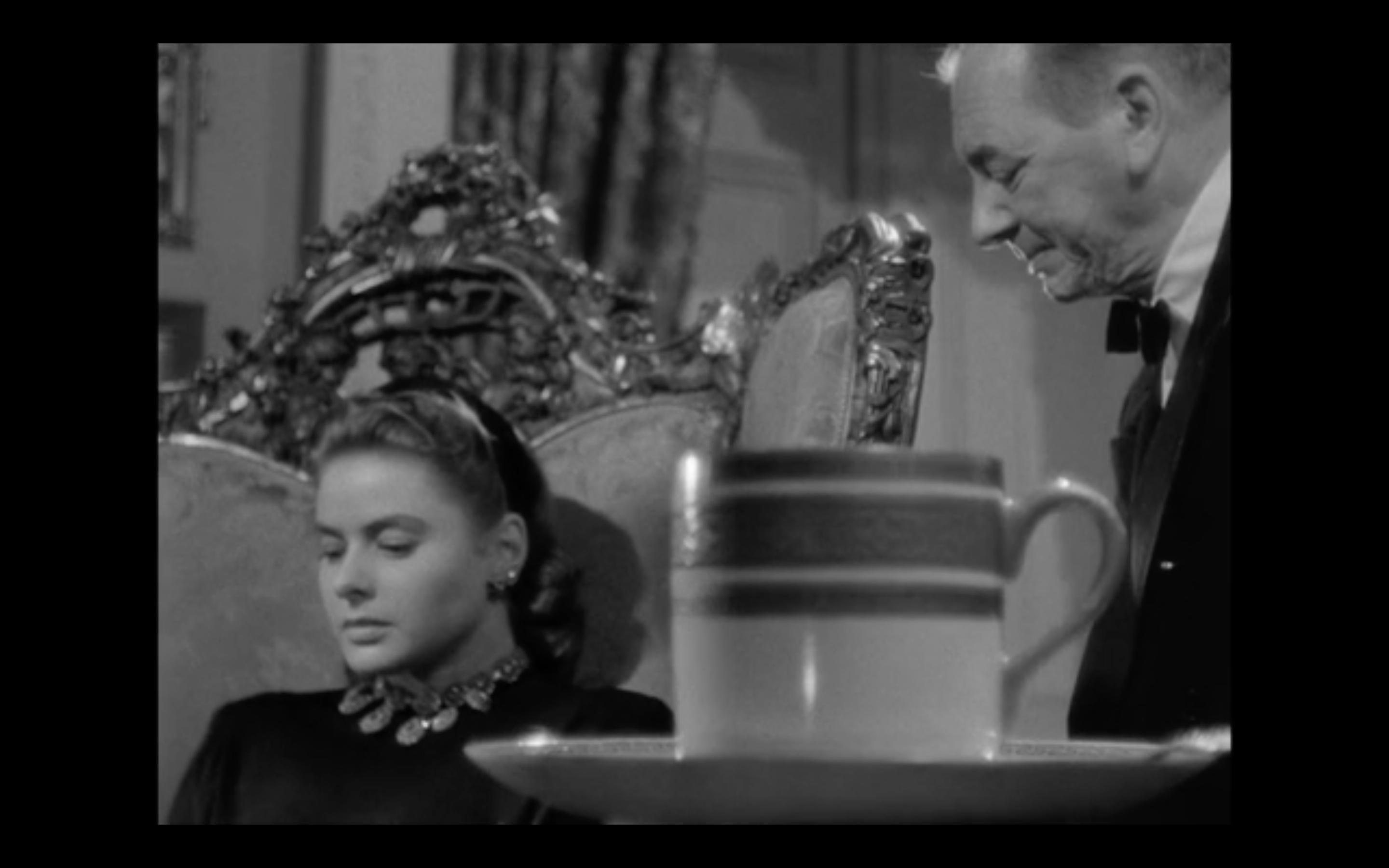
O cenário em que o plano é posto em prática é um parque de diversões hitchcockiano: das portas inúmeras e indecifráveis, cuja guarda das chaves permanece com Rains e sua mãe, à escadaria majestosamente à espera de uma queda, a mansão é um labirinto de visualidades que, paradoxalmente, abriga o olhar sempre certeiro de Rains. Além dele, há a mãe, a velha que pariu um nazista porque, provavelmente, pariu o nazismo; Madame Anne Sebastian (Leopoldine Konstantin) é dessas personagens que provocam calafrios enquanto destila seu sadismo entre o vai e vem da agulha do bordado. É também nessa casa em que está o McGuffin nuclear — segundo Hitchcock, concebido quando se tinha apenas uma pista sobre a bomba atômica —, atrás da porta que tem na fechadura a palavra “única” — a pista está dada. Sob o deadline das garrafas que se esgotam no gelo, a descoberta dessa adega, onde as botelhas não guardam bebida, leva ao contragolpe do café envenenado em xícaras que atraem a câmera, até que a última sobreponha a já adoentada Alicia como um monolito. Sob o efeito da bebida batizada, os nazistas se tornam uma dupla de silhuetas borradas, cujas sombras cercam e tomam o olhar e a consciência da protagonista.
Da descoberta ao desenlace — dilatados por certa inaptidão do mocinho —, um novo suspense se abre, pois o resgate de Alicia pode revelar que Rains deixou-se seduzir por uma agente dupla, e nessa pequena corja de nazistas refugiados nos trópicos, um está a espreita de devorar o outro. Em Interlúdio, o golpe final não é um tiro, mas o dedo de Grant deslizando firme até a trava do carro, deixando Claude Rains com a condenação no rosto, à mercê de outra dupla de nazistas que o aguardam à porta. Não são sombras, como as vistas por Alicia sob efeito do veneno, mas dois sujeitos tornados bastante concretos sob a luz; materializados o suficiente para fecharem a porta, cravando o fim do vilão e do filme.
Notorious
by Álvaro André Zeini Cruz
Between fatal flirtations, Ingrid Bergman is recruited by Cary Grant for a mission in Rio de Janeiro: her character, Alicia, is the daughter of a convicted Nazi and, to avoid sharing her father’s fate, joins the U.S. government agent in dismantling a gang of other Nazis hiding among rear-projected images of the marvelous city.
Alicia’s task is to get close to a man she has rebuffed several times before: Claude Rains (Alexander Sebastian), who reluctantly allows himself to be drawn in, creating a sense of imminent danger from the very beginning. Rains distrusts this suddenly infatuated persona that Alicia crafts to seduce him, while she herself navigates a game of attraction and repulsion with her partner, Devlin (Grant).
Between kisses carefully choreographed to capture the best angles of Grant and Bergman, Alicia remarks that “it’s a strange love affair,” because he does not love her; the disconnect is laid bare, as Devlin can barely speak on the phone, so consumed is he by passion. Upon returning, the dynamic shifts when Devlin reminds Alicia that she is an inveterate seductress and reveals that this trait will be central to the services she will render to the U.S. government. Alicia tries to coax a word of affection from him—“the man of her dreams”—but Devlin speaks only of business. In the shot-reverse shot sequence, against the backdrop of a Rio twilight in rear projection, Alicia loses the battle to Grant’s sphinx-like face, and it is precisely past a decorative sphinx that she walks before disappearing behind a curtain of mist—a set piece that accentuates the diffusion of her anguish.
The setting where the plan is set into motion is a Hitchcockian amusement park: from the countless indecipherable doors, whose keys remain with Rains and his mother, to the majestic staircase awaiting a fall, the mansion is a labyrinth of visuals that, paradoxically, hosts Rains’ ever-watchful gaze. Besides him, there is the mother, the old woman who gave birth to a Nazi, for she likely birthed Nazism itself; Madame Anne Sebastian (Leopoldine Konstantin) is one of those characters who sends chills down the spine as she exudes her sadism with the rhythmic motion of her embroidery needle. It is also within this house that the nuclear MacGuffin resides—according to Hitchcock, conceived when only a hint about the atomic bomb was known—hidden behind a door whose lock bears the word “unique”—the clue is given. Under the deadline of the dwindling supply of bottles in the ice, the discovery of this cellar, where the bottles hold not wine but uranium, leads to the counter-blow of poisoned coffee in cups that draw the camera’s focus, until the final one looms over the already ailing Alicia like a monolith. Under the effects of the spiked drink, the Nazis become a pair of blurred silhouettes, their shadows encircling and overwhelming the protagonist’s gaze and consciousness.
From the discovery to the resolution—protracted by a certain ineptitude on the hero’s part—a new suspense emerges, as rescuing Alicia may reveal that Rains allowed himself to be seduced by a double agent. And in this small gang of Nazis taking refuge in the tropics, one is lying in wait to devour the other. In Notorious, the final blow is not a gunshot but Grant’s finger sliding firmly to the car’s lock, leaving Claude Rains with condemnation written on his face, at the mercy of another pair of Nazis waiting for him at the door. They are not shadows, like those seen by Alicia under the poison’s influence, but two men rendered utterly concrete in the light; materialized enough to close the door, sealing the villain’s fate and the film’s conclusion.
 Pós-créditos