
por Álvaro André Zeini Cruz
Ainda que os musicais possam escamotear tragédias e horrores sob a alegria iluminada das superfícies polidas na era de ouro hollywoodiana — como bem observa Timothy Corrigan em sua análise magistral e à altura de Meet me in St. Louis —, é esperado que o público estranhe a combinação entre um gênero démodé e um vilão de quadrinhos cinematograficamente celebrado nas últimas décadas. Esperado, mas não compreensível, pois essa infiltração musical é a melhor coisa que poderia acontecer ao Coringa de Joaquin Phoenix e Todd Phillips.
Delírio a dois tem o cuidado de pactuar logo o novo velho gênero: inabitual em universos de super-heróis, a brecha musical aparece nas aulas de música que Arthur Fleck (Phoenix) passa a frequentar no presídio, recompensado pelo bom comportamento. É lá que ele conhece Lee Quinzel, a Arlequina interpretada por Lady Gaga, de Nasce uma Estrela. A lembrança do remake de Bradley Cooper não é gratuita; a própria escalação de Gaga parece evocar seu trabalho anterior: outrora estrela-título, nascida entre pequenas tragédias cotidianas, ela, agora, tenta reavivar uma estrela minguante — e que nunca deveria ter sido.
Afinal, é sob esse status que Fleck/Coringa termina o filme anterior; com a violência midiatizada decodificada não como barbárie e horror, mas como última possibilidade humana em um mundo desumanamente corrompido. Uma tragédia, mas que conduzia trama e protagonista a uma “hora de estrela” apoteótica, tornando o personagem abjeto em objeto de deleite e catarse. Desta vez, o carcereiro sádico, vivido por Brendan Gleeson, faz a pergunta que denuncia a mudança de chave — “você ainda acha que é uma estrela?”. Fleck não acha; a rotina carcerária faz da labareda um fiapo de fogo, mas Quinzel surge para atiçá-lo, ainda que as coisas não corram como ela espera.
Isso porque o desejo de Quinzel é de se sujeitar aos olhares; é ser, sobretudo, uma persona conscientemente constituída como extensão dessa primordial e antissocial, o Coringa; não é à toa que a Arlequina vai se compondo como alegoria progressivamente. Abre-se um paradoxo inconciliável: Arlequina se monta como se se preparasse para o filme anterior, de cunho predominantemente social, mas o que se tem neste é um deslizar psicológico, gradual e suave. É a música a situação/instrumento que Quinzel usa para (re)encontrar o Coringa, mas a proposição do gênero causa uma ruptura entre ação externa (a prisão, o júri) e interna (a maioria dos números musicais).
Abre-se, então, esse filme interno, que passeia por certa iconografia dos musicais dos anos 1930 e 1940 a partir da subjetividade de um Coringa que canta (e imagina) outro mundo, de Sinatra, Wonder e Armstrong. Entre tantas bifurcações, Flecker/Phoenix dança no sentido oposto, arriscando-se num salto que entrelaça ator e personagem num só corpo, posto a encarar a epifania desse sublime intruso, do entendimento do musical “como candidato primeiro ao cinema puro”, como sintetiza Adrian Martin. Assim, o mesmo corpo que sapateia com a elegância de Fred Astaire e Gene Kelly, aparece deformado pela magreza (a escápula saliente conduz a câmera numa das primeiras cenas); a presença que desliza com graça For Once in my life é a mesma que se curva a ponto de quase se partir ao meio, tal qual o filme.
Introduzida por Quinzel como algo externo (ou a se externar, pois esse é o modus operandi da personagem), a música leva o Coringa a mergulhar em si, reconduzindo a narrativa de antes a lugares mais interessantes e menos perigosos. A priorização do psicológico encobre o caráter pretensamente social do filme anterior, que cometia erros parecidos àqueles que fizeram o Capitão Nascimento, de Tropa de Elite, ser decodificado não como a figura trágica e medíocre, mas como herói. Além disso, é graças ao musical que o personagem tem delírios dilatados que suspendem a violência, ainda que ela reapareça, porque lhe é inescapável. Nesse sentido, o desfecho de To love somebody (um dos números mais resplandecentes) é o presságio mais evidente do destino do casal, mas há outro: a cena de sexo na cela, que remete imediatamente à outra feita por Phoenix em Amantes, de James Gray.
Em Gray, o sexo era deserotizado porque não havia ali um encontro real, e sim um jogo de fetiches, inseguranças e conveniências, algo que, de certa forma, se repete aqui. O descompasso entre os personagens é a peça do dominó que desencadeia a reiterada decepção do público (que atingiu em cheio a bilheteria): enquanto Arlequina delira para fora, a partir das imagens (quase desejando um filme para si), Coringa delira para dentro, perdendo-se em seus labirintos. É por isso mesmo que todas as suas possibilidades de fuga são rapidamente frustradas, levando-o logo de volta à prisão. Atento ao perigo do discurso delirante do primeiro filme, Delírio a dois orquestra um movimento gradativo, em que o protagonista dança entre seus salões permitindo-se deslumbrar-se, na impossibilidade de achar uma saída. (Antes tarde do que nunca) entende que não cabe ao Coringa ser intermediador de qualquer descarga fisiológica, psicológica, emocional ou moral; a catarse não existe em Delírio a dois porque, no fundo, esta não é uma sequência — é o epílogo de uma beleza farsante (o rosto maquiado) que descobre notas de real beleza durante a descida ao inferno que lhe é inescapável. É a principal diferença entre Arthur Fleck de Leonard Kraditor, personagem de Phoenix no filme de Gray: no pequeno reino melodramático de Amantes, sobrevive-se, entre paliativos, às pequenas tragédias de todos os dias. Assim, os amantes afinavam-se, ainda que momentaneamente, para atravessarem os desencantos. Aqui, o dueto logo entra em descompasso: o que Quinzel ama é a projeção, a sombra que escapole no desenho animado que abre o filme, mas Fletcher, embora tente, não consegue mais dançar com essa sombra diante do mundo; quer sapatear para dentro, nesses dias finais em que vislumbra alguma beleza/leveza num mundo e na alma.
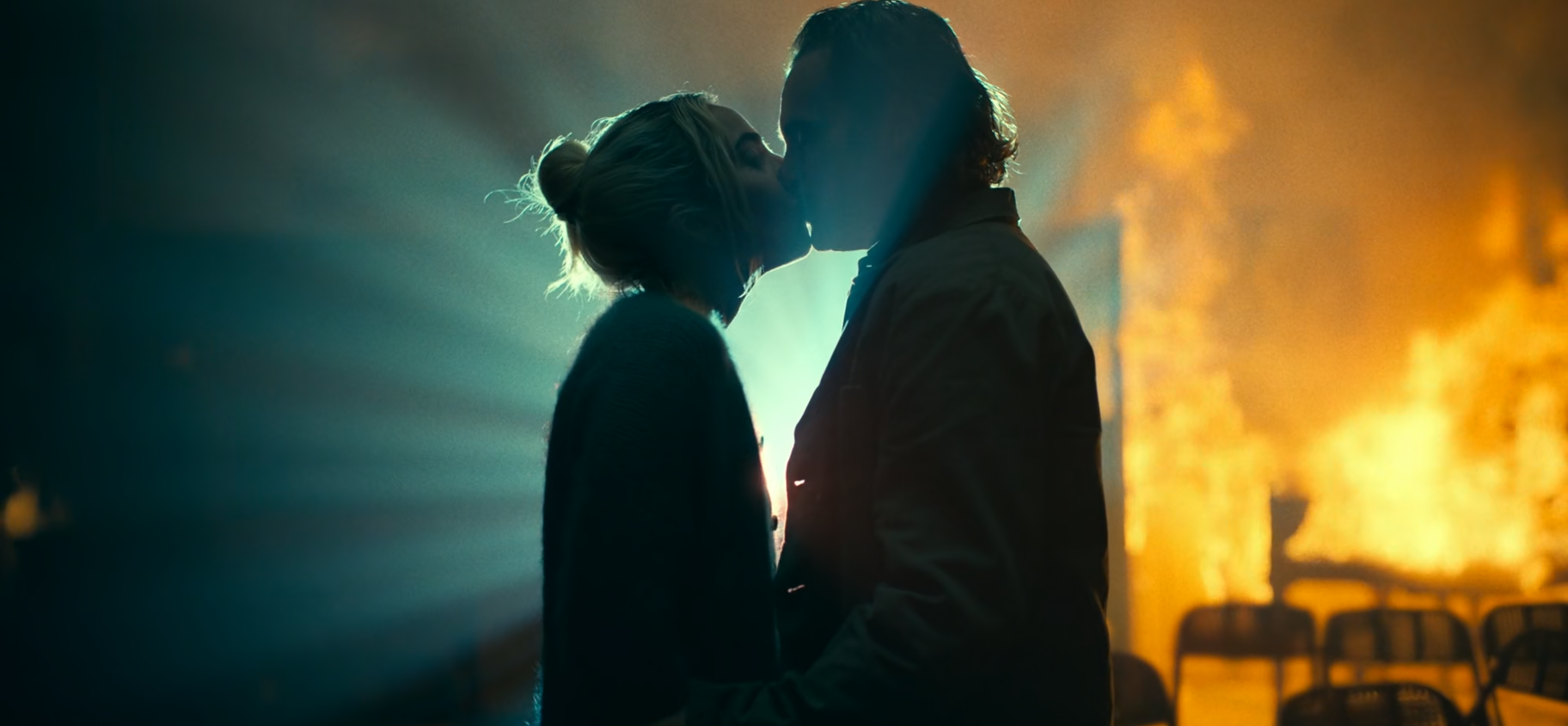
A síntese desse musical descompassado não está no som, mas na imagem, no beijo dado em meio à batalha entre a luz do projetor e as chamas, entre os fachos que consolidam controladamente a imagem e a dança da luminância caótica que constrói e corrói os infernos.
Joker: Folie à deux
by Álvaro André Zeini Cruz
Even though musicals can obscure tragedies and horrors beneath the illuminated joy of polished surfaces during the Hollywood golden age—as Timothy Corrigan astutely observes in his masterful analysis worthy of Meet Me in St. Louis—it is expected that audiences will find the combination of an old-fashioned genre and a cinematically celebrated comic book villain of recent decades strange. Expected, but not understandable, because this musical infiltration is the best thing that could have happened to Joaquin Phoenix and Todd Phillips’ Joker.
Folie à Deux takes care to establish the new/old genre right away: unusual in superhero universes, the musical breach appears in the music lessons Arthur Fleck (Phoenix) starts attending in prison, rewarded for good behavior. It is there that he meets Lee Quinzel, the Harley Quinn played by Lady Gaga, from A Star is Born. The memory of Bradley Cooper’s remake is not gratuitous; the very casting of Gaga seems to evoke her previous work: once the title star, born amidst small daily tragedies, she now tries to revive a waning star—one that should never have been one.
After all, it is under this status that Fleck/Joker ends the previous film; with media-mediated violence decoded not as barbarism and horror, but as the last human possibility in an inhumanely corrupted world. A tragedy, but one that led the plot and protagonist to an apotheotic “hour of the star,” turning the abject character into an object of delight and catharsis. This time, the sadistic prison guard, played by Brendan Gleeson, asks the question that signals the shift in key—”do you still think you’re a star?”. Fleck doesn’t think so; prison routine reduces the flame to a wisp of fire, but Quinzel appears to stoke it, even if things don’t go as she expects.
This is because Quinzel’s desire is to subject herself to gazes; it is to be, above all, a persona consciously constituted as an extension of that primordial, antisocial one, the Joker; it’s no coincidence that Harley Quinn progressively composes herself as an allegory. An irreconcilable paradox opens up: Harley Quinn constructs herself as if preparing for the previous film, predominantly social in nature, but what we have here is a psychological, gradual, and smooth slide. Music is the situation/instrument Quinzel uses to (re)find the Joker, but the proposition of the genre causes a rupture between external action (the prison, the jury) and internal action (most of the musical numbers).
Thus opens this internal film, which wanders through certain iconography of 1930s and 1940s musicals from the subjectivity of a Joker who sings (and imagines) another world, of Sinatra, Wonder, and Armstrong. Amid so many bifurcations, Fleck/Phoenix dances in the opposite direction, risking a leap that intertwines actor and character into a single body, facing the epiphany of this sublime intruder, the understanding of the musical “as the primary candidate for pure cinema,” as Adrian Martin summarizes. Thus, the same body that tap dances with the elegance of Fred Astaire and Gene Kelly appears deformed by thinness (the prominent scapula guides the camera in one of the first scenes); the presence that glides gracefully through “For Once in My Life” is the same one that bends over almost to the point of breaking in half, much like the film itself.
Introduced by Quinzel as something external (or to be externalized, as that is the character’s modus operandi), music leads the Joker to delve into himself, redirecting the previous narrative to more interesting and less dangerous places. The prioritization of the psychological overshadows the supposedly social character of the previous film, which made mistakes similar to those that caused Captain Nascimento from Tropa de Elite to be decoded not as a tragic and mediocre figure, but as a hero. Furthermore, it is thanks to the musical genre that the character has dilated delusions that suspend violence, even though it reappears, because it is inescapable for him. In this sense, the denouement of “To Love Somebody” (one of the most radiant numbers) is the most evident omen of the couple’s fate, but there is another: the sex scene in the cell, which immediately recalls another performed by Phoenix in James Gray’s Two Lovers.
In Gray’s film, sex was de-eroticized because there was no real encounter there, but rather a play of fetishes, insecurities, and conveniences, something that, in a way, repeats itself here. The mismatch between the characters is the domino piece that triggers the repeated disappointment of the audience (which hit the box office hard): while Harley Quinn deliriously projects outward, through images (almost desiring a film for herself), Joker deliriously projects inward, losing himself in his labyrinths. That is precisely why all his escape possibilities are quickly frustrated, leading him straight back to prison. Aware of the danger of the first film’s delusional discourse, Folie à Deux orchestrates a gradual movement, in which the protagonist dances through its halls, allowing himself to be dazzled, in the impossibility of finding a way out. (Better late than never) he understands that it is not up to the Joker to mediate any physiological, psychological, emotional, or moral discharge; catharsis does not exist in Folie à Deux because, deep down, this is not a sequel—it is the epilogue of a deceptive beauty (the made-up face) that discovers notes of real beauty during the descent into the hell that is inescapable for him. It is the main difference between Arthur Fleck and Leonard Kraditor, Phoenix’s character in Gray’s film: in the small melodramatic kingdom of Two Lovers, one survives, with palliatives, the small daily tragedies. Thus, the lovers tuned in, even if momentarily, to get through the disenchantments. Here, the duet soon falls out of sync: what Quinzel loves is the projection, the shadow that escapes in the cartoon that opens the film, but Fleck, although he tries, can no longer dance with this shadow before the world; he wants to tap dance inward, in these final days where he glimpses some beauty/lightness in the world and in the soul.
The synthesis of this out-of-sync musical lies not in the sound, but in the image, in the kiss given amidst the battle between the projector’s light and the flames, between the beams that controllably consolidate the image and the dance of chaotic luminance that builds and erodes the infernos.
 Pós-créditos