
I’m still here
por Álvaro André Zeini Cruz
Encaremos o bilionário na sala, já que tirá-lo seria improvável. Falo de Walter Salles, cineasta e herdeiro de Whalter Moreira Salles, bancário que, segundo consta, esteva entre os apoiadores da ditadura militar de 1964, retratada criticamente no filme do filho. Essa mudança de ponto de vista — aqui geracional — não é nova: sete anos após o fim da ditadura, a Globo, alicerçada e polida com as mangas militares, fez Anos Rebeldes, ainda um dos mais contundentes retratos do período. Mea culpa? Talvez. Pouco importa; é preciso apontar essas contradições com objetividade, sem que seja o objetivo da crítica deitar cineasta ou emissora (produtora do filme) no divã (até porque, eles têm dinheiro para isso). De qualquer forma, a presença de Salles é incontornável: primeiro porque (não sejamos hipócritas) o fato de ter um produtor abastado colabora diretamente na carreira nacional e internacional de Ainda estou aqui. Isso não diminui os méritos do filme, mas aponta a dissonância de um cenário em que outros filmes bons (ou melhores) não conseguiram rotas assim, tranquilamente auspiciosas. Mas isso é para-fílmico; no que diz respeito à diegese, Salles se apresenta em sua característica predileção pelo melodrama, evidente entre artifícios como o filme de família (em formato e textura de Super 8) e o surgimento do típico presságio melodramático: o pião caído e o lenço esquecido de Central do Brasil, aqui sintetizam-se na frase de Rubens Paiva à esposa — logo seremos só nós dois.
Não serão; sabemos. Por isso, a frase de Rubens Paiva (Selton Mello) cai cheia de ironia em meio àquela casa solar, que abriga uma festa com adultos e crianças dançando pela sala arejada. Gostam de receber, dirá Eunice (Fernanda Torres), quando interrogada no DOPs. Contudo, a despeito das estratégias do roteiro e da imagem, e da música melódica-melosa, Ainda estou aqui é consonante ao tempo que retrata e, por isso, um melodrama caracterizado pela própria modernidade brasileira, incompleta e atravancada. Salles pretende um melodrama de choro chique, comedidamente rasgado. Fernanda Torres o impede.
Isso porque Torres compõe Eunice em duas faces: a primeira é de uma mulher naturalmente contida, mas naturalista nos gestos e ações ao longo do momento em que a convivência familiar permanece imperturbada; a outra, predominante, nasce sob a súbita consciência de que tudo o que viverá naqueles anos de chumbo, desde a prisão de Rubens Paiva, será uma farsa. Eunice, então, a aceita e a encampa como tal, compondo em torno de si um grande teatro em que ninguém age, apenas reage diante — e no mesmo tom — de sua presença. Suas frases, portanto, ganham um outro tempo, uma marcação anti cotidiana que beira a artificialidade em algumas cenas — como aquela no carro, em que Eunice aumenta o som do rádio para cortar Vera (Valentina Herszage), ou mesmo o momento em que ela praticamente declama para que os filhos sorriam para uma fotografia jornalística.
Torres compõe essa mulher calculada em meio à dor, altiva para poder impor-se, aveludada para aparar as quedas; a textura submissa à dimensão. A partir disso, posiciona Eunice a uma certa distância do público, renunciando a recursos melodramáticos como o rosto contorcido ou a explosão catártica. Eunice, portanto, não é uma personagem que emociona desde os sentidos, pela identificação com o corpo e seus fenômenos fisiológicos; pelo contrário, emociona numa interlocução direta com o racional diante do situacional, a partir da compreensão de todo o mal que a cerca. A casa, agora sorumbática, se torna sua melhor extensão: lugar onde reconhece-se o acolhimento de outrora, transformado em masmorra, num dos porões da ditadura. Em um subgênero que tem dificuldade de resolver a imagem da tortura, o chiaroscuro surge como uma espécie de ato-falho acertado de Salles: o contraste entre luz e sombra é o que violenta o olhar e deforma os rostos. É na fotografia de Adrian Teijido que Torres consolida sua Eunice como essa personagem de corpo consumido e presença distanciada, que, por sobreviver à tortura e viver com o peso dela, escolhe as palavras, o tom, os tempos. Interpreta. A frase dita a Baby (Dan Stubach) sobre os cinco filhos que tem para criar sai com premeditação e ironia propositais, colocando-se como antítese à ironia acidental do presságio de Rubens Paiva.
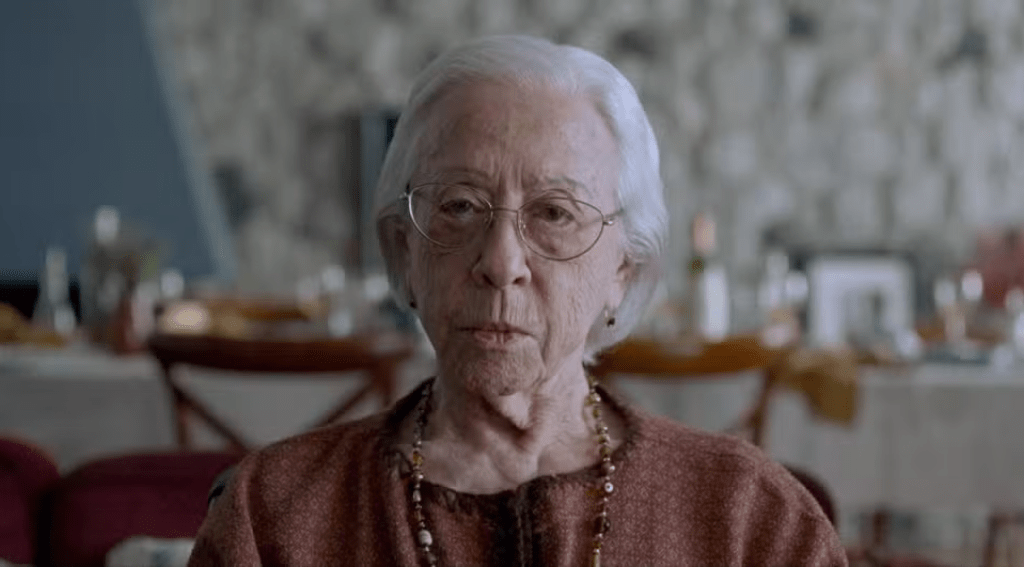
Protagonista, Torres cede espaço à mãe nos minutos finais de Eu ainda estou aqui. Fernanda Montenegro surge num dos cantos da extensa mesa do almoço em família, e a mise en scène trata de contrariar a altivez anterior encolhendo-a no fundo dos primeiros quadros — os tempos são outros; as distâncias, também. Se Torres é quem operava o desdobramento das encenações anteriores (a teatralidade diegética e a encenação fílmica) a partir do corpo e da voz, agora a câmera precisa ir até Fernanda Montenegro, próxima como poucas vezes conseguiu no tempo anterior. Então, encaram-se mutuamente: o olhar do filme persiste em Eunice, outrora distanciada pela violência da ditadura, agora distante por conta do Alzheimer. Mas, diferente da Eunice de Torres, que olha para fora do quadro, a Eunice de Montenegro olha de volta, para o neto, criança que entra e sai no canto do quadro, e para a câmera, revertendo a quebra de quarta parede — não mais dado de opacidade e afastamento, mas de identificação frontal, inédita. Depois, olhar múltiplo, ao futuro (a criança), ao passado (o marido) e para dentro (aquilo que sobrevive à tortura e ao Alzheimer). Comparsa da filha em sabotar o melodrama formulaico de Salles, Fernanda Montenegro sequestra o gênero para si nesse olhar, criando um chiaroscuro com a construção cerebral de Fernanda Torres, para entregar emoção pura e simples na troca cinematográfica entre quem olha e quem é olhado, em que ambos afirmam Ainda estou aqui.
Salles está no filme, mas não é o filme: as Eunices das Fernandas tiraram o bilionário da sala. Eu disse que era improvável, não impossível.
In English
I’m still here
written by Álvaro André Zeini Cruz
Let’s look at the billionaire in the room, since removing him would be unlikely. I’m talking about Walter Salles, filmmaker and heir to Whalter Moreira Salles, a banker who, according to reports, was among the supporters of the 1964 military dictatorship, critically portrayed in his son’s film. This change in point of view — here generational — is not new: seven years after the end of the dictatorship, Globo, founded and polished by military sleeves, made Anos Rebeldes, still one of the most compelling portraits of the period. Mea culpa? Maybe. It doesn’t matter; these contradictions need to be pointed out objectively, without the critics’ goal being to put the filmmaker or the broadcaster (the film’s producer) on the couch (after all, they have the money to do so). In any case, Salles’ presence is unavoidable: firstly because (let’s not be hypocrites) the fact that he had a wealthy producer directly contributed to the national and international career of I’m Still Here. This does not diminish the film’s merits, but it does point to the dissonance of a scenario in which other good (or better) films have not managed to find such a calmly auspicious path. But this is para-filmic; as far as the diegesis is concerned, Salles presents himself with his characteristic predilection for melodrama, evident among devices such as the family film (in the format and texture of Super 8) and the emergence of the typical melodramatic omen: the fallen spinning top and the forgotten handkerchief from Central Station, here summarized in Rubens Paiva’s phrase to his wife — soon it will be just the two of us.
They won’t be; we know that. That’s why Rubens Paiva’s (Selton Mello) phrase is so ironic in the middle of that sunny house, which is hosting a party with adults and children dancing in the airy living room. They like to entertain, Eunice (Fernanda Torres) will say when questioned at the DOPs. However, despite the strategies of the script and the image, and the melodic-sweet music, I’m Still Here is in tune with the time it portrays and, therefore, a melodrama characterized by Brazilian modernity itself, incomplete and cluttered. Salles wants a melodrama of chic, measured tears. Fernanda Torres prevents him from doing so.
This is because Torres composes Eunice in two faces: the first is of a naturally contained woman, but naturalistic in her gestures and actions throughout the moment in which family life remains undisturbed; the other, predominant, is born under the sudden awareness that everything she will experience in those leaden years, since Rubens Paiva’s arrest, will be a farce. Eunice then accepts and embraces her as such, composing around herself a great theatre in which no one acts, only reacts before — and in the same tone — her presence. Her sentences, therefore, gain another time, an anti-everyday marking that borders on artificiality in some scenes — like the one in the car, in which Eunice turns up the radio to cut Vera (Valentina Herszage), or even the moment in which she practically declaims so that her children smile for a journalistic photograph.
Torres creates this woman who is calculated in the midst of pain, proud to be able to impose herself, velvety to catch her falls; her texture submissive to dimension. From this, she positions Eunice at a certain distance from the audience, renouncing melodramatic resources such as the contorted face or the cathartic explosion. Eunice, therefore, is not a character who moves through the senses, through identification with the body and its physiological phenomena; on the contrary, she moves through a direct dialogue with the rational in the face of the situation, based on the understanding of all the evil that surrounds her. The house, now gloomy, becomes her best extension: a place where one recognizes the former welcome, transformed into a dungeon, one of the cellars of the dictatorship. In a subgenre that has difficulty resolving the image of torture, chiaroscuro emerges as a kind of successful slip of the tongue by Salles: the contrast between light and shadow is what violates the gaze and deforms the faces. It is in Adrian Teijido’s photography that Torres consolidates her Eunice as a character with a consumed body and a distant presence, who, having survived torture and lived with its weight, chooses the words, the tone, the times. She interprets. The phrase spoken to Baby (Dan Stubach) about the five children she has to raise comes out with intentional premeditation and irony, placing itself as an antithesis to the accidental irony of Rubens Paiva’s omen.
Protagonist, Torres gives place to her mother in the final minutes of I’m Still Here. Fernanda Montenegro appears in one of the corners of the extensive family lunch table, and the mise en scène tries to counter the previous haughtiness by shrinking her into the background of the first frames — times are different; the distances, too. If Torres is the one who operated the unfolding of the previous stagings (diegetic theatricality and filmic staging) based on the body and voice, now the camera needs to go to Fernanda Montenegro, close as it rarely managed to do in the previous time. Then, they face each other: the film’s gaze persists on Eunice, previously distanced by the violence of the dictatorship, now distant because of Alzheimer’s. But, unlike Torres’ Eunice, who looks out of the frame, Montenegro’s Eunice looks back, at her grandson, a child who enters and leaves the corner of the frame, and at the camera, reversing the breaking of the fourth wall — no longer a sign of opacity and distance, but of unprecedented frontal identification. Then, look at multiple things, to the future (the child), to the past (the husband) and inwards (what survives torture and Alzheimer’s). Accomplice of her daughter in sabotaging Salles’ formulaic melodrama, Fernanda Montenegro hijacks the genre for herself in this look, creating a chiaroscuro with Fernanda Torres’ cerebral construction, to deliver pure and simple emotion in the cinematic exchange between the one who looks and the one who is looked at, in which both affirm I’m still here.
Salles is in the film, but he is not the film: the Eunices of Fernandas took the billionaire out of the room. I said it was unlikely, not impossible.
 Pós-créditos