
por Álvaro André Zeini Cruz
(English translation below the original text)
Em Elefante, a câmera flutuante de Gus Van Sant segue — sem perseguir — adolescentes nas idas e vindas entre salas e corredores de uma escola. É um olhar que boia, comedidamente fascinado por aquelas existências tão iniciais, quanto banais; figuras que circulam e palpitam as contradições do crescer humano entre as veias e artérias de uma arquitetura funcional. Era 2003 e começava-se a falar em cinema de fluxo. E embora não fosse o caso de Elefante, confundia-se ao novo conceito (aproveitando-se dele) a acentuação de um comodismo da decupagem mínima, aquela que não planeja e cerca a ação, mas se sujeita a ela, como se o olhar fosse uma carry-on na esteira.
22 anos depois, a Netflix surpreende ao revisitar o tema da adolescência numa minissérie que, em 4 episódios, parece carregar a memória do filme de Van Sant, mas sob a consciência de que os tempos são outros. Assim, os planos longos dão lugar a planos-sequências, que manejam um olhar menos moderado do que em Elefante, já que, lá, o fluxo nos conduzia, entre vidas, até a iminência violenta da morte. Na série de Stephen Graham e Jack Thorne, a queda da água já passou e, agora, vive-se o vórtex dos corpos e destroços.
Não se trata, portanto, das últimas pulsações, como em Elefante, mas dos espasmos insistentes que teimarão a partir e acerca da morte. Entre paternidades letárgicas e adolescências que, de tão conectadas, tornaram-se desconexas — quando não, sádicas —, o colégio é visto da mesma forma como a delegacia, porque são instituições paliativas, que lidam — cada qual a seu modo e tempo — com as incapacidades da linguagem diante das falências de caráteres. Nesse sentido, ainda que as traquitanas sejam indispensáveis, a recorrência da câmera na mão — nem sempre na steadicam —, parece não somente uma escolha prática, mas também ética, como se coubesse ao olhar recuperar uma urgência humana e, consequentemente, uma capacidade de se recompor diante do que descompõe transversalmente — a inocência, a alteridade, o futuro.
Essa capacidade de não se acomodar a um ponto de vista reaproxima o trabalho de câmera do de Gus Van Sant, reconduzindo o olhar à habilidade de decupar, seja no fluxo ou no redemoinho. Dois momentos no primeiro episódio ilustram isso. No primeiro, quando deixados a sós na sala de interrogatório, Eddie (Stephan Graham), o pai, se inclina para falar com o filho, Jamie (Owen Cooper), 13 anos, acusado de assassinar uma colega da escola. Na composição, o rosto do menino — num ¾ frontal — é mais visível, enquanto o pai, de perfil, anuncia — “vou te perguntar uma vez só, tá?”. A fala antecipa e a câmera entende o que vem aí; sabe também que não é justo que a mais dolorosa das perguntas ocorra diante de um rosto e meio (o do filho por inteiro, o do pai pela metade). Então, essa câmera humanamente idealizada — que não treme ou tropeça, mas sabe diagnosticar emoções — se aproxima e faz uma discreta correção à esquerda, reenquadrando pai e filho em equidade. Os dois rostos em ¾ frontais, a sustentação dos olhares comunicada na imagem: “Foi você?”.

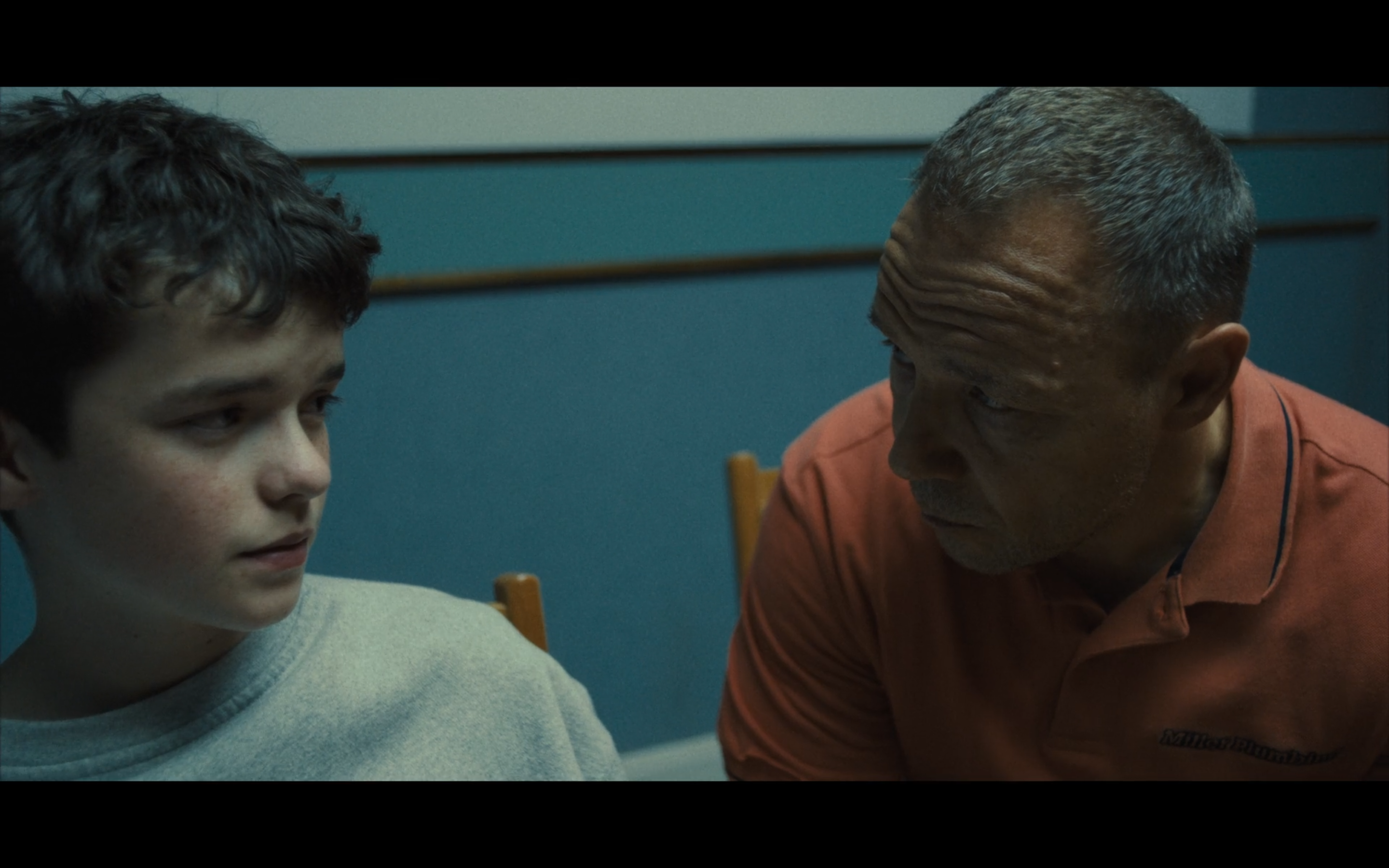
Jamie responde, mas uma prova surge para revelar a verdade factual e abrir um abismo de dúvidas abstratas, irrespondíveis. O episódio termina com a câmera a certa distância, mas diante deles, pai e filho, sentados lado a lado. Ambos levam a mão ao rosto, carregando, na ação, motivações diferentes, mas também estabelecendo uma espécie de réplica incompleta, geracionalmente atravancada, mas, ainda assim, dada entre gestos, posturas, genética e habitus. Espelham-se, mas não se reconhecem; entre eles, abre-se o abismo das monstruosidades humanas e das humanidades monstruosas, sem que sejam dicotomias estanques ou exatas. Nesse jogo de mãos, a câmera — olho da mão humana — vê de longe; não precisa do toque, uma vez que não se trata de sentir a pulsação. Segue assistindo esses espasmos personificados; mortos-vivos mortos cada vez mais cedo.
Se em Elefante, Gus Van San vasculha humanidade numa panorâmica entre as pistas de um quarto, aqui, o quarto estrelado remete a uma farsa tão bem ajambrada que ninguém enxerga, todos se enganam. É preciso olhar o Instagram, diz outro filho a outro pai. É preciso um “quarto” vazio para que se note a verdadeira violência dos espasmos quando confrontados. De mão em mão (vejam o making of), a câmera constitui um ideal humano para ver de perto, mesmo em vão, as dores incompreensíveis e inexplicáveis, nesse ínterim entre as mortes. Segue, humanamente, buscando motivos, à espera de uma autópsia.
Adolescence
by Álvaro André Zeini Cruz
In Elephant, the floating camera of Gus Van Sant follows — without pursuing — adolescents as they come and go between classrooms and corridors of a school. It is a gaze that floats, moderately fascinated by those lives so nascent, yet so banal; figures who circulate and pulse the contradictions of human growth within the veins and arteries of a functional architecture. It was 2003, and talk of flow cinema was beginning. And although it was not the case with Elephant, the accentuation of a complacency of minimal editing — the kind that does not plan and surround the action but subjects itself to it, as if the gaze were a carry-on on the conveyor belt — was confused with (and took advantage of) the new concept.
Twenty-two years later, Netflix surprises by revisiting the theme of adolescence in a miniseries that, in four episodes, seems to carry the memory of Van Sant’s film but with the awareness that times are different. Thus, long takes give way to sequence shots, which handle a less moderate gaze than in Elephant, since there, the flow led us, between lives, to the violent imminence of death. In the series by Stephen Graham and Jack Thorne, the waterfall has already passed, and now one lives in the vortex of bodies and debris.
It is not, therefore, about the final pulsations, as in Elephant, but about the insistent spasms that will stubbornly begin and revolve around death. Between lethargic fatherhoods and adolescences that, being so connected, have become disconnected — when not, sadistic — the school is seen in the same way as the police station, because they are palliative institutions that deal — each in its own way and time — with the incapacities of language in the face of character bankruptcies. In this sense, although gadgets are indispensable, the recurrence of the handheld camera — not always on a Steadicam — seems not only a practical choice but also an ethical one, as if it were up to the gaze to recover a human urgency and, consequently, an ability to recompose oneself in the face of what transversely decomposes — innocence, otherness, the future.
This ability to not settle into a single point of view brings the camera work closer again to that of Gus Van Sant, returning the gaze to the ability to edit, be it in the flow or in the whirlwind. Two moments in the first episode illustrate this. In the first, when left alone in the interrogation room, Eddie (Stephen Graham), the father, leans in to speak to his son, Jamie (Owen Cooper), 13 years old, accused of murdering a schoolmate. In the composition, the boy’s face — in a three-quarter frontal view — is more visible, while the father, in profile, announces — “I’m going to ask you just once, okay?” The speech anticipates and the camera understands what is coming; it also knows that it is not fair for the most painful of questions to occur before a face and a half (the son’s fully, the father’s halfway). Then, this humanly idealized camera — which does not shake or stumble but knows how to diagnose emotions — moves closer and makes a discreet correction to the left, reframing father and son in equity. Two faces in three-quarter frontal view, the support of their gazes communicated in the image: “Was it you?”
Jamie answers, but evidence emerges to reveal the factual truth and open an abyss of abstract, unanswerable doubts. The episode ends with the camera at a certain distance, but before them, father and son, sitting side by side. Both bring a hand to their face, carrying, in the action, different motivations, but also establishing a kind of incomplete replica, generationally hindered, yet still given between gestures, postures, genetics, and habitus. They mirror each other, but do not recognize themselves; between them opens the abyss of human monstrosities and monstrous humanities, without them being airtight or exact dichotomies. In this game of hands, the camera — the eye of the human hand — watches from afar; it does not need touch, since it is not about feeling the pulse. It continues to watch these personified spasms; living dead dead earlier and earlier.
If in Elephant, Gus Van Sant searches for humanity in a panorama between the clues of a room, here, the staged room refers to a farce so well concocted that no one sees it, everyone is fooled. You have to look at Instagram, says another son to another father. You need an “empty” room for the true violence of the spasms to be noticed when confronted. From hand to hand (see the making-of), the camera constitutes a human ideal to see up close, even if in vain, the incomprehensible and inexplicable pains, in this interim between deaths. It continues, humanly, seeking motives, awaiting an autopsy.
 Pós-créditos