
por Álvaro André Zeini Cruz

Arminda desce as escadas. No dia a dia, um ato corriqueiro de trânsito, ida de um patamar a outro. No audiovisual, uma ação que, quando banal, pode ser perfeitamente suprimida numa elipse. Caso é que na televisão e, sobretudo, no cinema, uma descida ou subida pela escada pode não ser prosaica; pelo contrário, pode se tornar uma ação extraordinária a depender de como a mise en scène vê a motivação desse deslocamento. Como Grazi Massafera, mulheres como Vivien Leigh (… E o vento levou), Gloria Swanson (Crepúsculo dos Deuses), Deborah Kerr (Os Inocentes), Joan Fontaine (Rebecca), Marylee Hadley (Palavras ao Vento) e tantas outras desafiaram ou foram desafiadas por escadarias, cujas visualidades as redimensionaram ao coprotagonismo das próprias obras.
Nas telenovelas, as escadas quase sempre denotam classe social: se os ricos também choram, é também verdade que uma boa monta de degraus lhes são quase uma exclusividade. Foi do topo da escadaria do Teatro Municipal do Rio de Janeiro que duas Marias de Fátima se lançaram para tentarem abortar gravidezes indesejadas. A mesma escada pela qual Filomena Ferreto (Aracy Balabanian) deslizava como um Don Corleone de tailleur serviu à humilhação da femme fatale Isabela (Claudia Ohana) em A Próxima Vítima. Nas tramas de Aguinaldo Silva, elas se tornaram personagens recorrentes desde que Nazará Tedesco (Renata Sorrah) começou a lançar seus desafetos caracol abaixo. Nem sempre acertaram: em Fina Estampa, não havia decupagem que transformasse a escada de Tereza Cristina (Christiane Torloni) em serial killer. Quando os degraus helicoidais surgiram em Três Graças, o público logo sacou — Arminda (Grazi Massafera), a vilã, irá eliminar alguns da casa.
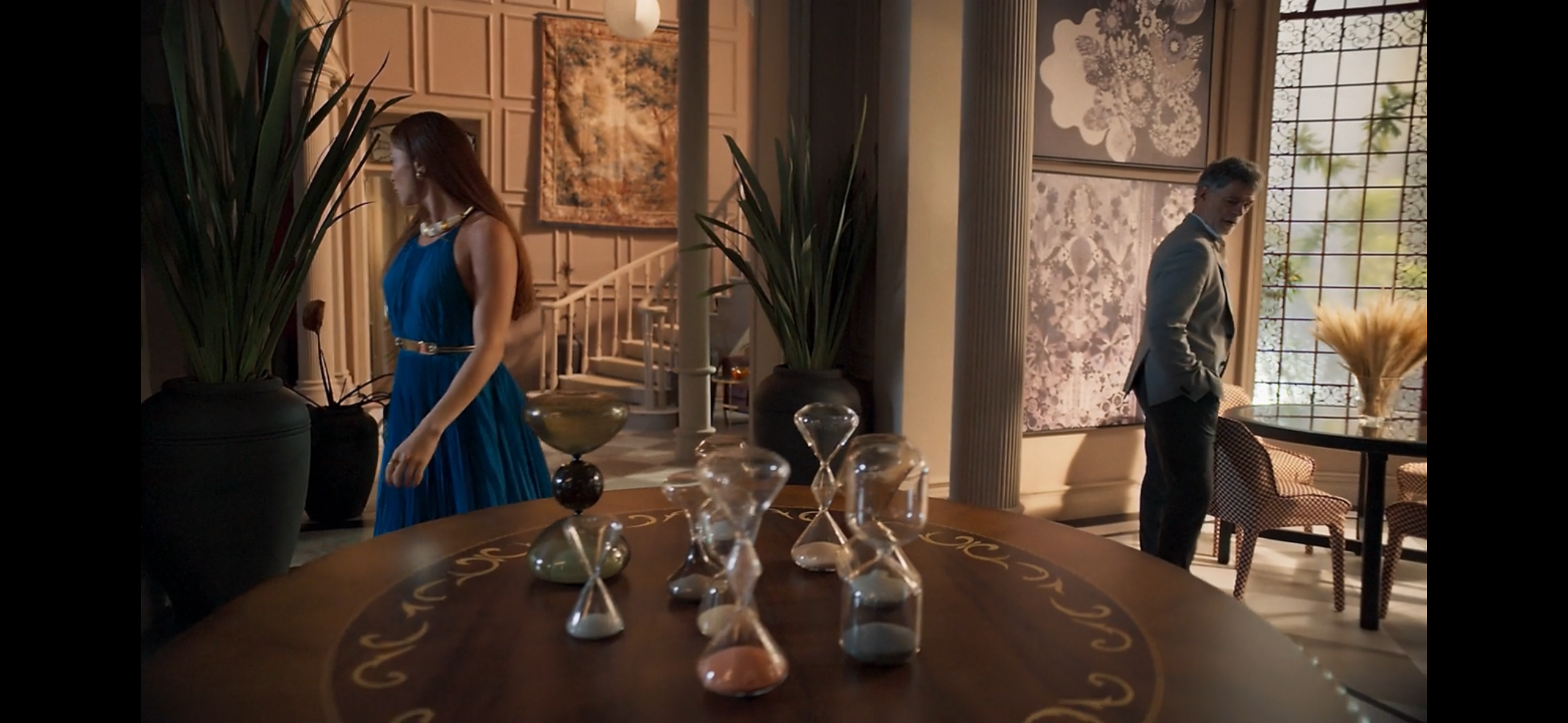
Até aqui, tem se respeitado a devida serventia dessa estrutura arquitetônica; o que não quer dizer que sua representação seja ordinária ou passe desapercebida. Fato é que em nenhum outro capítulo a descida de Arminda foi tão estonteante quanto no que foi ao ar em 05/01, primeira segunda-feira de 2026, que marca uma virada em Três Graças. A escada, obviamente, esteve reservada ao gancho, cuja cena começa num contra-plogée vertiginoso, que captura os passos da vilã entre os vãos das pilastras do corrimão; ao fundo, uma imensa janela corta o pé direito alto, acompanhando a longitude do vestido azul, que se anuncia entre os tons de bege do cenário. É na curva entre a câmera e a escada que Arminda se revela por inteiro, justamente quando ela cruza uma tapeçaria que conjuga as paletas do espaço e figurino. Contudo, o rosto da atriz ainda não é o centro da ação, porque os degraus acionam principalmente os membros inferiores, velados pela saia do vestido azul drapeado, cujo sanfonar, de caimento leve, antagoniza o peso aveludado da passadeira sobre os degraus. O vestido — mais especificamente, a barra da saia — tremula, farfalha, imprime uma visualidade em ondas hipnotizantes por toda a descida. Esses passos — “gestos habituais”, segundo Jordan Schonig em sua pesquisa sobre o movimento no cinema — produzem esse “movimento contingente” (Schoning, de novo), secundário na ação, mas primário (já que é a própria superfície) e imprevisível à vista, tal qual o efeito do vento sobre as árvores. A ação contínua num único plano sinaliza se tratar de uma direção que sabe o que está fazendo; a decupagem é consciente de que poucos figurinos imprimem a matéria-prima cinematográfica/televisiva — o movimento — como faz um vestido.
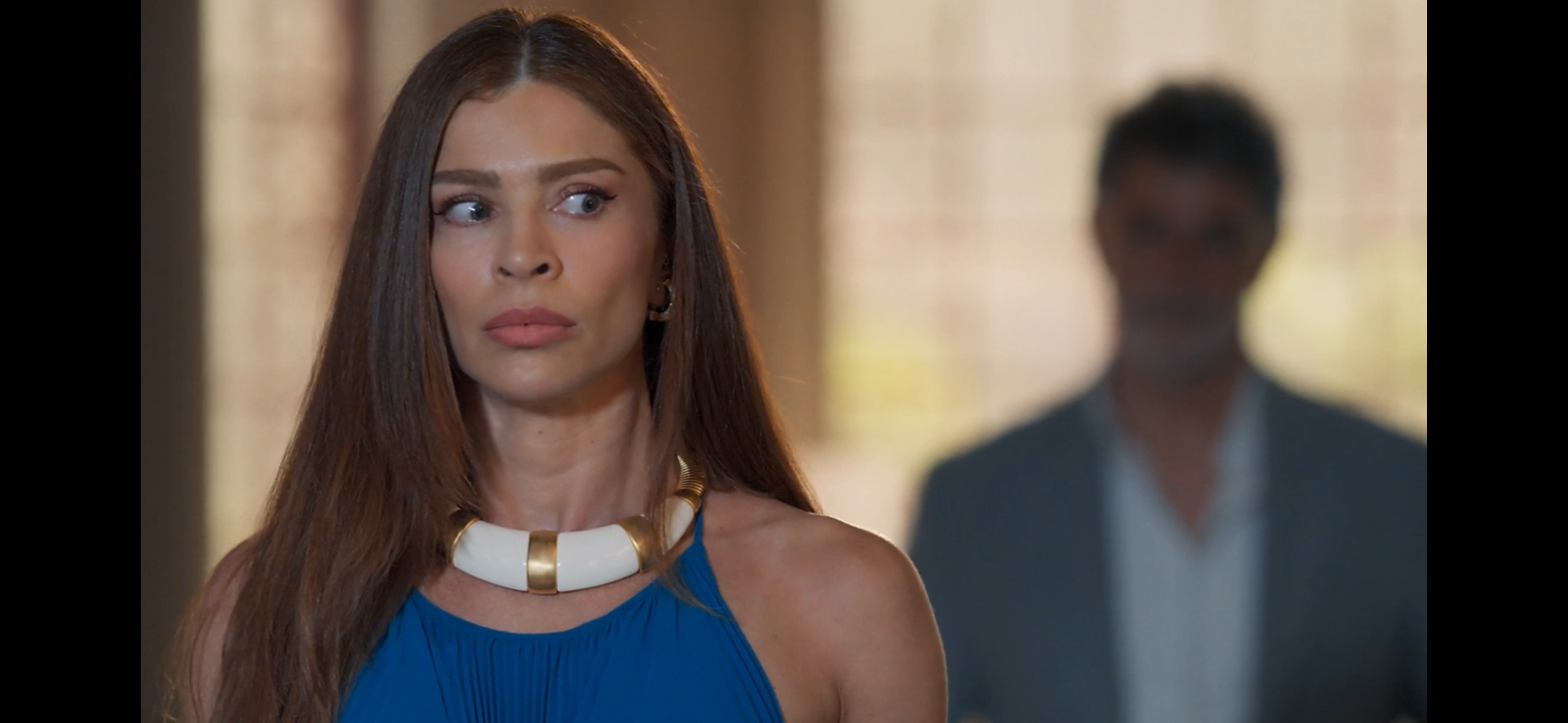
Quando os degraus terminam, a câmera segue num travelling out, puxando Arminda/Grazi à outra sala. Então, por um instante, vemos um homem em posição meticulosamente pensada para haver um átimo de suspense — Arminda ainda não o viu, mas nós o vimos. O movimento de Rogério (Eduardo Moscovis) é a deixa ao raccord que conduz à cena definitivamente ao rosto da malvada das 9, que paralisa ao ouvir a voz do marido que ela tinha como morto (até porque fora cúmplice desse suposto assassinato). Quando Rogério diz que Arminda não mudou nada, Grazi Massafera que, há pouco, flanara pela escada como uma ninfa diabólica, enrijece subitamente, numa transformação que quase a torna apta de compor a ciranda das Graças (agora no ferro-velho do Joaquim). Os olhos se perdem por um instante, até que as íris se direcionam à voz que está às costas, emitida do falecido-que-nunca-foi em desfoque. Então, o giro propositalmente marcado (na ação e pela trilha sonora), quase artificial, conduz a mudança de foco, que passa de Arminda a Rogério, entregando a cena ao campo e contracampo. Até aqui, no entanto, é quase uma livre inspiração às avessas da cena de Pérfida.

No filme dirigido por William Wyler, a Pérfida do título (em português, pois o original é The Little Foxes) é vivida por Bette Davis, e mata o marido numa oportunidade sádica: após um embate verbal com a esposa, o cardíaco Horace (Herbert Marshall) se sente mal e derruba o vidro do remédio que pode ajudá-lo. Pede, então, que a esposa suba a escada agourenta ao fundo para apanhar outro frasco, mas, das palavras rígidas, ela passa ao corpo enrijecido. A recusa de Regina Giddens é um dos momentos mais lembrados da carreira de Davis: confortavelmente jogada numa poltrona, ela não mexe um músculo, exceto os que lhe são vitais — o arfar da respiração; os olhos que vão se escanteando à visão periférica, acompanhando a trôpega saída de Horace, até o último suspiro fora de foco, no engatinhar escada acima. Horace morre ao fundo; em primeiro plano, Davis encarna essa mulher gélida, esculpida em gestos petrificados. Uma Desgraça.
A cena de Três Graças brinca com o avesso porque a situação dá uma volta no parafuso. Primeiro, porque não é uma cena de morte, mas de ressurreição, como se Horace voltasse para questionar o cônjuge assassina. Segundo, porque a cena não culmina, portanto, num subir sôfrego do marido pela escada, abrindo, ao invés disso, na descida dessa viúva que, até então, não sabe que é Porcina, e, por isso, pisa o chão como se nada temesse. Também porque quando esse primeiro plano se abre para revelar Rogério, a pose de Eduardo Moscovis lembra a de Davis no momento em que Regina desafia Horace pelas costas, encarando-o sobre ombros. Por fim, pois a composição em profundidade, com Grazi em primeiro plano e Moscovis no background, conjuga diferentes elementos da cena de Pérfida: as marcações, o contraste entre rosto e corpo, a ação da atriz como ativação da mudança focal, mas, principalmente, essa transmutação comum das mulheres em estátuas — Davis solidifica para ser diabólica; Grazi congela porque foi pega sendo o diabo (antes de saber que o outro está vivo).
A escada ainda será cenografia ativa em Três Graças, cúmplice dos assassinatos que Arminda promete. Até aqui, no entanto, seu melhor uso foi nessa descida que quebra a cena em dois andares, da fluidez à tensão, do transe à realidade, da movimentação à imobilidade. A ver como será o caminho de volta, porque é cedo para que essa descida simbolize a queda derradeira da Pérfida das 9. Arminda há de ter seu momento reencenando o título de Mikio Naruse: Quando uma mulher sobe as escadas. Ao que tudo indica, quando o fizer, será para empurrar alguém. Uma coisa é certa: ninguém morreu como Robert Keith ao rolar de uma escada em Palavras ao Vento. Pode ser uma boa referência aos próximos capítulos…

The Perfidious One of the 9
by Álvaro André Zeini Cruz
Arminda descends the stairs. In daily life, a routine act of transit, moving from one floor to another. In audiovisual media, an action that, when banal, can be perfectly suppressed in an ellipsis. The fact is that on television and, especially, in cinema, descending or ascending a staircase may not be prosaic; on the contrary, it can become an extraordinary action depending on how the mise en scène views the motivation for this movement. Like Grazi Massafera, women such as Vivien Leigh (Gone with the Wind), Gloria Swanson (Sunset Boulevard), Deborah Kerr (The Innocents), Joan Fontaine (Rebecca), Marylee Hadley (Written on the Wind) and so many others have challenged or been challenged by staircases, whose visuals have resized them into co-protagonists of the works themselves.
In telenovelas, staircases almost always denote social class: if the rich also cry, it is also true that a good number of steps are almost their exclusive privilege. It was from the top of the staircase of the Theatro Municipal in Rio de Janeiro that two Marias de Fátima threw themselves to try to abort unwanted pregnancies. The same staircase down which Filomena Ferreto (Aracy Balabanian) slid like a Don Corleone in a tailored suit served for the humiliation of the femme fatale Isabela (Claudia Ohana) in A Próxima Vítima. In Aguinaldo Silva’s plots, they became recurring characters ever since Nazará Tedesco (Renata Sorrah) began throwing her enemies spiraling down. They didn’t always succeed: in Fina Estampa, no editing could transform Tereza Cristina’s (Christiane Torloni) staircase into a serial killer. When the spiral steps appeared in Três Graças, the audience immediately figured it out — Arminda (Grazi Massafera), the villain, would eliminate some from the house.
Up to this point, the proper utility of this architectural structure has been respected; which does not mean its representation is ordinary or goes unnoticed. The fact is that in no other episode was Arminda’s descent as stunning as in the one that aired on 01/05, the first Monday of 2026, which marks a turning point in Três Graças. The staircase was obviously reserved for the cliffhanger, a scene that begins with a vertiginous low-angle shot, capturing the villain’s steps between the gaps of the handrail’s balusters; in the background, a large window cuts through the high ceiling, following the length of the blue dress, which announces itself among the beige tones of the set. It is in the curve between the camera and the staircase that Arminda reveals herself entirely, precisely when she crosses a tapestry that combines the color palettes of the space and the costume. However, the actress’s face is still not the center of the action, because the steps primarily activate the lower limbs, veiled by the skirt of the draped blue dress, whose light, pleated fall contrasts with the velvety weight of the runner on the steps. The dress — more specifically, the hem of the skirt — flutters, rustles, imprints a hypnotic, wave-like visuality throughout the descent. These steps — “habitual gestures,” according to Jordan Schonig in his research on movement in cinema — produce this “contingent movement” (Schonig, again), secondary to the action but primary (since it is the very surface) and unpredictable to the sight, much like the effect of wind on trees. The continuous action in a single shot signals that this is a direction that knows what it’s doing; the editing is conscious that few costumes imprint the raw cinematic/televisual material — movement — like a dress does.
When the steps end, the camera follows with a tracking shot out, pulling Arminda/Grazi into another room. Then, for an instant, we see a man in a meticulously thought-out position to create a moment of suspense — Arminda hasn’t seen him yet, but we have. Rogério’s (Eduardo Moscovis) movement is the cue for the match cut that leads the scene definitively to the face of the villainess of the 9 p.m. slot, who freezes upon hearing the voice of the husband she thought was dead (especially since she was an accomplice in this supposed murder). When Rogério says that Arminda hasn’t changed at all, Grazi Massafera, who just moments ago strolled down the stairs like a diabolical nymph, suddenly stiffens, in a transformation that almost makes her fit to join the round dance of the Graces (now in Joaquim’s junkyard). Her eyes are lost for a moment, until the irises direct themselves to the voice coming from behind, emitted by the deceased-who-never-was, out of focus. Then, the deliberately marked turn (in the action and by the soundtrack), almost artificial, leads the change of focus, which shifts from Arminda to Rogério, delivering the scene to shot and reverse shot. Up to this point, however, it’s almost a free reverse inspiration from the scene in The Little Foxes.
In the film directed by William Wyler, the Perfidious One of the title (in Portuguese, as the original is The Little Foxes) is played by Bette Davis, and she kills her husband in a sadistic opportunity: after a verbal clash with his wife, the heart patient Horace (Herbert Marshall) feels ill and drops the glass of medicine that could help him. He then asks his wife to go up the ominous staircase in the background to fetch another bottle, but, from rigid words, she moves to a rigid body. Regina Giddens’s refusal is one of the most remembered moments of Davis’s career: comfortably lounged in an armchair, she doesn’t move a muscle, except the vital ones — the heaving of her breath; the eyes that drift to peripheral vision, following Horace’s faltering exit, until the last out-of-focus gasp, in his crawl up the stairs. Horace dies in the background; in the foreground, Davis embodies this icy woman, sculpted in petrified gestures. A Dis-Grace.
The scene in Três Graças plays with the reverse because the situation takes a turn of the screw. First, because it is not a death scene, but a resurrection scene, as if Horace came back to question his murderous spouse. Second, because the scene therefore does not culminate in a husband’s desperate climb up the stairs, instead opening with the descent of this widow who, until then, does not know she is “Porcina” (a play on ‘swine’), and therefore treads the ground as if she feared nothing. Also because when this close-up opens to reveal Rogério, Eduardo Moscovis’s pose resembles Davis’s at the moment Regina challenges Horace from behind, facing him over her shoulder. Finally, because the composition in depth, with Grazi in the foreground and Moscovis in the background, combines different elements from the The Little Foxes scene: the blocking, the contrast between face and body, the actress’s action as the trigger for the focal change, but mainly, this common transmutation of women into statues — Davis solidifies to be diabolical; Grazi freezes because she was caught being the devil (before knowing the other is alive).
The staircase will still be an active scenography in Três Graças, an accomplice to the murders Arminda promises. Up to now, however, its best use was in this descent that breaks the scene into two floors, from fluidity to tension, from trance to reality, from movement to immobility. We shall see what the way back will be like, because it is too early for this descent to symbolize the ultimate fall of the Perfidious One of the 9. Arminda will have her moment reenacting Mikio Naruse’s title: When a Woman Ascends the Stairs. By all indications, when she does, it will be to push someone. One thing is certain: no one died like Robert Keith rolling down a staircase in Written on the Wind. That might be a good reference for the upcoming episodes…
 Pós-créditos